14 — "Die Welt" — No. 51
(continued from page 13)
…origin, elected president of the Chamber of Commerce. In name he remained a Jew, perhaps because baptism was not demanded; he himself said later: because baptism destroys the bonds of family. When he married, he gave his father-in-law, at his request, the promise to remain a Jew all his life; the giving of a like guarantee for his children he refused, since the fulfilment of such a promise would not lie in his power. They were preserved to Judaism, . . . . because their father found the way to Zionism. . . .
1881 is the momentous year of his Jewish rebirth. Having returned to Europe, he remained ten years in Manchester and in 1879 removed again to his native city of Hamburg. Unfree Germany repelled him. The discovery of antisemitism, unknown to him, tore him out of his assimilationist dreams, as it later did Herzl. . . .
At about the same time the heaviest blow of fate befell him, a grief he never got over: he lost his only son. In his mourning he withdrew wholly into himself and spent lonely weeks on Norderney in meditation and reading. Then chance so ordered it that George Eliot's novel "Daniel Deronda" fell into his hands. It dawned upon him like a revelation, he used to say afterwards. The freedom enjoyed in England had, as he now perceived in this state of refined sensibility, been purchased for the Jew at the sacrifice of his own innermost national personality; and the resistance in Germany is no accident, but is grounded in history. Assimilation, just as much as Jew-hatred, demoralises us. "Many peoples of antiquity have perished; Phoenicians, Trojans, Assyrians, Hittites and others have vanished as nations; but their name still shines in history like a star. Men search for their traces and are made happy when from beneath the rubble of a thousand years a relic of the time of their existence comes to light. — But we? — Contempt, nay aversion, clings to our name. Many of us ourselves bring it over their lips only hesitantly and half apologetically. — Is this to be a memory that a late posterity shall keep of us? — — No, we are besmirched, and we must stand clean again; the name "Jew" must come to honour again; the stubborn, heroic steadfastness of our forefathers, in spite of insult and servitude, in spite of torture and death, must find its justification! Only then will there be no Jewish question any more; it will be "solved" in an honourable manner. "There is but one way out: national restoration," and that in the ancient land of our race, Palestine.
This was written by Gustav Cohen, then about fifty years old, absorbed in West European culture, a man of wide experience and artistic feeling, at about the same time as the East European physician Dr. Pinsker was composing his "Auto-Emancipation"; only that Cohen, in modest reserve, did not give his notes to the public, and only ten years later (1891) had them printed, as a manuscript, under the title: "The Jewish Question and the Future." The pamphlet, a little masterpiece of rigorous reasoning and of a brisk and graceful manner of exposition, has to this day not appeared in the book-trade; the modest author, who left his name unmentioned in print as well, distributed it among his friends.
This is not the place to enter more closely into the details of Cohen's fundamental conception of the Jewish problem; it will be a rewarding task for the psychologist to compare the four classic original works of the birth-epoch of Zionism with one another for their agreements and differences. So much is certain, that Cohen, like Herzl, as men of culture with an artistic bent, set out in the last resort from the beauty of the idea and from the Jewish distress of soul as they subjectively apprehended it. The element of the economic misery of the Jews predominates with Hess and Pinsker. Against Pinsker and Herzl, at first pure Jewish-State men, stand Hess and Cohen, who from the first moment saw in the acquisition of Palestine the self-evident condition for the solution of the Jewish question. Cohen was one who felt his way cautiously, anxiously guarding the rights of every personality, no man of storm and stress; he was a mixture of English calm, German thoroughness, Hellenic love of beauty and Jewish depth of feeling. And one thing more: Cohen, like Herzl, when the Zionist idea arose in him, did not know the mass of the Eastern Jews and their cultural worth. He came to know them only when the throngs of Jewish refugees from Russia passed through Hamburg in 1891. Frankly he reports, in an afterword to his "Jewish Question," certain errors, and stands in admiration before the unsuspected national strength of Eastern Jewry.
Cohen's development went from the speculative ideal of Zion to a full-blooded nationalism. He began as a wise friend of mankind and ended as a Jew.
The Jewish people may well mourn a great son. . . . Dr. Kalmus (Hamburg).
[Illustration]
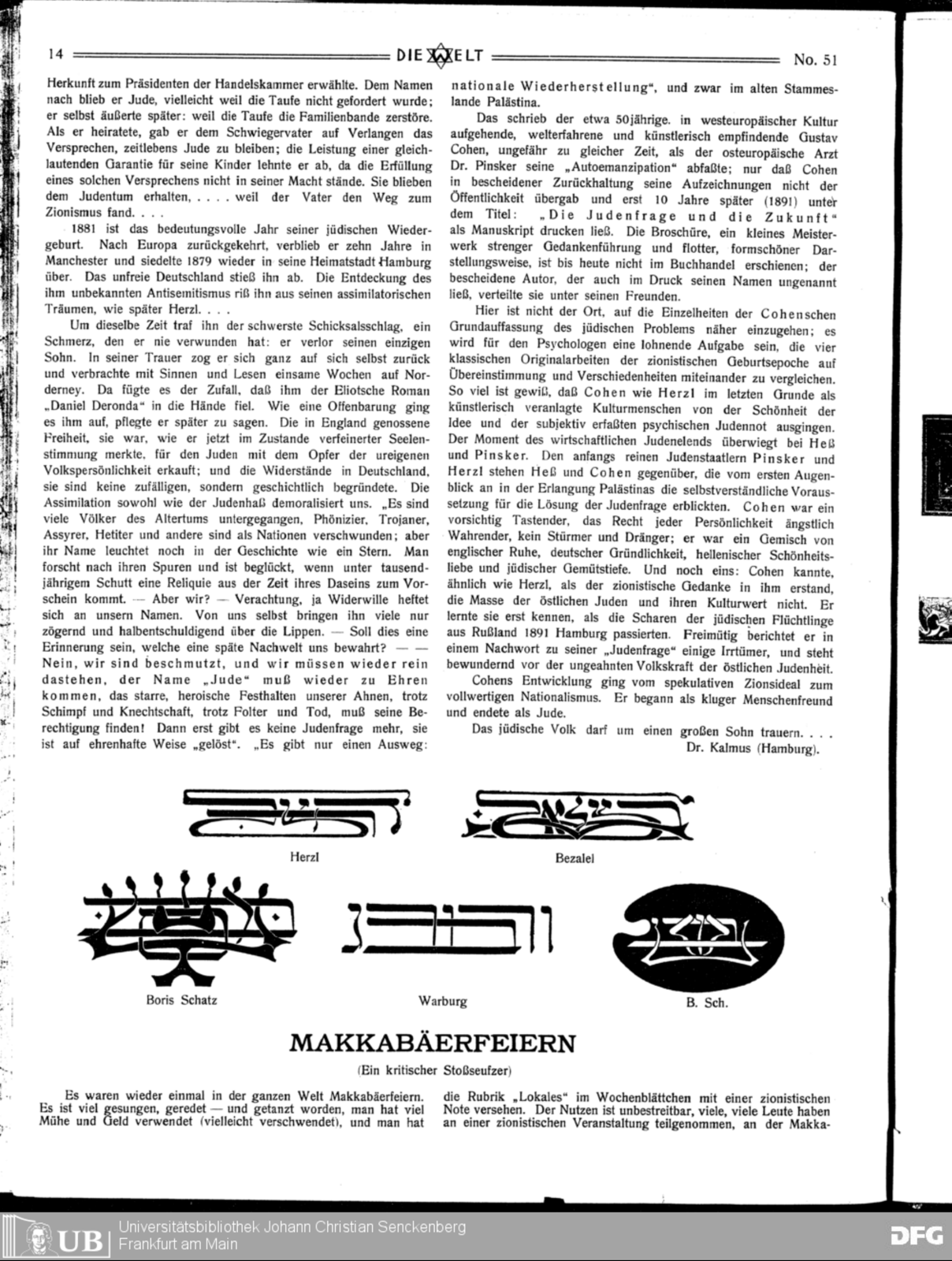
Herzl
[Illustration]
Bezalel
[Illustration]
Boris Schatz
[Illustration]
Warburg
[Illustration]
B. Sch.
MACCABEAN CELEBRATIONS
(A Critical Sigh of Complaint)
Once again there have been Maccabean celebrations all over the world. There has been much singing, much speechmaking — and much dancing; much trouble and money has been spent (perhaps squandered), and the "Local News" column in the little weekly sheet has been given a Zionist note. The benefit is indisputable: many, many people have taken part in a Zionist function, in the Macca-