No. 51 — "Die Welt" — 13
(continued from page 12)
…striving, this good Hebraist creates many a Hasidic-philosophical association of ideas, of poetic consecration, with Jewish inwardness and depth.
"In order to know a thing in a way that may be called knowing, one must first love it and sympathise with it." This saying of Taine's holds perfectly true with regard to Hasidism. We may brand its excrescences and aberrations in the sharpest terms; but if we wish to be faithful guardians of Jewish individuality, we must above all take care that this individuality of our people is set lovingly before our eyes. And a part of this individuality is, after all, Hasidism: a world of feeling that one does not know, something ethereal that can scarcely be grasped, — a teased and tortured problem that still awaits its reconciling and transfiguring solution.
Has Martin Buber solved this problem in his book? Not yet. Many more labours will be required, and many more who are called to it, poets, students of the people, men who have lived Hasidism inwardly, will have to take their turn in order to illuminate this "terra incognita." But the Buber book is a good and useful achievement. Above all, Buber has chosen his hero well. In truth Reb Nachman Kossower towers like a solitary mountain peak above the hill-country of the dynasties of wandering rabbis. A usurper with the sovereign subjectivism of an individuality complete in itself. A man who lived the most wretched of lives, but how he could tell a tale! Deeply chaste and diffident, — with sudden, curious, often quite revolutionary leaps of thought — and tales that fairly take one's breath away.
Yes, I should like once to have heard him, how he murmured, and to have seen how his head sank deep upon his breast, — and the lifting of his eyes! How he held his table (the term of art: "led the table"), where man drew close to man without ceremony, and where one listened in bliss to the soft-spoken Torah, and where, following the sparkling aphoristic dazzler, one reeled through magic circles. Him I did not hear, yet I know and feel the manner, and I must say: in so far as it is possible at all in a European language, in literary form, to reproduce for a foreign world that whisper of Torah so full of mood, — Martin Buber has accomplished it. They are threads, but one will see how these bright-coloured threads are woven into the poetry and thought of the people.
Well — and one thing more. It is also in keeping with the feeling of the age. In modernist garb, Reb Nachman Kossower is almost a forerunner of a Peter Hille. Yes, Reb Nachman could hardly have suspected that, but often quite remote worlds of feeling touch one another at their deep foundations. The eternally human.
N. SOKOLOW
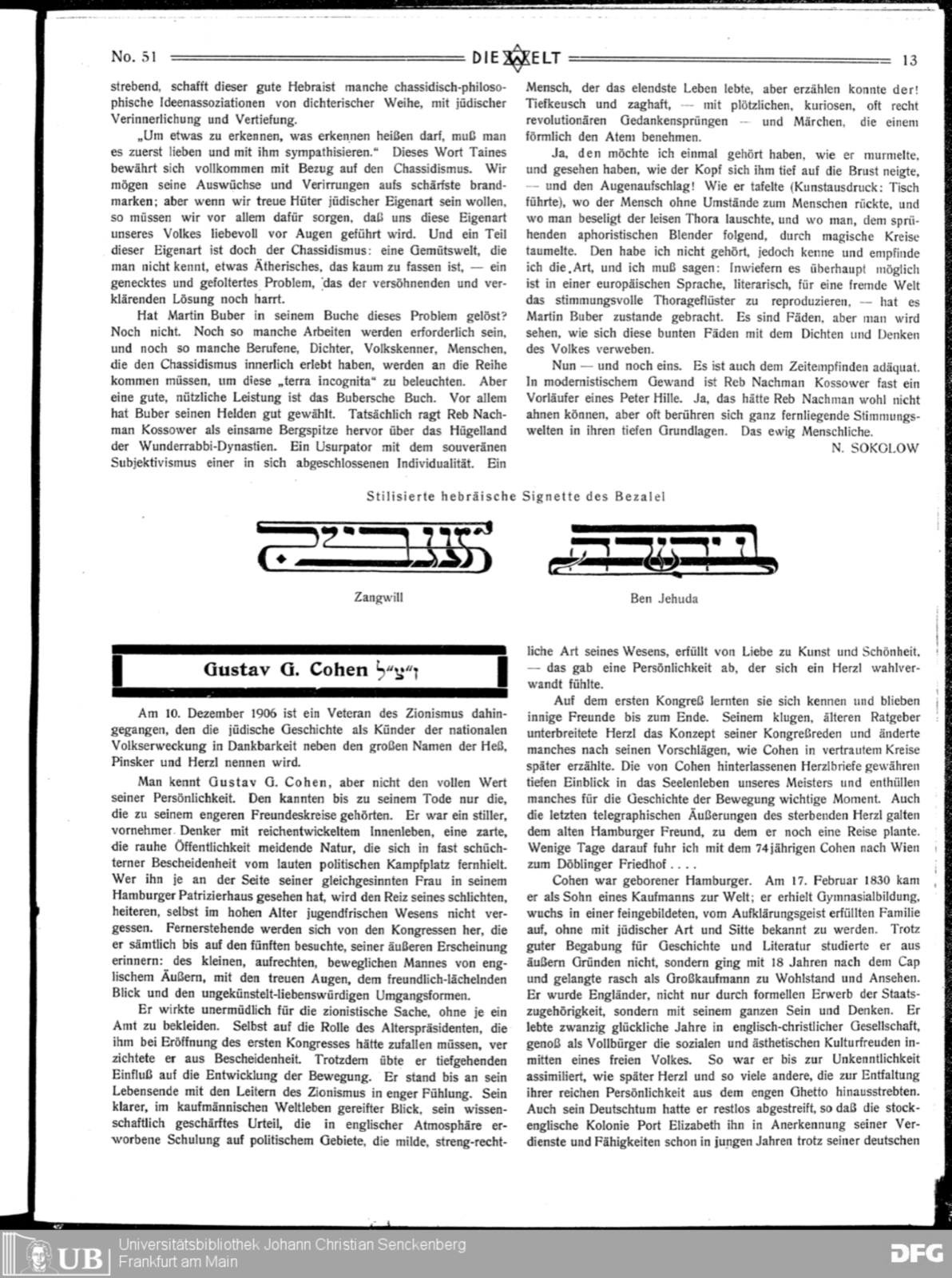
Stylized Hebrew vignettes of the Bezalel
[Hebrew characters]
Zangwill
[Hebrew characters]
Ben Jehuda
Gustav G. Cohen ז"ל
On the 10th of December 1906 there passed away a veteran of Zionism whom Jewish history will name with gratitude, as a herald of the national awakening of the people, beside the great names of Hess, Pinsker and Herzl.
Gustav G. Cohen is known, but not the full worth of his personality. Until his death that was known only to those who belonged to the narrower circle of his friends. He was a quiet, distinguished thinker with a richly developed inner life, a delicate nature that shunned the rough publicity of affairs and kept, in an almost shy modesty, away from the loud political arena. Whoever has once seen him at the side of his like-minded wife in his patrician house at Hamburg will not forget the charm of his simple, cheerful nature, youthfully fresh even in advanced age. Those who stood further off will remember his outward appearance from the Congresses, all of which save the fifth he attended: the small, upright, lively man of English appearance, with the faithful eyes, the friendly, smiling glance and the unaffected, amiable manners.
He worked untiringly for the Zionist cause without ever holding an office. Even the part of senior president by age, which ought to have fallen to him at the opening of the First Congress, he declined out of modesty. Nevertheless he exercised a profound influence upon the development of the movement. To the end of his life he stood in close touch with the leaders of Zionism. His clear vision, matured in the commercial life of the world, his judgment sharpened by science, the schooling in political matters acquired in an English atmosphere, the mild and strictly upright character of his being, filled with love of art and beauty, — all this made up a personality to which a Herzl felt an elective affinity.
At the First Congress they became acquainted, and they remained intimate friends to the end. To his wise, older counsellor Herzl submitted the drafts of his Congress speeches, and altered many things according to his suggestions, as Cohen later related in an intimate circle. The letters of Herzl which Cohen has left afford a deep insight into the inner life of our master and reveal many a moment of importance for the history of the movement. The last telegraphic messages of the dying Herzl, too, were addressed to his old friend in Hamburg, to whom he was still planning a journey. A few days later I travelled with the seventy-four-year-old Cohen to Vienna, to the Döbling cemetery ....
Cohen was a native of Hamburg. He was born on the 17th of February 1830, the son of a merchant; he received a gymnasium education and grew up in a family of refined culture, filled with the spirit of the Enlightenment, without becoming acquainted with Jewish ways and customs. In spite of a good gift for history and literature he did not, for external reasons, go to the university, but went at the age of eighteen to the Cape, and as a great merchant quickly attained to wealth and standing. He became an Englishman, not only through the formal acquisition of nationality, but with his whole being and thought. He lived twenty happy years in English Christian society, and enjoyed as a full citizen the social and aesthetic pleasures of culture in the midst of a free people. Thus he was assimilated past all recognition, as Herzl was later, and so many others who strove out of the narrow ghetto to unfold their rich personalities. His Germanism too he had stripped off completely, so that the thoroughly English colony of Port Elizabeth him, in recognition of his merits and abilities, while he was still young, in spite of his German