No. 51 — "Die Welt" — 15
(continued from page 14)
…bean celebration, have come to know Zionism — in the Maccabean celebration. Is it really a success? A success for Zionism? Are these celebrations worth the trouble they cause?
I beg you, I am no heretic. I should not like to spoil the pleasure of any society committee enthusiastic for celebrations. But may we not for once discuss the value, the ethical, the Zionist value of the à la mode — Maccabean celebrations? Perhaps we shall be lucky; a Chanukah light will dawn upon us and show us that things can be done better. Let us, then, for once discuss it.
First of all: the idea of the Maccabean celebration is a very good one, because it is natural. Very good, too, in many other respects. A fine celebration, above all, is always very good. Joy is good and light is good, and an hour of festive entertainment is an hour gained. We base the festival upon a general idea, and a Jewish one at that, and a Zionist one at that. There is nothing to be said against it. And to the dry philistine and to the romantic, yearning youths and maidens, in the heightened atmosphere of the splendour of a festival hall shot through and lit up with Jewish traditions, many a secret thing becomes clear that until then "lay slumbering, hidden."
But: is it really quite so? Is the Maccabean celebration really a Maccabean celebration? Or is it perhaps only a homely philistine amusement sailing under a false label? Like the greater part of all other celebrations, an advertising platform for the singing school of ex-prima donna A or of piano virtuoso B? Or perhaps a compensation to the family for the many evenings when one has to stay at home?
That would be a poor joke. But let us not be jocular. Let us consider the question quite seriously.
There can be no doubt whatever that many Maccabean celebrations among us in Western Europe do not correspond to the lofty idea which they are meant to express and to serve. The only Jewish thing about them is usually the name and, at the most, the festival address. But if the name is already felt in many quarters to be disagreeable, by the society committee too, namely because it puts it into the head of many a good Jew not to come, then with a festival address that is always the case. "The end of every celebration is the ball!" And if the admission is not too dear, one cannot, after all, object if there is a little speaking as well. And then of course one applauds and notes with satisfaction that the speaker was considerate enough to have delayed the dancing by only half an hour. And now quickly a flute solo, a recitation, Young-Jewish of course, and then the tables cleared away. "Fall in for the polonaise!"
No, that is no Maccabean celebration! Nor is it so celebrated everywhere. "We Berliners," for instance, do it quite differently! Jewishly, Zionistically! Jewish pieces of music, that is, Jewish music by Jewish composers and played, if possible, by a Jewish orchestra, Jewish and Hebrew songs, national speeches, a performance of "Doktor Kohn" or "New Ghetto," and then of course a ball. Yes, we Berliners can do it. We have composers among us who place their manuscripts at our disposal — as yet little Jewish music is printed and published — we have singers, men and women, who possess a Jewish repertoire because they can venture to shine with it even where they are paid; we have above all a Jewish public that understands Jewish. We are, after all, an eminently Jewish city to-day. But the provinces! If they do not laugh at Jargon songs, they will certainly not understand them; but then there are none there that could be performed. And there is one thing more: our programme, our repertoire, is so limited. And though the "Rundschau" brings out every year a programme proposal, however fine and tempting, it always brings out the same one. And when once in a while, rarely enough, something new turns up, it is ten to one — Jargon. And that they do not understand! And always to hear the same thing, to hear what is not understood and cannot be understood, no, one has no need of that at the Maccabean celebration either; then they would rather not go. And so nothing is left but "The Violet by the Brook" and "First Love," or, when things go high indeed, "The Queen of Sheba," and in especially Jewish cases "The Prophet," or even Handel's "Messiah" — is it not so?
Now we certainly do not wish to spoil the festive mood of all good people, nor the young people's delight in dancing. People like ourselves gladly join in, too. But the question is whether we should use or misuse the name of the Maccabees for it. If one is pursuing something like a purpose, one must also show it; but that there is any agitational power in this sort of Maccabean celebration, no, nobody will make me believe that. Dancing will not get us Zionists, nor will the singing of indifferent songs. And the speech, well, in such company it does not do it either.
My view is this: where we appear, we should appear well, so that people notice that we are there. If we do hold festivals, hold festivals as Zionists, they should really be Zionist ones. Where that is not possible, we had better leave it alone. Where we cannot put together a Zionist programme, we should not take any other either! If we must for once give our members a festival — it is not, to be sure, absolutely necessary, nor yet entirely superfluous — let us give them a festival, but then let it be called so. Call the celebrations what they are: entertainment evening, festival ball, whatever you please, ladies and gentlemen, but

Carpet pattern
Carpet pattern
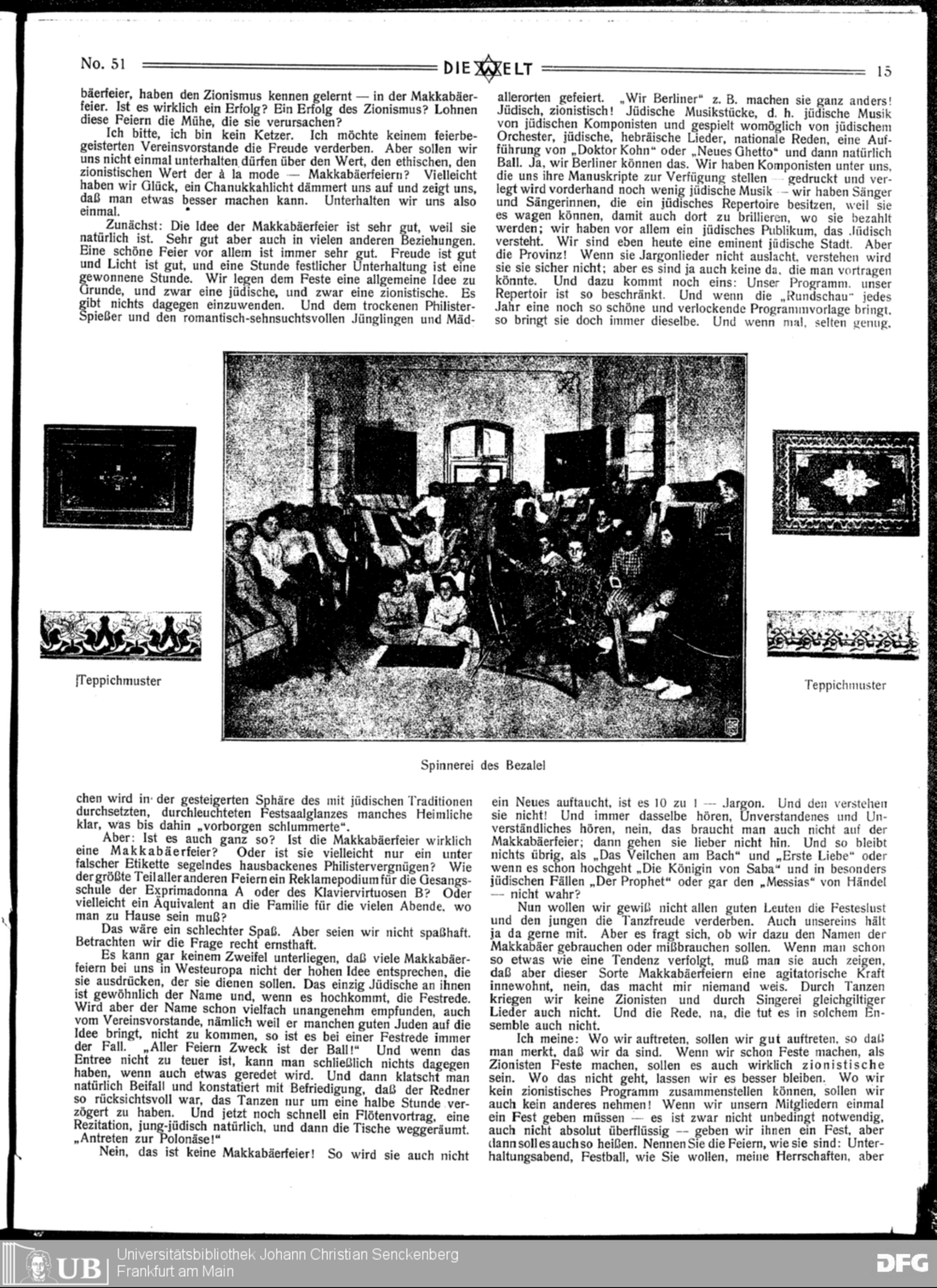
Spinning-mill of the Bezalel