No. 51 — "Die Welt" — 11
(continued from page 10)
. . . come into consideration. The administration of the Shekel within the federations is to be organised on centralist lines. Concessions in the sense of self-government are to be made insofar as it is a question of organisations which represent a particular character or current within Zionism. With that, however, the necessary changes in organisation are far from exhausted.
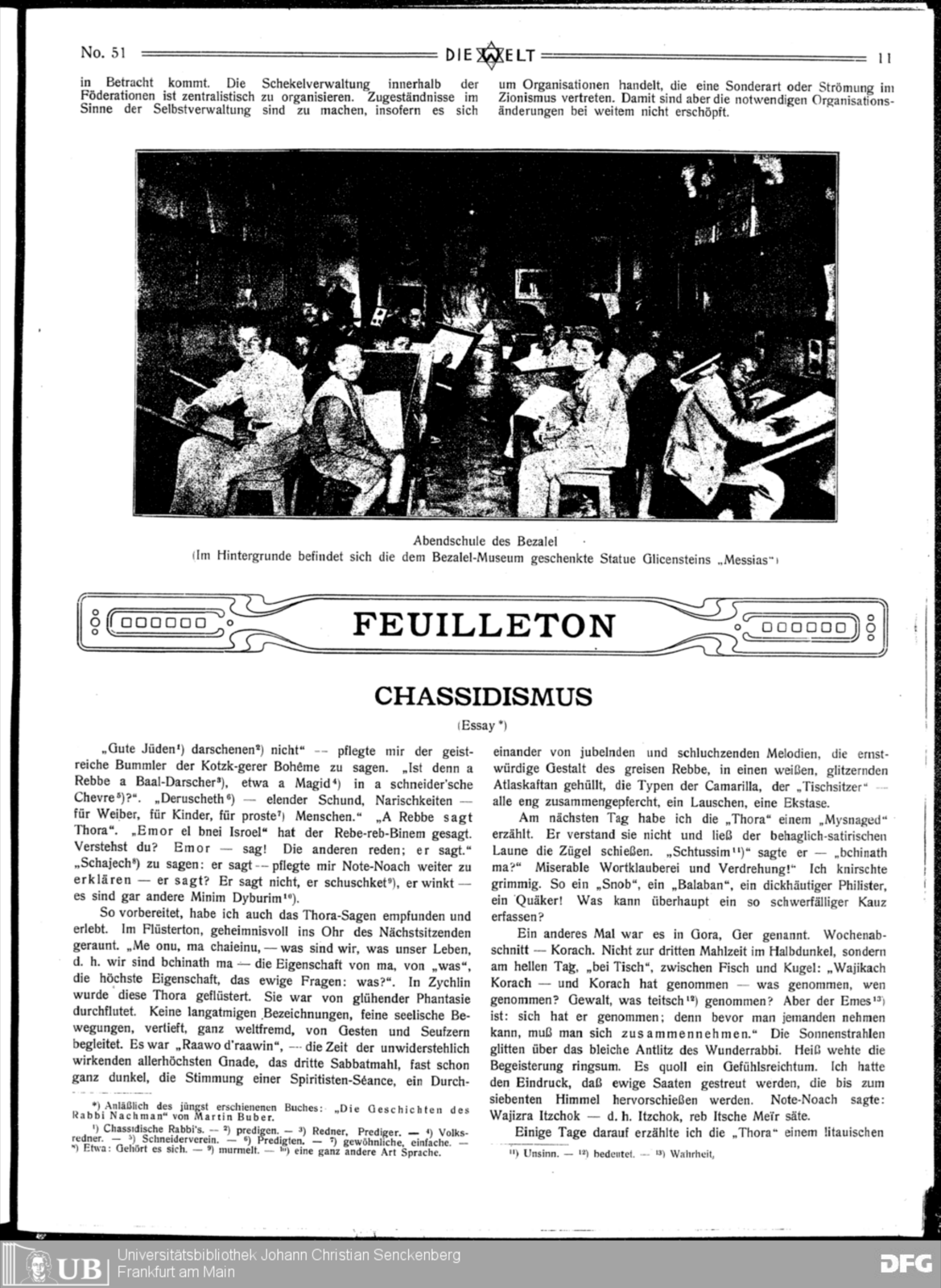
Evening School of the Bezalel (In the background stands Glicenstein's statue "Messiah", presented to the Bezalel Museum)
FEUILLETON
CHASSIDISM
(Essay *)
"Gute Jüden¹⁾ don't darshen²⁾" — the witty idler of the Kotzk-Ger Bohemia used to say to me. "Is a Rebbe, then, a Baal-Darscher³⁾, some Magid⁴⁾ in a tailors' Chevre⁵⁾?" "Deruscheth⁶⁾ — wretched trash, foolishness — for women, for children, for proste⁷⁾ people." "A Rebbe says Thora". "Emor el bnei Isroel, the Rebe-reb-Binem said. Do you understand? Emor — say! The others talk; he says." "Schajech⁸⁾ to say: he says — Note-Noach used to go on explaining to me — he says? He does not say, he schuschkets⁹⁾, he beckons — these are quite other Minim Dyburim¹⁰⁾.
So prepared, I too felt and lived the saying of Thora. In a whisper, mysteriously murmured into the ear of the one sitting nearest. "Me onu, ma chaieinu, — what are we, what is our life, that is, we are bchinath ma — the quality of ma, of 'what', the highest quality, the eternal questioning: what?". In Zychlin this Thora was whispered. It was flooded through with glowing fantasy. No long-winded designations, delicate stirrings of the soul, deepened, wholly unworldly, accompanied by gestures and sighs. It was "Raawo d'raawin", — the time of the irresistibly working most high grace, the third Sabbath meal, already almost quite dark, the mood of a spiritualist séance, a confusion of exulting and sobbing melodies, the grave and venerable figure of the aged Rebbe, wrapped in a white, glittering satin caftan, the types of the camarilla, the "table-sitters" — all crowded close together, a listening, an ecstasy.
The next day I told the "Thora" to a "Mysnaged". He did not understand it and gave free rein to a comfortably satirical humour. "Schtussim¹¹⁾", he said — "bchinath ma? Miserable hair-splitting and twisting of words!" I ground my teeth grimly. Such a "snob", such a "Balaban", a thick-skinned Philistine, a Quaker! What can so ponderous an old owl grasp at all?
Another time it was in Gora, called Ger. The weekly portion — Korach. Not at the third meal in the half-dark, but in broad daylight, "at table", between fish and kugel: "Wajikach Korach — and Korach took — took what, took whom? Gewalt, what does teitsch¹²⁾ 'took'? But the Emes¹³⁾ is: himself he took; for before one can take anyone, one must take oneself together." The sun's rays glided over the pale countenance of the wonder-rabbi. Enthusiasm blew hot all around. A wealth of feeling welled up. I had the impression that eternal seeds were being strewn which would shoot up to the seventh heaven. Note-Noach said: Wajizra Itzchok — that is, Itzchok, Reb Itsche Meïr, sowed.
A few days afterwards I told the "Thora" to a Lithuanian
*) On the occasion of the recently published book: "Die Geschichten des Rabbi Nachman" (The Tales of Rabbi Nachman) by Martin Buber. ¹) Chassidic rabbis. — ²) preach. — ³) orator, preacher. — ⁴) popular preacher. — ⁵) tailors' society. — ⁶) sermons. — ⁷) common, simple. — ⁸) Roughly: Is it fitting. — ⁹) murmurs. — ¹⁰) a quite different kind of speech. — ¹¹) nonsense. — ¹²) means. — ¹³) truth.