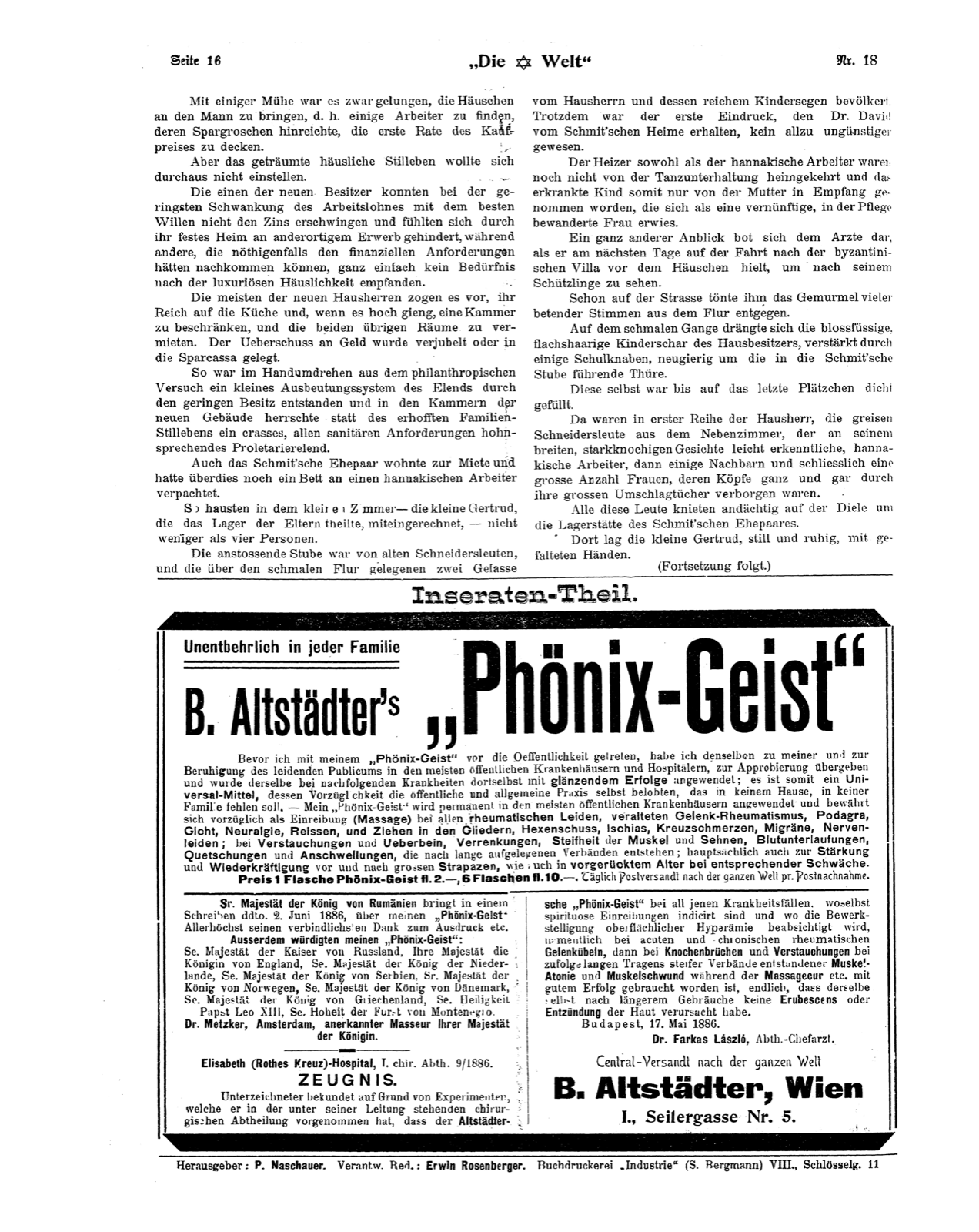
Page 16. — "Die Welt" — No. 18.
With some trouble it had indeed been contrived to dispose of the little houses, that is to say, to find a few workmen whose savings sufficed to cover the first instalment of the purchase price.
But the dreamed-of domestic still life would by no means make its appearance.
Some of the new owners could not, with the best will, raise the interest upon the slightest fluctuation of wages, and felt themselves hindered by their fixed home from earning a living elsewhere; while others, who at need might have met the financial demands, quite simply felt no want of the luxurious domesticity.
Most of the new householders preferred to restrict their kingdom to the kitchen and, at the utmost, a chamber, and to let the two remaining rooms. The surplus of money was squandered or laid in the savings bank.
Thus in a twinkling there had grown out of the philanthropic experiment a little system for the exploitation of misery by means of petty property, and in the chambers of the new buildings there reigned, instead of the hoped-for family idyll, a crass proletarian wretchedness that mocked at every sanitary requirement.
The Schmit couple too lived as tenants, and had over and above let out a bed to a Hanak workman.
So there dwelt in the little room — little Gertrud, who shared her parents' bed, included — not fewer than four persons.
The adjoining room was occupied by an aged couple of tailors, and the two apartments lying across the narrow passage were peopled by the landlord and his rich blessing of children. Nevertheless the first impression which Dr. David had received of the Schmit home had not been an all too unfavourable one.
Both the stoker and the Hanak workman had not yet returned from the dance, and the sick child had therefore been received only by the mother, who proved to be a sensible woman, well versed in nursing.
A quite different sight presented itself to the physician when on the following day, driving to the Byzantine villa, he halted before the little house to look after his protégée.
Already in the street the murmur of many praying voices sounded towards him out of the passage.
In the narrow corridor the barefooted, flaxen-haired troop of the house-owner's children, reinforced by a few schoolboys, pressed curiously about the door leading into the Schmits' room.
This itself was densely filled to the very last place.
There were, in the first rank, the landlord, the aged tailor folk from the next room, the Hanak workman, easily recognisable by his broad, strong-boned face, then a few neighbours, and finally a great number of women, whose heads were wholly and entirely hidden by their large shawls.
All these people were kneeling devoutly upon the boards about the bed of the Schmit couple.
There lay little Gertrud, still and quiet, with folded hands.
(To be continued.)
Advertisement Section.
Indispensable in every family
B. Altstädter's "Phönix-Geist"
Before I came before the public with my "Phönix-Geist," I submitted the same, for my own reassurance and for that of the suffering public, to most of the public hospitals and infirmaries for approbation, and it was there employed with brilliant success in the following maladies; it is therefore a universal remedy, the excellence of which public and general practice has itself commended, and which should be wanting in no house and in no family. — My "Phönix-Geist" is permanently employed in most of the public hospitals and approves itself excellently as an embrocation (massage) in all rheumatic complaints, inveterate articular rheumatism, podagra, gout, neuralgia, shooting and drawing pains in the limbs, lumbago, sciatica, pains in the loins, migraine, nervous complaints; in sprains and ganglion, dislocations, stiffness of the muscles and sinews, extravasations of blood, contusions and swellings, which arise after bandages that have lain long upon the part; principally also for strengthening and reinvigoration before and after great exertions, as likewise in advanced age with corresponding weakness.
Price 1 bottle of Phönix-Geist fl. 2.—, 6 bottles fl. 10.—. Daily despatch by post to the whole world against cash on delivery.
His Majesty the King of Roumania, in a letter dated the 2nd of June 1886, most graciously expresses his most obliged thanks for my "Phönix-Geist," etc.
My "Phönix-Geist" has moreover been honoured by: His Majesty the Emperor of Russia, Her Majesty the Queen of England, His Majesty the King of the Netherlands, His Majesty the King of Servia, His Majesty the King of Norway, His Majesty the King of Denmark, His Majesty the King of Greece, His Holiness Pope Leo XIII., His Highness the Prince of Montenegro.
Dr. Metzker, Amsterdam, recognised masseur to Her Majesty the Queen.
Elisabeth (Red Cross) Hospital, 1st Surgical Department, 9/1886.
CERTIFICATE.
The undersigned certifies, upon the ground of experiments which he has undertaken in the surgical department standing under his direction, that Altstädter's "Phönix-Geist" has been used with good success in all those cases of illness in which spirituous embrocations are indicated and where the production of superficial hyperæmia is intended, namely in acute and chronic rheumatic affections of the joints, then in fractures of the bones and sprains, in muscular atony and muscular wasting arising in consequence of the long wearing of stiff bandages during the massage cure, etc.; finally, that the same, even after prolonged use, has caused no erubescens or inflammation of the skin.
Budapest, 17th May 1886.
Dr. Farkas László, Chief Physician of the Department.
Central despatch to the whole world
B. Altstädter, Vienna
I., Seilergasse No. 5.
Publisher: P. Naschauer. Responsible Editor: Erwin Rosenberger. Printing-house "Industrie" (S. Bergmann) VIII., Schlösselg. 11