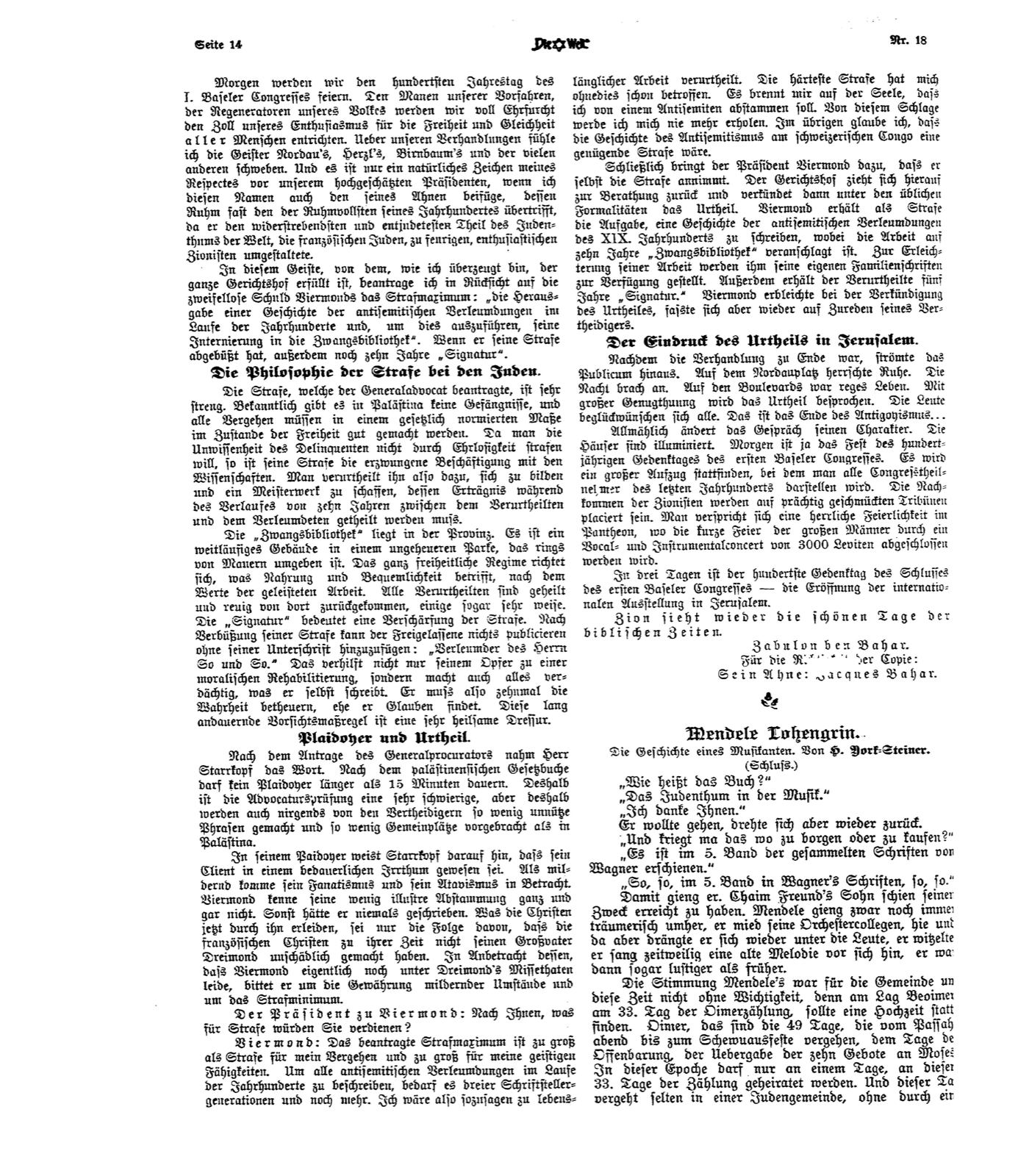
Page 14. — "Die Welt" — No. 18.
To-morrow we shall celebrate the hundredth anniversary of the First Basle Congress. To the manes of our forefathers, the regenerators of our people, we shall render, full of reverence, the tribute of our enthusiasm for the freedom and equality of all men. Above our deliberations I feel the spirits of Nordau, Herzl, Birnbaum and of the many others hovering. And it is but a natural mark of my respect for our highly esteemed President if to these names I add also that of his ancestor, whose fame almost surpasses that of the most illustrious of his century, since he transformed the most recalcitrant and most de-Judaised portion of the Jewry of the world, the French Jews, into fiery, enthusiastic Zionists.
In this spirit, with which, as I am convinced, the whole Court is filled, I move, in view of the indubitable guilt of Viermond, the maximum penalty: "the publication of a history of the antisemitic calumnies in the course of the centuries and, in order to accomplish this, his internment in the Compulsory Library." When he has expiated his penalty, ten years of "Signature" in addition.
The Philosophy of Punishment among the Jews.
The penalty which the Advocate-General moved for is very severe. As is well known, there are no prisons in Palestine, and all offences must be made good, in a measure fixed by law, in a state of freedom. Since it is not desired to punish the ignorance of the delinquent by dishonour, his penalty is the enforced occupation with the sciences. He is accordingly condemned to educate himself and to create a masterpiece, the proceeds of which must, during the course of ten years, be divided between the condemned man and the man calumniated.
The "Compulsory Library" lies in the provinces. It is a spacious building in an immense park, girt round about with walls. The wholly liberal regime is regulated, so far as food and comfort are concerned, according to the value of the work performed. All the condemned have returned thence cured and penitent, some of them even very wise. The "Signature" signifies an aggravation of the penalty. After serving out his sentence, the man set free can publish nothing without adding to his signature: "Calumniator of Herr So-and-So." That not only helps his victim to a moral rehabilitation, but also renders suspect everything that he himself writes. He must therefore protest the truth ten times over before he finds belief. This long-enduring measure of precaution is a very salutary discipline.
Plaidoyer and Judgment.
After the motion of the Procurator-General, Herr Starrkopf took the word. According to the Palestinian code his plaidoyer may last longer than 15 minutes. For that reason the examination for the advocate's calling is a very difficult one; but for that reason, too, nowhere do the defenders make so few useless phrases and bring forward so few commonplaces as in Palestine.
In his plaidoyer Starrkopf points out that his client has been in a regrettable error. In mitigation his fanaticism and his atavism fall to be considered. Viermond knows nothing whatever of his little illustrious descent. Otherwise he would never have written. What the Christians now suffer through him is but the consequence of the fact that the French Christians of their day did not render his grandfather Dreimond harmless. In consideration of the fact that Viermond is really still suffering under Dreimond's misdeeds, he prays for the granting of extenuating circumstances and for the minimum penalty.
The President, to Viermond: According to you, what penalty would you deserve?
Viermond: The maximum penalty moved for is too great as a punishment for my offence and too great for my mental faculties. To describe all the antisemitic calumnies in the course of the centuries there is need of three generations of writers and of more. I should thus be condemned, so to speak, to labour for life. The hardest punishment has in any case already befallen me. It burns upon my soul that I am said to be descended from an antisemite. From that blow I shall never recover. For the rest, I believe that the history of Antisemitism on the Swiss Congo would be a sufficient punishment.
In the end the President brings Viermond to the point of accepting the penalty himself. The Court thereupon withdraws to deliberate, and then, under the customary formalities, pronounces the judgment. Viermond receives as his penalty the task of writing a history of the antisemitic calumnies of the XIX. century, the work being estimated at ten years of "Compulsory Library." For the easing of his labour his own family writings are placed at his disposal. In addition the condemned man receives five years of "Signature." Viermond turned pale at the pronouncement of the judgment, but composed himself again upon the urging of his defender.
The Impression of the Judgment in Jerusalem.
After the proceedings were at an end, the public streamed out. Upon the Nordauplatz quiet reigned. Night was falling. Upon the boulevards there was lively movement. The judgment is discussed with great satisfaction. The people all congratulate one another. This is the end of Antigoyism...
Little by little the conversation changes its character. The houses are illuminated. To-morrow, indeed, is the festival of the hundredth anniversary of the first Basle Congress. There will be a great procession, in which all the participants in the Congresses of the last century will be represented. The descendants of the Zionists will be placed upon splendidly decked tribunes. A magnificent solemnity is looked for in the Pantheon, where the brief commemoration of the great men will be closed by a vocal and instrumental concert of 3000 Levites.
In three days falls the hundredth anniversary of the close of the first Basle Congress — the opening of the international exhibition in Jerusalem.
Zion sees again the fair days of biblical times.
Zabulon ben Bahar.
For the correctness of the copy:
His ancestor: Jacques Bahar.
Mendele Lohengrin.
The story of a musician. By H. York-Steiner.
(Conclusion.)
"What is the book called?"
""Judaism in Music.""
"I thank you."
He was about to go, but turned round again.
""And is that to be got somewhere to borrow or to buy?""
"It appeared in the 5th volume of Wagner's collected writings."
""So, so, in the 5th volume in Wagner's writings, so, so.""
With that he went. Chaim Freund's son seemed to have attained his object. Mendele still went about dreamily, it is true, and avoided his colleagues of the orchestra; but here and there he pressed in among people again, he made his jests, he now and then hummed an old melody to himself, and was then even merrier than before.
Mendele's humour was at this time not without importance for the community, for on Tag Beoimer, on the 33rd day of the counting of the Omer, a wedding was to take place. Omer, that is the 49 days which pass from the eve of Passover to the feast of Schewuos, the day of the Revelation, of the delivery of the Ten Commandments to Moses. In this period marriage is permitted upon one day only, upon this 33rd day of the counting. And this day seldom passes in a Jewish community without a