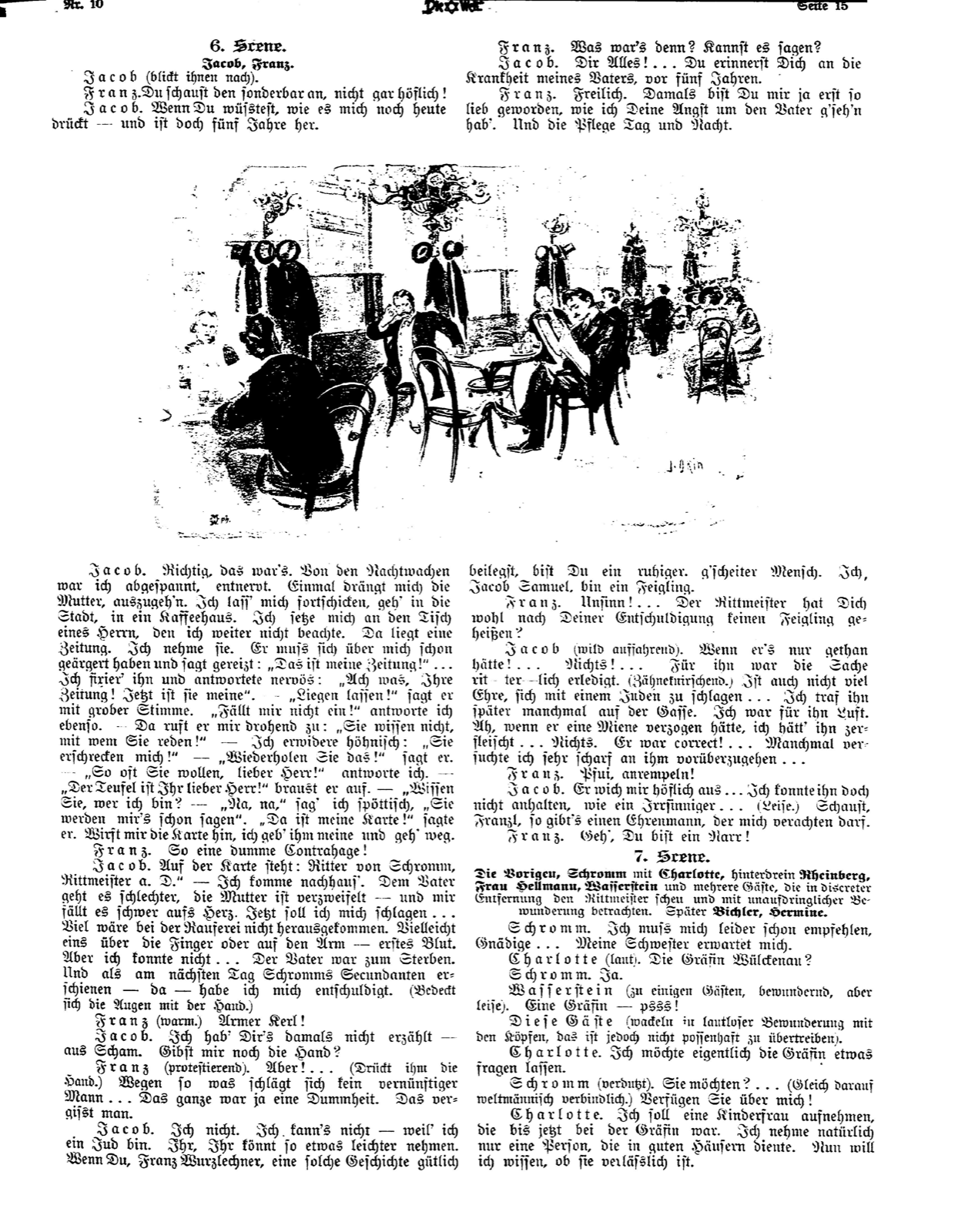
Scene 6.
Jacob, Franz.
Jacob (looks after them). Franz. You look at him strangely, not very politely! Jacob. If you knew how it still weighs on me today — and yet it is five years ago. Franz. What was it, then? Can you tell? Jacob. To you, everything! ... You remember my father's illness, five years ago. Franz. Of course. It was then that you first grew so dear to me, when I saw your anxiety for your father. And the nursing, day and night.
Jacob. Right, that was it. From the night-watches I was worn out, unnerved. One day my mother urges me to go out. "I let myself be sent off, go into the town, into a coffee-house. I sit down at the table of a gentleman to whom I otherwise pay no heed. A newspaper is lying there. I take it. He must already have been vexed with me, and says irritably: "That is my newspaper!" ... I stare at him and answered nervously: "Oh come, your newspaper! Now it is mine." — "Put it down!" he says in a coarse voice. "I shall do nothing of the sort!" I answer likewise. — Then he calls to me threateningly: "You do not know with whom you are speaking!" — I retort scornfully: "You frighten me!" — "Repeat that!" he says. — "As often as you like, my dear sir!" I answer. — "The devil is your dear sir!" he flares up. — "Do you know who I am? — "Well, well," I say mockingly, "you'll tell me soon enough." "There is my card!" he said. "Throws the card at me, I give him mine and go away. Franz. Such a stupid affair of honour! Jacob. On the card it reads: Ritter von Schromm, Rittmeister (retired)." — I come home. Father is worse, Mother is in despair — and it weighs heavily upon my heart. Now I am to fight a duel . . . Not much would have come of the scuffle. Perhaps one across the fingers or on the arm — first blood. But I could not . . . Father was at the point of death. And when Schromm's seconds appeared the next day — then — I made my apology. (Covers his eyes with his hand.) Franz (warmly.) Poor fellow! Jacob. I did not tell you of it then — out of shame. Will you still give me your hand? Franz (protesting). Come now! . . . (Presses his hand.) No sensible man fights over such a thing . . . The whole affair was mere folly. One forgets it. Jacob. I do not. I cannot — because I am a Jew. You, you can take such a thing more lightly. If you, Franz Wurzlehner, settle such an affair amicably, you are a calm, sensible man. I, Jacob Samuel, am a coward. Franz. Nonsense! . . . The Rittmeister surely did not call you a coward after your apology? Jacob (flaring up wildly). If only he had done it! . . . Nothing! . . . For him the matter was settled in a chi-val-rous manner. (Grinding his teeth.) Nor is there much honour in fighting with a Jew . . . I met him sometimes afterwards in the street. To him I was thin air. Ah, had he but twitched a muscle, I would have torn him to pieces . . . Nothing. He was correct! . . . Sometimes I tried to pass very sharply close by him . . . Franz. Fie, to jostle him! Jacob. He politely gave way to me . . . I could hardly stop him like a madman . . . (Softly.) You see, Franzl, so there is a man of honour who is permitted to despise me. Franz. Come, you are a fool!
Scene 7.
The preceding, Schromm with Charlotte, behind them Rheinberg, Frau Hellmann, Wasserstein and several guests who, at a discreet distance, regard the Rittmeister shyly and with unobtrusive admiration. Later Bichler, Hermine.
Schromm. I must unfortunately take my leave already, Gracious lady . . . My sister awaits me. Charlotte. The Countess Wülckenau? Schromm. Yes. Wasserstein (to a few guests, admiringly but softly). A Countess — psss!
(These guests wag their heads in soundless admiration; this, however, is not to be exaggerated into farce.)
Charlotte. I should really like to have the Countess asked something. Schromm (taken aback). You should? . . . (Immediately after, with worldly courtesy.) I am at your disposal! Charlotte. I am to engage a children's nurse who has until now been with the Countess. Naturally I take only a person who has served in good houses. Now I wish to know whether she is reliable.