Mount Tzvi 57
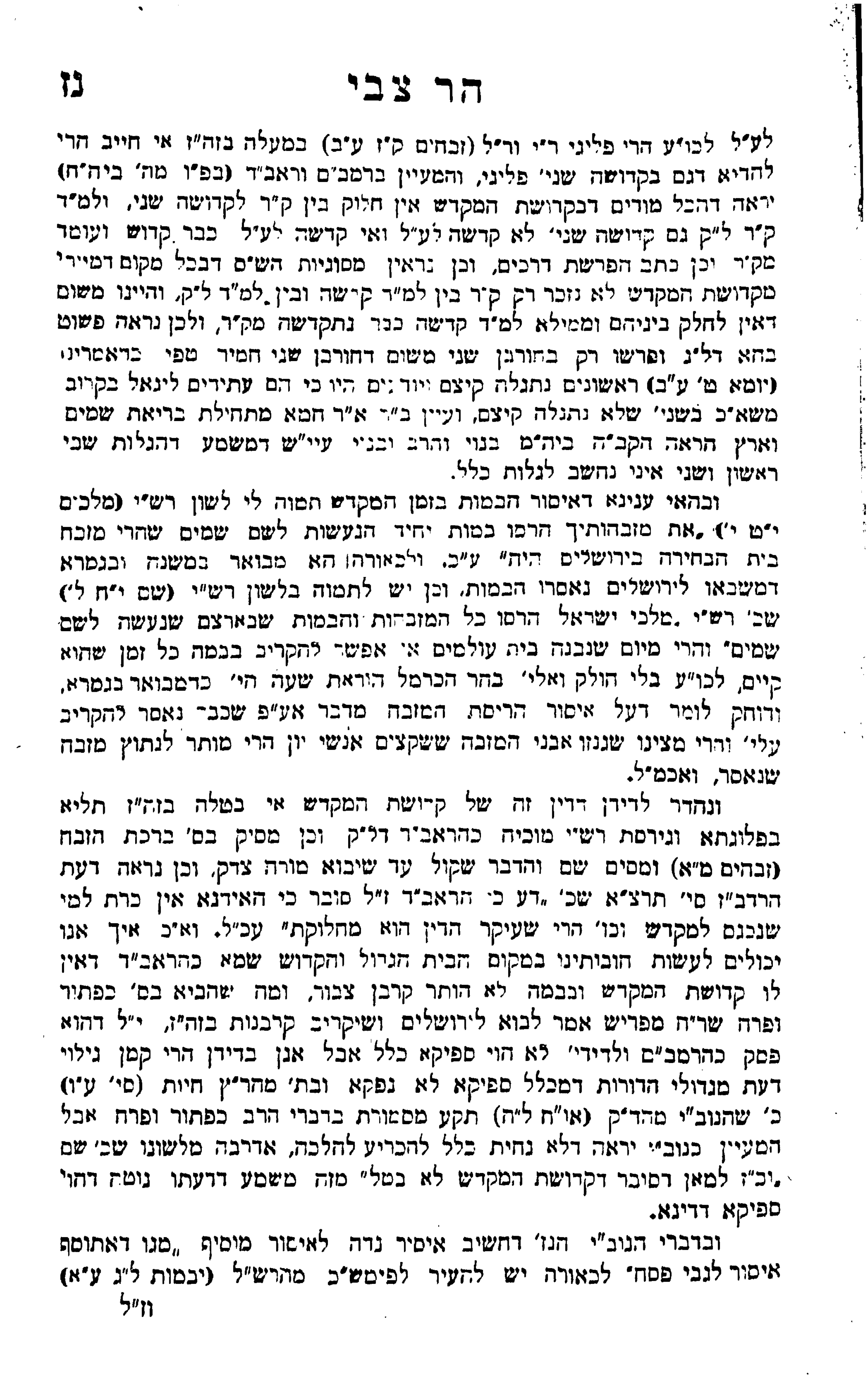
…for the time to come by all accounts: behold, Rabbi Yohanan and Resh Lakish dispute (Zevahim 107b) concerning one who offers up at the present time, whether he is liable; hence it is explicit that concerning the second sanctification too they dispute. And whoever examines Maimonides and Rabad (in chapter 6 of the Laws of the Chosen House) will see that all agree that regarding the holiness of the Sanctuary there is no difference between the first sanctification and the second sanctification; and according to the one who says the first sanctification did not sanctify, the second sanctification too did not sanctify for the time to come; and if it sanctified for the time to come, it was already holy and standing from the first sanctification. And so the Parashat Derakhim wrote. And so it appears from the passages of the Talmud, that in every place where they speak of the holiness of the Sanctuary only the first sanctification is mentioned, both according to the one who says it sanctified and according to the one who says it did not sanctify; and that is because there is no distinguishing between them, and consequently, according to the one who says it sanctified, it was already sanctified from the first sanctification. And therefore it seems plain, regarding the fact that they did not decree, and abstained only at the second destruction, that it is because the second destruction is graver, as we say (Yoma 9b): The former ones, their End was revealed, and they knew that they were destined to be redeemed soon; which is not so with the second, whose End was not revealed. And see Bereshit Rabbah: Rabbi Hama said: From the beginning of the creation of heaven and earth the Holy One, blessed be He, showed the Temple built and destroyed and built; see there; from which it is implied that the exile between the First and the Second is not reckoned as an exile at all.
And in this matter of the prohibition of the high places in the time of the Sanctuary, the wording of Rashi (Kings 19:10) is astonishing to me: "'They have thrown down thine altars': individual high places made for the sake of Heaven; for behold, evidently, the Chosen House was in Jerusalem"; end of quote. And at first sight it is explained in the Mishnah and in the Gemara that once they came to Jerusalem the high places were forbidden. And likewise one may wonder at the wording of Rashi (there, 18:30), where Rashi wrote: "The kings of Israel threw down all the altars and the high places in their land that were made for the sake of Heaven"; and yet from the day the everlasting House was built it is impossible to offer on a high place so long as it stands, by all accounts, without dissent; and Elijah on Mount Carmel was a ruling for the hour, as is explained in the Gemara. And it is forced to say that he speaks of the prohibition of throwing down the altar, even though it had already been forbidden to offer upon it; for behold, we find that they stored away the stones of the altar which the men of Greece had defiled; hence it is permitted to pull down an altar that has been forbidden. And this is not the place to elaborate.
We return to our own matter: that this law of the holiness of the Sanctuary, whether it has lapsed at the present time, depends on a dispute; and the reading of Rashi proves as Rabad, that it did not sanctify; and so the book Birkat ha-Zevah concludes (Zevahim 41), and he ends there: and the matter is evenly balanced until the teacher of righteousness comes. And so appears the view of the Radbaz, section 691, who wrote: "Know that Rabad of blessed memory holds that nowadays there is no karet for one who enters the Sanctuary etc.; hence the essence of the law is a dispute"; end of his words. And if so, how can we perform our obligations in the place of the great and holy House, lest it be as Rabad holds, that it has no holiness of the Sanctuary, and on a high place a communal sacrifice was not permitted? And as for what is brought in the book Kaftor va-Ferah, that Rabbi Hayyim of Paris said he would come to Jerusalem and offer sacrifices at the present time, one may say that he decided as Maimonides, and for him it is no doubt at all; but we, for our part, behold, we have before us a disclosure of opinion from the great ones of the generations that it does not leave the category of doubt. And in the Responsa of Maharatz Chajes (section 76) he wrote that the Noda bi-Yehudah, first edition (Orah Hayyim 35), drove a nail fast into the words of the Rabbi of Kaftor va-Ferah; but whoever examines the Noda bi-Yehudah will see that he did not set out at all to decide the halakhah; on the contrary, from his wording where he wrote there, "And all this is according to the one who holds that the holiness of the Sanctuary has not lapsed", it is implied from this that his opinion inclines to its being a doubt of law.
And concerning the words of the Noda bi-Yehudah mentioned above, who reckons the prohibition of a menstruant as an adding prohibition, "since a prohibition was added with respect to the Passover offering", at first sight one may remark, according to what the Maharshal wrote (Yevamot 33a),