Mount Tzvi 56
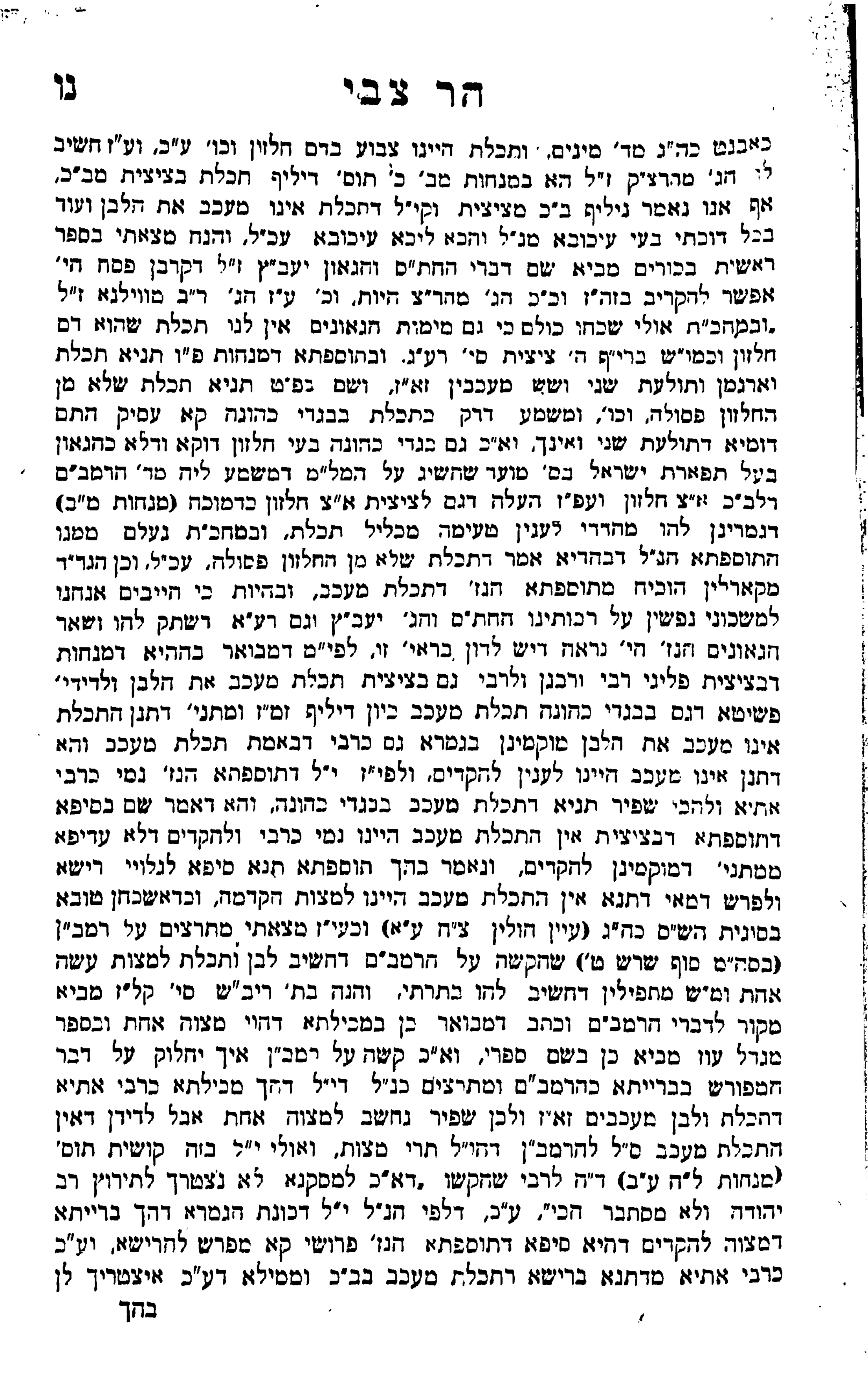
…is like the girdle of the High Priest, of four kinds, and tekhelet (the blue) is that dyed with the blood of the chilazon (the shellfish of the blue dye), etc." End. And on this the Gaon our teacher Rabbi Tzvi Kalischer, of blessed memory, answered him: behold, in Menahot 42 Tosafot wrote that tekhelet in the fringes is derived from the priestly garments; we too shall say, let us derive the priestly garments from the fringes, and it is established for us that tekhelet is not indispensable to the white. And further, everywhere, for indispensability one requires "whence do we know it?", and here there is no indispensability. End of his words. And behold, I found in the book Reishit Bikkurim that it cites there the words of the Hatam Sofer and of the Gaon Yaavetz, of blessed memory, that the Passover offering could be offered in this time; and so wrote the Gaon our teacher Rabbi Tzvi Chajes. And on this the Gaon Rabbi Bezalel of Vilna, of blessed memory, wrote: "And with the pardon of their honour, perhaps they all forgot that even from the days of the Geonim we have had no tekhelet, which is the blood of the chilazon, as is written in the Rif, Laws of Fringes, section 273. And in the Tosefta of Menahot, chapter 6, it is taught: 'The tekhelet and the purple and the scarlet and the fine linen are indispensable to one another'; and there in chapter 9 it is taught: 'Tekhelet not from the chilazon is invalid', etc. And it implies that it deals there only with tekhelet in the priestly garments, like the scarlet and the others; and if so, the priestly garments too require the chilazon specifically; and not as the Gaon, the author of Tiferet Yisrael, in the order Moed, who disputed the Mishneh la-Melekh, for it was implied to him from the words of Maimonides that the priestly garments do not require the chilazon, and on this basis he concluded that the fringes too do not require the chilazon, as is proven (Menahot 42), that we derive them from one another with regard to the testing, from 'entirely of tekhelet'. And with the pardon of his honour, the Tosefta mentioned above escaped him, which says explicitly that tekhelet not from the chilazon is invalid." End of his words. And likewise the Gaon Rabbi David of Karlin proved from the Tosefta mentioned that tekhelet is indispensable. And since we are obliged to pledge our souls for our masters the Hatam Sofer and the Gaon Yaavetz, and also Rabbi Akiva Eger, who kept silent about them, and the other Geonim mentioned, it would seem that there is room to deliberate on this proof, according to what is explained in that passage of Menahot, that concerning the fringes Rabbi and the Rabbis dispute, and according to Rabbi tekhelet is indispensable to the white in the fringes too; and according to him it is plain that in the priestly garments too tekhelet is indispensable, since he derives them from one another. And our Mishnah, where we learned "the tekhelet is not indispensable to the white", is established in the Talmud as Rabbi too, that in truth tekhelet is indispensable, and what we learned, "it is not indispensable", concerns precedence. And according to this it may be said that the Tosefta mentioned also follows Rabbi, and therefore it rightly teaches that tekhelet is indispensable in the priestly garments; and what it says there in the latter clause of the Tosefta, that in the fringes the tekhelet is not indispensable, is also as Rabbi, and concerns precedence, for it is no better than our Mishnah, which we establish as concerning precedence; and we shall say that in this Tosefta the latter clause was taught to reveal the first clause, and to explain that what it taught, "the tekhelet is not indispensable", concerns the commandment of precedence; as we find often in the discussion of the Talmud in such a case (see Hullin 98a). And similar to this I found that they answer for Nahmanides (in the Book of the Commandments, end of Principle 9), who raised a difficulty against Maimonides, who counts the white and the tekhelet as one positive commandment: and how does it differ from phylacteries, which he counts as two? And behold, in the Responsa of the Rivash, section 137, he brings a source for the words of Maimonides, and wrote that it is explained so in the Mekhilta, that it is one commandment; and the book Migdal Oz brings this in the name of the Sifre. And if so, it is difficult for Nahmanides: how could he disagree with a thing explicit in a baraita, as Maimonides holds? And they answer as above, that it may be said that this Mekhilta follows Rabbi, that tekhelet and white are indispensable to one another, and therefore it is rightly counted as one commandment; but for us, for whom the tekhelet is not indispensable, Nahmanides holds that they are two commandments. And perhaps by this one may settle the difficulty of Tosafot (Menahot 38b), at the heading "According to Rabbi", who raised the difficulty "that if so, in the conclusion we should not need the answer of Rav Judah, and this is not reasonable"; end. For according to the above it may be said that the intention of the Talmud is that this baraita, "it is a commandment to give precedence", which is the latter clause of the Tosefta mentioned, explains the first clause; and necessarily it follows Rabbi, since it taught in the first clause that tekhelet is indispensable in the priestly garments; and of itself, necessarily, we need