Mount Tzvi
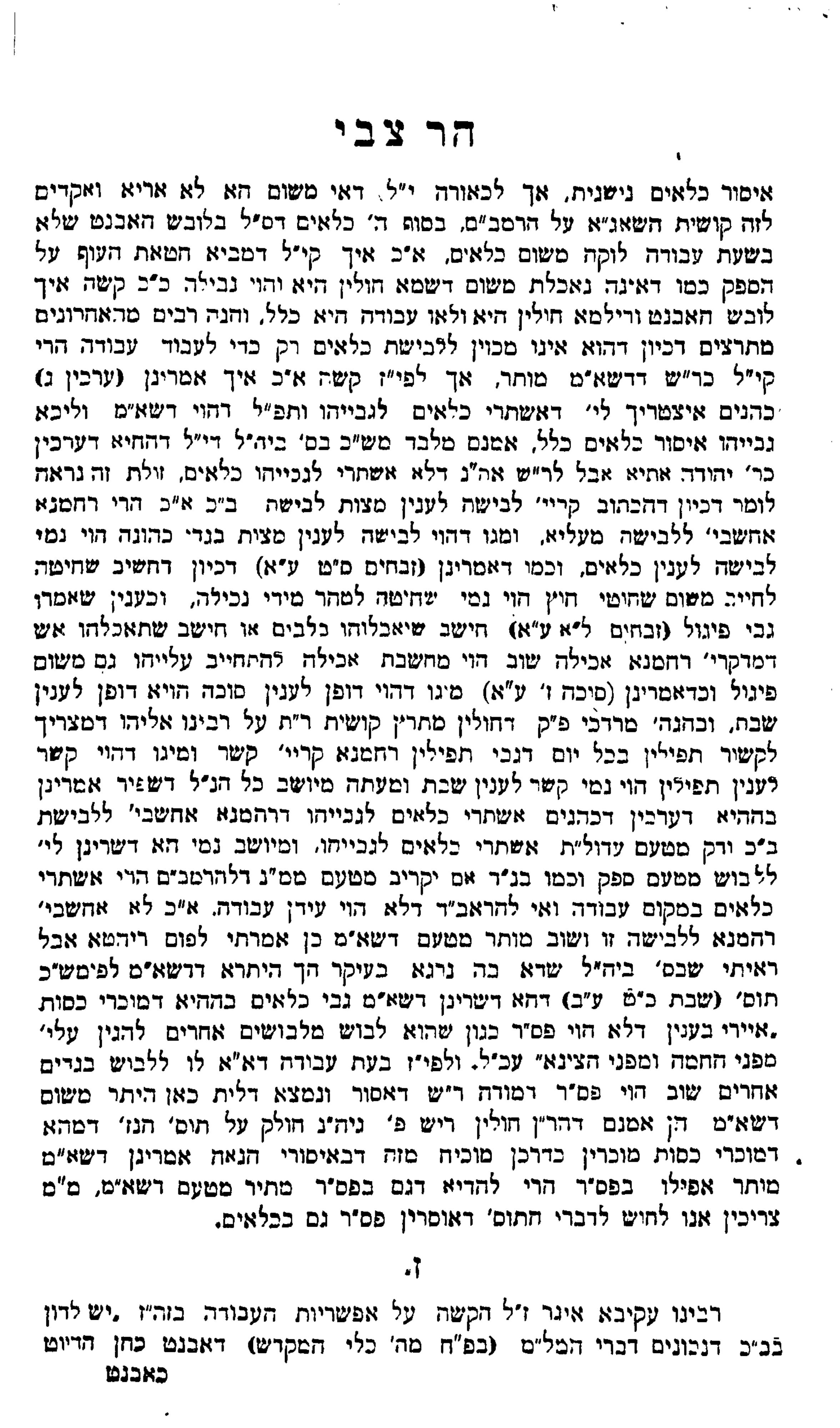
…the prohibition of mixed kinds was it taught. But at first sight it may be said that on that account it is no objection; and I shall preface to this the difficulty of the Shaagat Aryeh against Maimonides, at the end of the Laws of Mixed Kinds, who holds that one who wears the girdle not at the time of the Service is flogged on account of mixed kinds: if so, how is it established for us that one brings a bird sin-offering on a doubt? Just as it is not eaten, because perhaps it is unconsecrated and is carrion, so too it is difficult: how does he wear the girdle, when perhaps it is unconsecrated and it is no Service at all? And behold, many of the later authorities answer that since he does not intend the wearing of mixed kinds, but only to perform the Service, it is established for us as Rabbi Shimon, that an unintended act is permitted. But according to this it is difficult: if so, how do we say (Arakhin 3): "For priests it was needed, that mixed kinds were permitted for them"? Let him derive it from the fact that it is an unintended act, and for them there is no prohibition of mixed kinds at all. However, besides what is written in the book Beit ha-Levi, that it may be said that that passage of Arakhin follows Rabbi Judah, but according to Rabbi Shimon it is indeed so that mixed kinds were not permitted for them; apart from this it seems right to say that since Scripture calls it wearing with regard to the commandment of wearing the priestly garments, then the Merciful One has accounted it a proper wearing; and since it is a wearing with regard to the commandment of the priestly garments, it is also a wearing with regard to mixed kinds. Just as we say (Zevahim 69a) that since it is accounted slaughtering so as to make one liable on account of slaughtering outside, it is also slaughtering to purify from the impurity of carrion; and like the matter that they said concerning piggul (Zevahim 31a), if he intended that dogs should eat it or intended that fire should consume it: since the Merciful One called it eating, it is then an intention of eating, to make him liable for them also on account of piggul; and as we say (Sukkah 7a): since it is a wall with regard to the sukkah, it is a wall with regard to the Sabbath; and as the glosses of the Mordekhai on the first chapter of Hullin answer the difficulty of Rabbenu Tam against Rabbenu Eliyahu, who requires one to tie the phylacteries every day: that with regard to phylacteries the Merciful One called it a knot, and since it is a knot with regard to phylacteries, it is also a knot with regard to the Sabbath. And now all that is mentioned above is settled: that we rightly say in that passage of Arakhin that for priests mixed kinds were permitted, for the Merciful One accounted it the wearing of the priestly garments, and only by reason of "a positive commandment overrides a negative commandment" were mixed kinds permitted for them. And also settled is the fact that we permit him to wear them by reason of doubt, and as in the case before us, if he offers by reason of "whichever way": that according to Maimonides mixed kinds are permitted in the place of the Service; and if according to Rabad, that it is not the time of the Service, then the Merciful One did not account this wearing as wearing, and it is then permitted by reason of an unintended act. So I said at a quick glance; but I saw that the book Beit ha-Levi struck an axe at the very root of this permission of an unintended act, according to what Tosafot wrote (Shabbat 29b), that what we permit an unintended act with mixed kinds, in that passage of the sellers of garments, "speaks of a case where it is not an inevitable consequence, as where he wears other garments to protect himself from the sun and from the cold." End of his words. And according to this, at the time of the Service, when he cannot wear other garments, it is then an inevitable consequence, where Rabbi Shimon concedes that it is forbidden; and it is found that there is no permission here on account of an unintended act. True it is that the Ran, on Hullin at the beginning of the chapter Gid ha-Nasheh, disagrees with the Tosafot mentioned; for from that of "sellers of garments sell in their usual way" he proves that with prohibitions of benefit we say an unintended act is permitted even in an inevitable consequence; behold, explicitly, that even in an inevitable consequence he permits by reason of an unintended act. Nevertheless we must take into account the words of Tosafot, who forbid an inevitable consequence also with mixed kinds.
Rabbi Akiva Eger, of blessed memory, raised a difficulty concerning the possibility of the Service in this time: "There is room to deliberate concerning the priestly garments, for the words of the Mishneh la-Melekh (in chapter 8 of the Laws of the Vessels of the Sanctuary) are correct, that the girdle of an ordinary priest