[illegible]
Essay on Holy Things
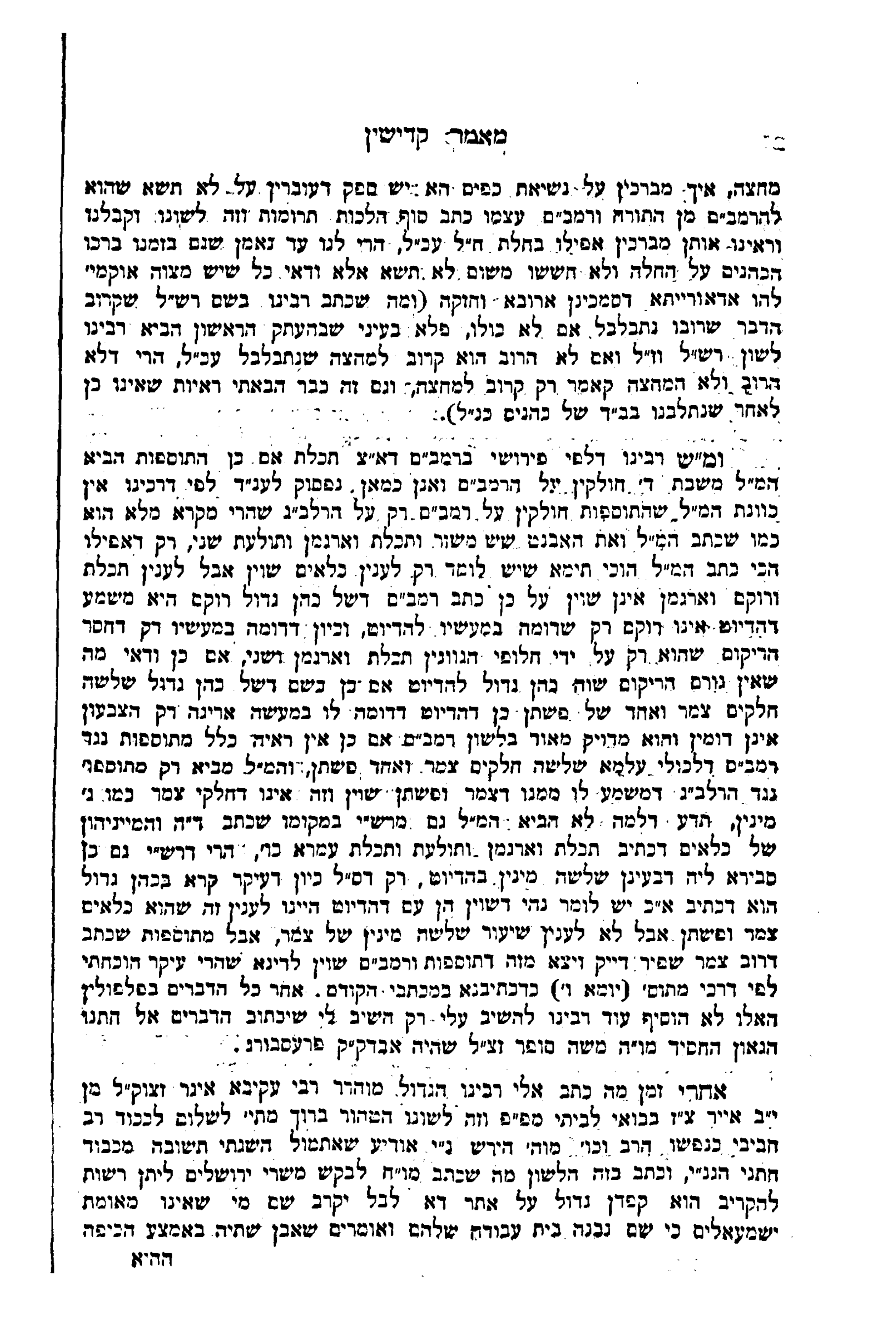
…half, how do they say the blessing over the lifting up of the hands? For there is a doubt that they transgress "Thou shalt not take", which according to Maimonides is from the Torah; and Maimonides himself wrote at the end of the Laws of Heave-Offerings, and these are his words: "We have received, and have seen them saying the blessing even over the hallah of outside the Land." End of his words. Here we have a faithful witness that in his time too the priests said the blessing over the hallah and had no concern on account of "Thou shalt not take"; but certainly, wherever there is a commandment, we set them on their Torah footing, for we rely on the majority and on presumption. (And as to what our master wrote in the name of Rashal, that it is near that the greater part has been confused, if not all of it: it is a wonder in my eyes, for in the first copy our master brought the language of Rashal, and these are his words: "and if not the greater part, it is near to half that has been confused." End of his words. So he says neither the greater part nor half, but only near to half; and even this, I have already brought proofs that it is not so, after they have been clarified in a court of priests, as above.)
And as to what our master wrote, that according to my interpretation of Maimonides, that tekhelet (the blue) is not required, then Tosafot, which the Mishneh le-Melekh brought from Shabbat 4, dispute Maimonides, and whom do we follow? Let us decide: in my humble opinion, according to our way, the intention of the Mishneh le-Melekh is not that Tosafot dispute Maimonides, but only Ralbag; for it is an explicit verse, as the Mishneh le-Melekh wrote: And the girdle of twined fine linen, and tekhelet, and purple, and scarlet. Only that, even so, the Mishneh le-Melekh wrote "and if you should say", that one may say they are alike only with respect to mixed kinds, but with respect to tekhelet and embroidery and purple they are not alike; therefore Maimonides wrote that that of the High Priest is embroidered, implying that the ordinary one is not embroidered, only that it resembles the ordinary one in its making. And since it resembles it in its making, lacking only the embroidery, which comes about only through the alternation of the colours, tekhelet and purple and scarlet, then certainly in whatever the embroidery does not bring about, the High Priest is equal to the ordinary priest. If so, just as that of the High Priest is three parts wool and one of linen, so is that of the ordinary priest, which resembles it in the work of weaving, only the colours are not alike; and this is very precise in the language of Maimonides. If so, there is no proof at all from Tosafot against Maimonides, for according to all opinions it is three parts wool and one linen; and the Mishneh le-Melekh brings Tosafot only against Ralbag, from whom he understands that wool and linen are equal; and this is not so, for the parts of wool are as three kinds. Know it: for why did the Mishneh le-Melekh not bring also Rashi in his place, who wrote, at the heading "and their girdles": "of mixed kinds, for it is written tekhelet and purple and scarlet, and tekhelet is wool, etc."? So Rashi too holds that we require three kinds in the ordinary priest's; only he holds that, since the verse is written chiefly of the High Priest, one may therefore say: granted that they are alike with the ordinary one's, that is with respect to its being mixed kinds, wool and linen, but not with respect to the measure of three kinds of wool. But from Tosafot, who wrote that it is mostly wool, he inferred well. And it follows from this that Tosafot and Maimonides agree in the law, for my main proof, according to my way, is from Tosafot (Yoma 6), as I wrote in my previous letter. After all these words in these disputations our master did not add further to answer me, but replied to me that he would write the matter to his son-in-law, the pious Gaon, our teacher Rabbi Moses Sofer, of blessed memory, who was head of the rabbinical court of the holy community of Pressburg.
After some time our great master, our teacher Rabbi Akiva Eger, of saintly and blessed memory, wrote to me, on the 12th of Iyar 597, on my coming home from Frankfurt, and these are his pure words: Blessed be He who brought me back in peace. To the honour of my dear friend, beloved as his own soul, the Rabbi etc., our teacher Rabbi Hirsch, may his light shine. I inform you that yesterday I received a reply from his honour my son-in-law, the Gaon, may his light shine, and he wrote in these words: "As to what my master and father-in-law wrote, to ask the rulers of Jerusalem to give permission to sacrifice: he is very strict concerning this place, that none shall approach there who is not of the nation of the Ishmaelites, for there their house of worship is built, and they say that the Foundation Stone is in the midst of the dome