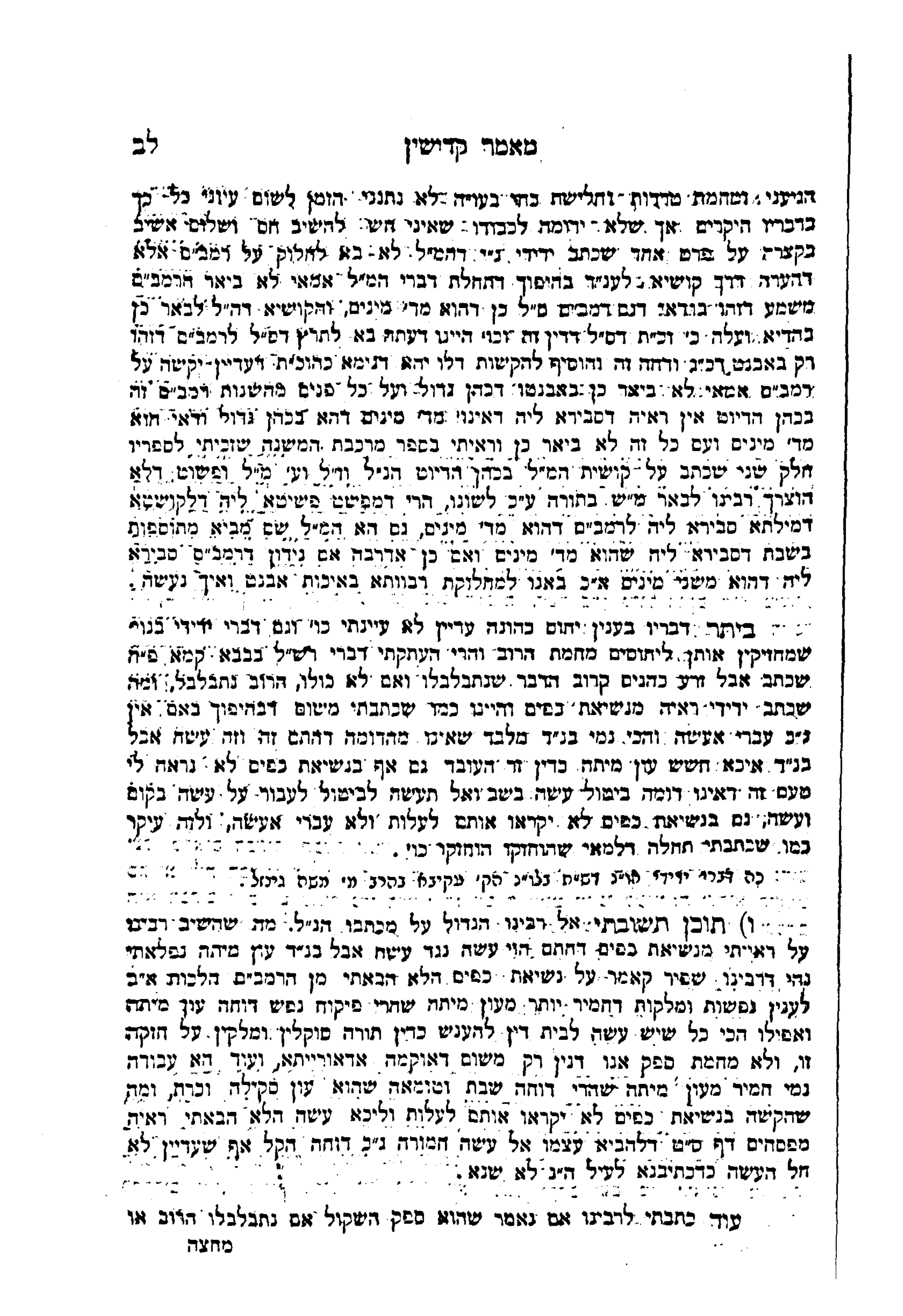
Essay on Holy Things 32
…reached me; and on account of preoccupations and the weakness of my strength, because of our many sins, time has not allowed me to give so much study to his precious words. But lest it seem to his honour that I do not care to reply, God forbid, I shall reply briefly on one detail. As to what my friend, may his light shine, wrote, that the Mishneh le-Melekh did not come to dispute Maimonides but only made a remark by way of a difficulty: in my humble opinion it is the reverse. For the beginning of the words of the Mishneh le-Melekh, "why did Maimonides not explain", implies that this is certain, that Maimonides too holds so, that it is of four kinds, and the difficulty is that he ought to have explained so explicitly; and on this he wrote, "and if you should say that he holds that this law etc.", that is, now he comes to answer that Maimonides holds this to be only in the girdle of the High Priest; and he rejected this, and added the further difficulty that, even if we should say as in "and if you should say", there would still be a difficulty against Maimonides: why did he not explain so for the girdle of the High Priest? And at all events, from these words of Maimonides concerning an ordinary priest there is no proof that he holds it is not of four kinds, since in the High Priest it is certainly of four kinds, and nevertheless he did not explain so. And I have seen in the book Merkevet ha-Mishneh, whose books I have been privileged to obtain, Part Two, that he wrote on the difficulty of the Mishneh le-Melekh concerning the ordinary priest mentioned above, and these are his words: "And see the Mishneh le-Melekh; and it is plain that our master did not need to explain what is written in the Torah." Thus far his words. So it is quite plain to him that in truth Maimonides holds that it is of four kinds. Moreover, the Mishneh le-Melekh there cites from Tosafot in Shabbat that they hold it is of four kinds; and if so, on the contrary, if we judge that Maimonides holds it is of two kinds, then we have come to a dispute of the great authorities over the nature of the girdle, and what shall we do?
As to the rest of his words concerning priestly lineage, I have not yet studied them, etc. And also my friend's words rest on their being presumed to be of attested lineage on account of the majority; yet I have copied the words of Rashal on Bava Kamma, chapter 5, who wrote: "but the seed of priests, it is near that they have been confused; and if not all of it, the greater part has been confused." And as for what my friend wrote, a proof from the lifting up of the hands: that is as I wrote, because in the reverse case, if not, they too would transgress a positive commandment; and so too in the case before us; besides that it is not comparable, for there both this and that are positive commandments, whereas in the case before us there is the concern of a sin punishable by death, as in the law of a stranger who performs the Service. Also, even in the lifting up of the hands this reason does not seem right to me, for the neglect of a positive commandment by sitting still and not acting is not like the neglect of transgressing a positive commandment by rising up and acting. Also, in the lifting up of the hands, they would not call them to go up, and they would not transgress a positive commandment. And therefore the main thing is as I wrote at first, that in what they have been presumed, they have been presumed, etc.
Thus the words of his friend who loves him greatly, who seeks his welfare always with heart and soul, the humble Akiva, son of the Rabbi, our teacher Moses Ginzl.
- The substance of my reply to our great master on his letter mentioned above. As to what our master replied to my proof from the lifting up of the hands, that there it is a positive commandment against a positive commandment, whereas in the case before us it is a sin punishable by death, I wondered. Granted that our master speaks well concerning the lifting up of the hands; did I not bring from Maimonides, Laws of Forbidden Relations, concerning capital cases and lashes, which are graver than a sin punishable by death, for the saving of life sets aside a sin punishable by death, and even so, wherever there is a positive commandment for the court to punish according to the law of the Torah, they stone and flog on the strength of this presumption? And it is not as a matter of doubt that we judge, but because we have set it on its Torah footing. Moreover, the Service too is graver than a sin punishable by death, for it sets aside the Sabbath and impurity, which are sins of stoning and of excision. And as to the difficulty he raised, that in the lifting up of the hands they would not call them to go up and there is no positive commandment: did I not bring a proof from Pesahim folio 69, that to bring oneself to a weighty positive commandment also sets aside the light one, even though the positive commandment has not yet taken effect, as I wrote above? So here too it is no different.
I further wrote to our master: if we say that it is an evenly balanced doubt whether the greater part has been confused or