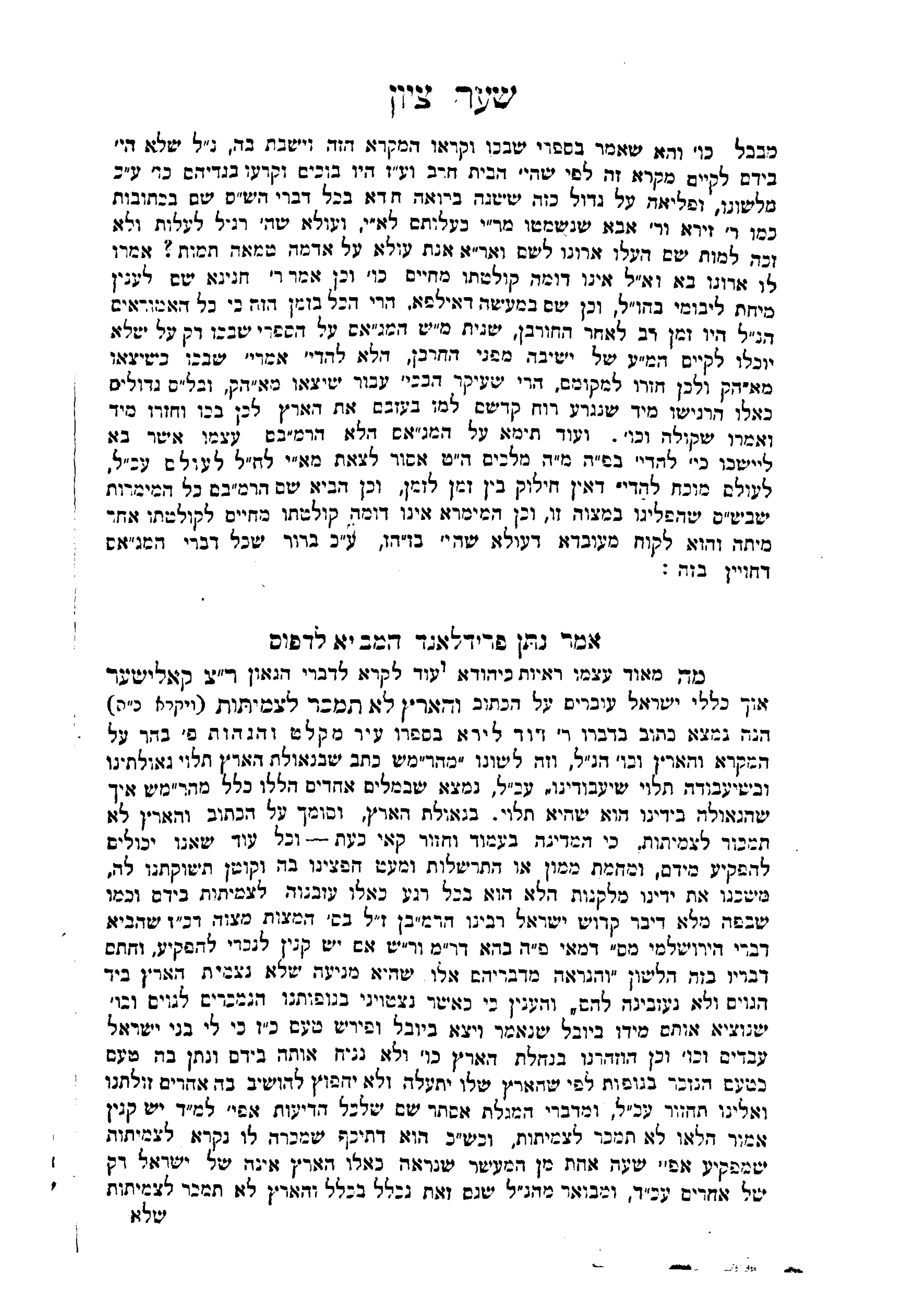
The Gate of Zion
…from Babylon, etc. And as for what is said in the Sifre, that they wept and read this verse, 'and thou shalt dwell in it', it seems to me that it was not in their power to fulfil this verse, because the House was destroyed, and over this they wept and rent their garments, etc." Thus far from his language. And it is a wonder at so great a man that he erred in vision. First: in all the words of the Talmud there in Ketubot, such as Rabbi Zeira and Rabbi Abba, who slipped away from Rav Judah when they went up to the Land of Israel; and Ulla, who was accustomed to go up, and did not merit to die there, and they brought his coffin up there, and Rabbi Eleazar said: "You, Ulla, shall die upon an unclean land?" They said to him: "His coffin has come." And he said to them: "It is not alike: one whom it receives in life, etc." And so Rabbi Hanina said there concerning going down to perform levirate marriage outside the Land; and so there in the story of Ilfa. Behold, all of it is at the present time, for all the Amoraim mentioned above lived a long time after the destruction. Second: what the Megillat Esther wrote on the Sifre, that they wept only because they would not be able to fulfil the positive commandment of dwelling on account of the destruction — but it is said explicitly that they wept when they went out of the Holy Land, and therefore they returned to their place; behold, the chief cause of the weeping was that they had gone out of the Holy Land. And without doubt such great men felt at once that their holy spirit was diminished when they left the Land; therefore they wept and returned at once and said: "It is equal, etc." And it is further astonishing about the Megillat Esther: behold, Maimonides himself, whom he came to justify — for explicitly, in chapter 5 of the Laws of Kings, halakhah 9: "It is forbidden to go out from the Land of Israel to outside the Land for ever." Thus far his words. "For ever" proves explicitly that there is no distinction between one time and another. And so Maimonides brought there all the sayings in the Talmud that extolled this commandment, and likewise the saying "It is not alike, one whom it receives in life and one whom it receives after death", and this is taken from the incident of Ulla, which was at the present time. Therefore it is clear that all the words of the Megillat Esther are refuted in this.
Said Natan Friedland, who brings it to the press:
How very mighty are the proofs, like Judah and more, to call in support of the words of the Gaon Rabbi Tzvi Kalischer, as to how the generality of Israel transgress the verse "And the land shall not be sold in perpetuity" (Leviticus 25). Behold, it is found written in the words of Rabbi David Lira, in his book Ir Miklat and the glosses on the portion Behar, on the verse "And the land, etc." mentioned above, and these are his words: "The Maharmash wrote that on the redemption of the Land our redemption depends, and on its subjugation our subjugation depends." Thus far his words. It follows that in these few words the Maharmash comprehended how the redemption is in our hands, in that it depends on the redemption of the Land; and he relies on the verse "And the land shall not be sold in perpetuity", for the country now stands in a state of "stand and return"; and so long as we are able to wrest it from their hands, and on account of money or negligence, and the littleness of our desire for it and the smallness of our longing for it, we withhold our hand from buying, is it not at every moment as though we had abandoned it in perpetuity in their hands? And as the holy one of Israel, our master Nahmanides of blessed memory, spoke with full mouth in the Book of the Commandments, commandment 27, where he brought the words of the Jerusalem Talmud, tractate Demai, chapter 5, concerning the dispute of Rabbi Meir and Rabbi Simeon whether a gentile's acquisition has the power to release, and he sealed his words in this language: "And what appears from these words of theirs is that it is a prohibition, so that the Land shall not be left in perpetuity in the hand of the gentiles and we shall not abandon it to them." And the matter is this: that just as we were commanded concerning our bodies that are sold to gentiles, etc., that we bring them out of his hand at the Jubilee, as it is said, "And he shall go out in the Jubilee", and He explained the reason for all this, "For the children of Israel are servants unto Me, etc.", so we were warned concerning the inheritance of the Land, etc., that we should not leave it in their hand; and He gave a reason for it like the reason mentioned for the bodies, because the Land is His, may He be exalted, and He does not desire to settle others in it besides us, and to us it shall return. Thus far his words. And from the words of the Megillat Esther there: that according to all opinions, even according to the one who says that there is acquisition, the prohibition "shall not be sold in perpetuity" is stated; and it is all the more so, for as soon as he has sold it to him it is called "in perpetuity", since it releases it even for a single hour from the tithe, so that it appears as though the Land were not Israel's but others'. Thus far his words. And it is clear from the above that this too is included under "And the land shall not be sold in perpetuity"