The Gate of Zion 8
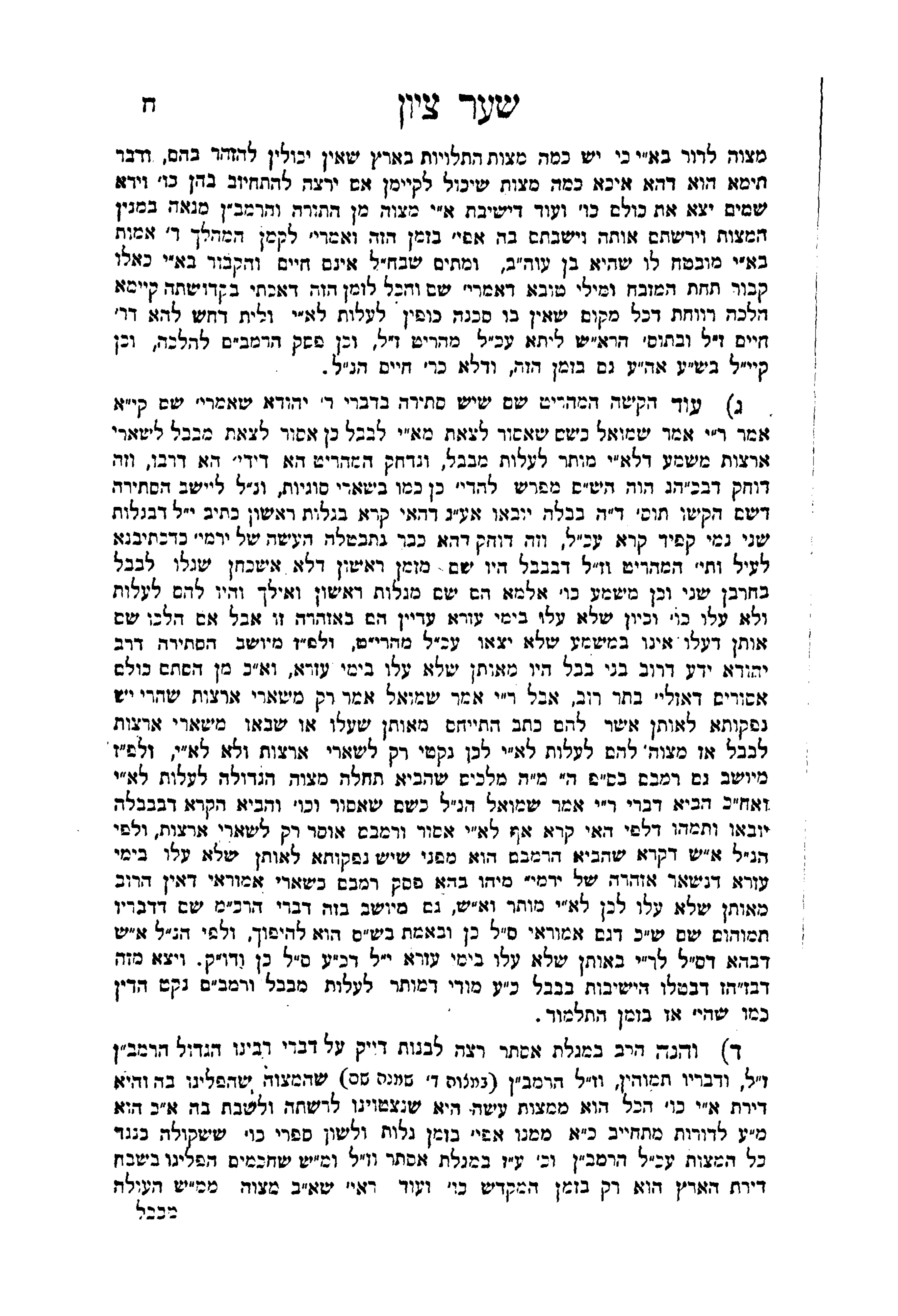
…a commandment to dwell in the Land of Israel, for there are a number of commandments dependent on the Land which one cannot take care to observe." And this is astonishing, for there are a number of commandments which one can fulfil if one wishes to make oneself obligated in them, etc., and one who fears Heaven discharges his duty in all of them, etc. And further, dwelling in the Land of Israel is a commandment of the Torah, and Nahmanides counted it in the number of the commandments, "and you shall possess it and dwell in it", even at the present time. And we say further on: whoever walks four cubits in the Land of Israel is assured that he is a son of the World to Come; and the dead outside the Land do not live; and whoever is buried in the Land of Israel is as though buried beneath the altar; and many things that are said there; and all of it applies to the present time, since the Land still stands in its holiness. It is a prevailing halakhah that wherever there is no danger one is compelled to go up to the Land of Israel, and no one pays heed to that saying of Rabbi Hayyim of blessed memory, and in the Tosafot of the Rosh it is not found. Thus far the words of the Maharit of blessed memory. And so Maimonides decided as halakhah, and so we hold in the Shulhan Arukh, Even ha-Ezer, even at the present time, and not according to Rabbi Hayyim mentioned above.
-
The Maharit further raised a difficulty there, that there is a contradiction in the words of Rav Judah, for we say there, 111: "Rav Judah said in the name of Samuel: Just as it is forbidden to leave the Land of Israel for Babylon, so it is forbidden to leave Babylon for other lands", which implies that it is permitted to go up from Babylon to the Land of Israel. And the Maharit strained to answer: this is his own view and that is his teacher's. And this is strained, for in such a case the Talmud would have explained so explicitly, as in other passages. And it seems to me to resolve the contradiction thus: there Tosafot raised a difficulty, in the passage beginning "They shall be carried to Babylon": "Although this verse is written concerning the first exile, one may say that the verse is particular about the second exile as well." Thus far their words. And this is strained, for the positive commandment of Jeremiah had already been annulled, as I wrote above. And the Maharit answered, and these are his words: "That in Babylon they had been there from the first time, for we do not find that they were exiled to Babylon at the second destruction, and so it is implied, etc.; hence they were there from the first exile onward, and they ought to have gone up and did not go up, etc.; and since they did not go up in the days of Ezra, they are still under this warning. But if those who had gone up went there, it is not implied that they should not leave." Thus far the words of the Maharit. And according to this the contradiction is resolved: Rav Judah knew that most of the people of Babylon were of those who did not go up in the days of Ezra, and if so, presumably all of them are forbidden, since we follow the majority. But Rav Judah said in the name of Samuel only "from other lands", for there is a practical difference for those who have a written record of lineage that they are of those who went up, or who came from other lands to Babylon: then it is a commandment for them to go up to the Land of Israel; therefore he mentioned only "other lands" and not the Land of Israel. And according to this Maimonides too is reconciled, at the end of chapter 5 of the Laws of Kings, who first brought the great commandment to go up to the Land of Israel and afterwards brought the words of Rav Judah in the name of Samuel mentioned above, "Just as it is forbidden, etc.", and brought the verse "They shall be carried to Babylon"; and they wondered at it, for according to this verse it is forbidden even to go to the Land of Israel, whereas Maimonides forbids only to other lands. And according to what was said above it is well: the verse that Maimonides brought is there because there is a practical difference for those who did not go up in the days of Ezra, upon whom the warning of Jeremiah remains; however, in this Maimonides decided like the other Amoraim, that the majority are not of those who did not go up; therefore to the Land of Israel it is permitted, and it is well. This also reconciles the words of the Rabbi, author of the Kesef Mishneh, there, for his words there are astonishing, in that he wrote that the Amoraim too hold so, while in truth in the Talmud it is the reverse; and according to the above it is well: in what Rav Judah holds concerning those who did not go up in the days of Ezra, one may say that everyone holds so; and consider it carefully. And it follows from this that at the present time, when the academies in Babylon have ceased, everyone agrees that it is permitted to go up from Babylon; and Maimonides stated the law as it was then, in the time of the Talmud.
-
And behold, the Rabbi, in the Megillat Esther, wished to build a siege-wall against the words of our great master Nahmanides of blessed memory, and his words are astonishing. And these are the words of Nahmanides (in commandment 4, which he counted there): that the commandment which they extolled, namely dwelling in the Land of Israel, all of it is from a positive commandment, that we were commanded to possess it and to dwell in it; if so, it is a positive commandment for all generations, obligating each one of us, even in the time of exile; and the language of the Sifre, etc., that it is equal to all the commandments. Thus far the words of Nahmanides. And on this the Megillat Esther wrote, and these are his words: "And what he wrote, that the Sages extolled the praise of dwelling in the Land, applies only in the time of the Sanctuary, etc. And a further proof that it is not a commandment is from what is said: whoever goes up