Essay on Holy Things 13
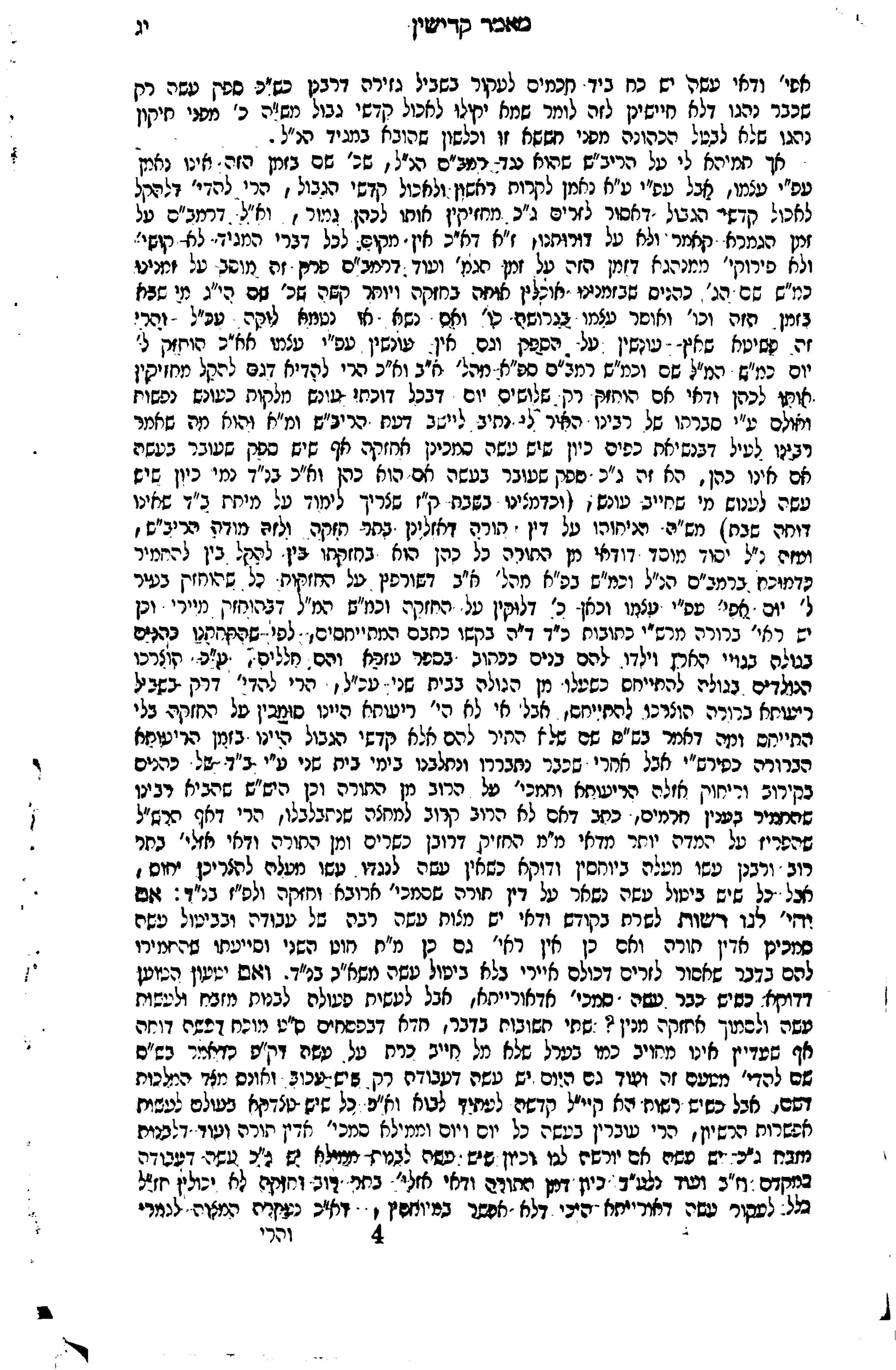
…even a certain positive commandment the Sages have power to uproot for the sake of a Rabbinic decree, all the more so a doubtful positive commandment; only that it has already become customary that we are not concerned about this, to say that perhaps they will be lenient and eat the holy things of the provinces; therefore he wrote that for the sake of good order they made it customary not to abolish the priesthood on account of this fear, and as in the language cited in the Maggid mentioned above.
But I wonder at Ribash, for he is against Maimonides mentioned above, who wrote there that at this time he is not believed on his own word, but on the word of one witness he is believed, to be called first and to eat the holy things of the provinces. So it is explicit that for leniency, to eat the holy things of the provinces, which are forbidden to non-priests, we also hold him to be a complete priest. And one cannot say that Maimonides speaks of the time of the Talmud and not of our generations; that is not so, for if so there would be no place for all the words of the Maggid, neither the difficulty nor its resolution, from the custom of this time against the time of the Talmud. And further, this chapter of Maimonides refers to our time, as he wrote there, halakhah 3: "The priests of our time eat it on presumption." And more difficult still is what he wrote there, halakhah 3: "He who comes at this time, etc., and forbids himself a divorced woman, etc., and if he married or became impure, he is flogged." End of his words. And it is obvious that one does not punish on a doubt, and also one does not punish on a man's own word; for if so, he had been presumed thirty days, as the Mishneh la-Melekh wrote there and as Maimonides wrote at the end of chapter 8 of the Laws of Forbidden Unions; and if so, it is explicit that even for leniency we hold him a certain priest if he has been presumed only thirty days, for everywhere the penalty of flogging is like a capital penalty. However, through the reasoning of our master a path has been lit for me to settle the view of Ribash and Magen Avraham; and it is what our master said above, that in the priestly blessing, since there is a positive commandment, we rely on presumption, even though there is a doubt that he transgresses a positive commandment if he is not a priest, for this too is a doubt that he transgresses a positive commandment if he is a priest. And if so, in our case as well, since there is a positive commandment to punish him who is liable to punishment (as we find in Shabbat 107, that a scriptural derivation is needed for an execution by the court, that it does not override the Sabbath), therefore they left it under the law of the Torah, that we follow presumption, and to this Ribash agrees. And from this it seems to me a sure foundation, that certainly by the Torah every priest stands in his presumption, both for leniency and for stringency, as is proved in Maimonides mentioned above, and as he wrote in chapter 1 of the Laws of Forbidden Unions, that we burn on presumptions anyone who has been presumed in the city thirty days, even on his own word; and here he wrote that we flog on presumption, and, as the Mishneh la-Melekh wrote, he speaks of one who has been presumed. And likewise there is a clear proof from Rashi, Ketubot 24, at the words "They sought their register, those that were reckoned by genealogy": "Because priests in the exile intermarried with the peoples of the land and had sons born to them, as is written in the book of Ezra, and these are profaned; therefore the great ones in the exile needed to establish their genealogy when they went up from the exile in the Second Temple." End of his words. So it is explicit that only because of a clear flaw did they need to establish their genealogy; but had there been no flaw, we would rely on the presumption without genealogy. And what is said in the Talmud there, that he permitted them only the holy things of the provinces, refers to the time of the clear flaw, as Rashi explained; but after they had already been clarified and made clean in the days of the Second Temple by the court of priests, in bringing near and putting far, the flaw is gone, and we rely on the majority by the Torah. And likewise the Yam shel Shlomo, which our master cited, who was stringent in the matter of devoted things, wrote, "and if not the majority, close to half have become confused"; so even Rashal, who exceeded the measure too far, nevertheless held that most of them are fit. And by the Torah we certainly follow the majority, and the Rabbis added a higher degree in genealogy; and only where there is no positive commandment against it did they add the higher degree of requiring genealogy, but wherever a positive commandment would be neglected, it remains under the law of the Torah, that we rely on majority and presumption. And according to this, in our case: if we shall have permission to minister in holiness, there is certainly a great positive commandment of the Service, and where a positive commandment would be neglected we rely on the law of the Torah; and if so, there is also no proof from Magen Avraham, Hut ha-Shani and those who stand with them, who were stringent with them in what is forbidden to non-priests, for all of them speak where no positive commandment is neglected, which is not so in our case. And if the claimant should claim that only when there is already a positive commandment do we rely on the law of the Torah, but to take action, to build an altar and to perform a positive commandment and to rely on presumption, whence do we know it? There are two replies in the matter. One, that in Pesahim 69 it is proved that the Passover overrides even though he is not yet obliged, as with an uncircumcised man who has not circumcised himself, who is liable to excision for the positive commandment of the Passover offering, as the Talmud says there explicitly for this reason. And further, even today there is a positive commandment of the Service, only that there is hindrance and compulsion on the part of the government here; but when there is permission, behold, we hold that it was sanctified for the time to come; and it is possible that wherever there is a means in the world to bring about the possibility of permission, we transgress a positive commandment each and every day, and as a matter of course we rely on the law of the Torah. And further, to build an altar there is also a positive commandment, if it should be permitted us; and since there is a positive commandment to build, it follows that there is also a positive commandment of the Service in the Sanctuary, if so. And further, in my humble opinion, since by the Torah we certainly follow majority and presumption, our Sages of blessed memory cannot at all uproot a positive commandment of the Torah where it is not possible with those of attested lineage, for if so the commandment would be uprooted entirely