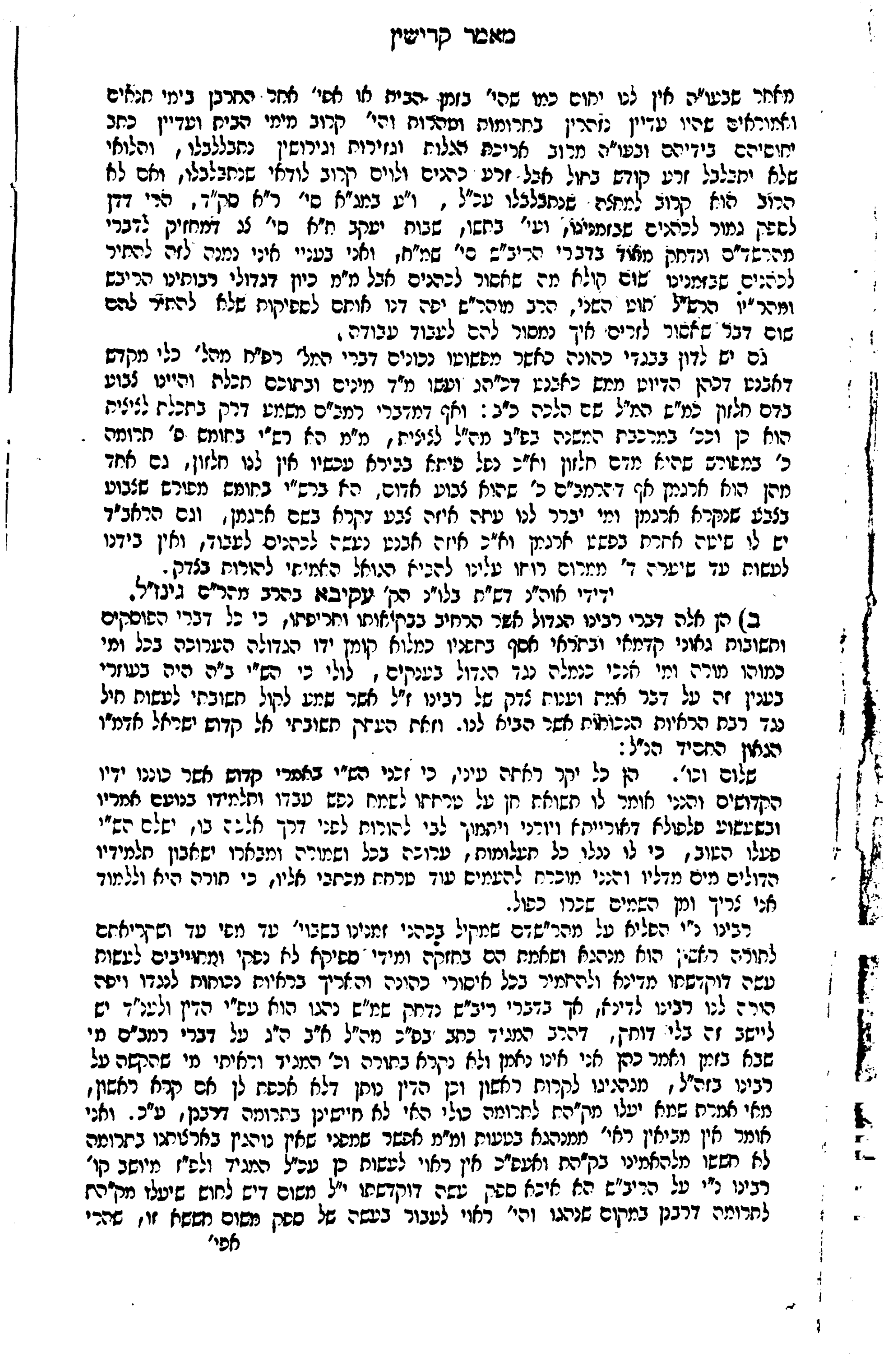
Essay on Holy Things
…since, for our many sins, we have no genealogy as there was in the time of the Temple, or even after the Destruction, in the days of the Tannaim and Amoraim, who were still careful about heave-offerings and the priestly gifts, and it was near to the days of the Temple, and their written genealogies were still in their hands; and for our many sins, through the great length of the Exile, and decrees, and expulsions, they have become confused. Would that the holy seed had not become mixed among the profane; the seed of priests and Levites, it is close to certain that they have become confused, and if not the majority, it is close to half that have become confused." End of his words. And see Magen Avraham, section 201, subsection 4. So he treats the priests of our time as a complete doubt. And see the Responsa Shevut Ya'akov, part 1, section 53, who upholds the words of Maharashdam and strains greatly over the words of Ribash, section 348. And I, in my poverty, am not of the number who would permit to the priests of our time any leniency in what is forbidden to priests; but nevertheless, since the greatest of our masters, Ribash, Mahariv, Rashal, Hut ha-Shani, and the Rabbi, our teacher Rabbi Shmuel Yafeh, treated them as doubtful, so as not to permit them anything forbidden to non-priests, how shall we hand over to them the performance of the Service?
There is also a question to consider in the priestly garments, as their law requires. Correct are the words of the Mishneh la-Melekh, beginning of chapter 8 of the Laws of the Vessels of the Sanctuary, that the girdle of an ordinary priest was exactly like the girdle of the High Priest, and they made it of four kinds, and among them tekhelet (the blue), that is, dyed with the blood of the chilazon (the shellfish of the blue dye), as the Mishneh la-Melekh wrote there, halakhah 22. And although from the words of Maimonides it is implied that it is so only in the tekhelet of the fringes, as is written in Mirkevet ha-Mishneh on chapter 2 of the Laws of Fringes, nevertheless Rashi on the Pentateuch, portion Terumah, wrote explicitly that it is from the blood of the chilazon; and if so, the loaf has fallen into the well: now we have no chilazon. Also, one of them is targaman; although Maimonides wrote that it is dyed red, yet in Rashi on the Pentateuch it is explicit that it was dyed with a dye called targaman; and who will make clear to us now which dye is called by the name targaman? And Rabad too has another view of the plain sense of targaman; and if so, what girdle shall we make for the priests to serve in? It is not in our power to act until Yahweh pour out His spirit upon us from on high, to bring the true redeemer to teach in righteousness.
His friend, who loves him as his own soul, who seeks the welfare of his Torah with heart and soul, the humble Akiva, son of the Rabbi, our teacher Rabbi Moshe Ginz, of blessed memory.
- Behold, these are the words of our great master, who spread wide in his erudition and his acuity; for all the words of the decisors and the responsa of the Geonim, early and late, he gathered in his fists, as the fill of the handful of his great hand, ordered in all things; and who is a teacher like him? And who am I, like an ant before the greatest of the giants, were it not that Yahweh, blessed be He, blessed be He, was my help in this matter, on account of the truth and the righteous humility of our master of blessed memory, who listened to the voice of my reply, to do valiantly against the multitude of cogent proofs that he brought us. And this is a copy of my reply to the holy one of Israel, my lord, my teacher and my master, the pious Gaon mentioned above:
Peace, etc. Behold, my eye has seen every precious thing, for Yahweh, blessed be He, has granted me the holy words which his holy hands have established; and here I give him cries of grace for his trouble, to gladden the soul of his servant and disciple with the pleasantness of his words and with the savour of the dialectic of the Torah; and he has taught me and let my heart hold fast, to show before me the way of the halakhah in it. May Yahweh, blessed be He, repay his good work, for to him all hidden things are revealed, ordered in all things and secure, and from his choicest his disciples will draw, who draw water from his buckets. And I am compelled to lay before him further the trouble of my letter to him, for it is Torah, and I need to learn, and from Heaven his reward will be doubled.
Our master, may his light shine, wondered at Maharashdam, who is lenient with the priests of our time in the case of a captive woman on hearsay testimony, and holds that their being called first to the Torah is a custom; and our master held that in truth they stand in presumption and do not leave the category of doubt, and that we are obliged by law to fulfil the positive commandment "And thou shalt sanctify him", and to be stringent in all the prohibitions of the priesthood; and he set out at length cogent proofs against him, and our master has well instructed us as to the law. But in the words of Ribash he was forced to strain, saying that what he wrote, "it is customary", is according to the law; and in my humble opinion this can be settled without strain. For the Rabbi, the Maggid, wrote on chapter 20 of the Laws of Forbidden Unions, halakhah 3, on the words of Maimonides, "He who comes at this time and says, I am a priest, is not believed, and is not called to the Torah", and the Maggid wrote: "And I have seen one who raised a difficulty against our master in this language: Our custom is to call him first, and so the law requires, for it does not matter to us if he is called first. What do you say, that perhaps they will promote him from the reading of the Torah to heave-offering? We are not so greatly concerned for Rabbinic heave-offering. End. And I say: one does not bring proof from a mistaken custom; nevertheless it is possible that, because heave-offering is not practised in our lands, they were not concerned to be strict in the reading of the Torah; and even so, it is not proper to do so." End of the words of the Maggid. And according to this, the difficulty of our master, may his light shine, against Ribash is settled, namely that there is a doubtful positive commandment of "And thou shalt sanctify him": one may say that it is because there is reason to fear that they will promote him from the reading of the Torah to Rabbinic heave-offering in a place where it is practised, and it would have been fitting to transgress a doubtful positive commandment on account of this fear; for