Essay on Holy Things
…and indeed the Magen Avraham, in section 589, subsection 4, wrote that where the commandment would be uprooted forever we do not make an ordinance; for the power that our Sages of blessed memory have to uproot applies only occasionally, as for instance not to blow the shofar on the Sabbath of a given year, but to uproot the commandment forever, no. And if so, how shall we uproot the Service forever for the sake of an added stringency?
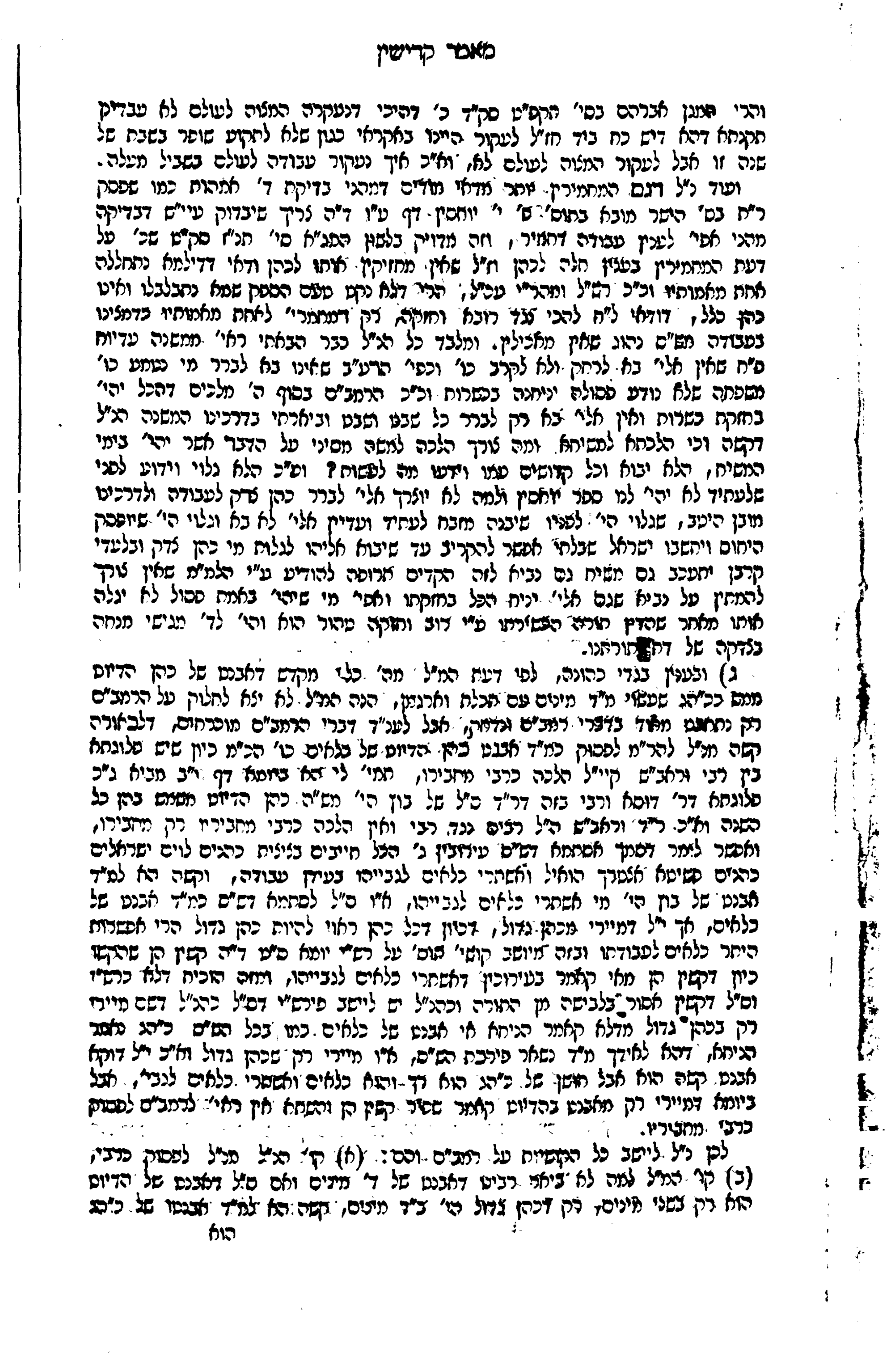
Further, it seems to me that even those who are excessively strict agree that the examination of four mothers is effective, as Rabbenu Tam ruled in Sefer ha-Yashar, cited in Tosafot, chapter "Ten Lineages", folio 76, at the words "He must examine"; see there, that examination is effective even with regard to the Service, which is the stricter; and this is precisely implied by the wording of the Magen Avraham, section 457, subsection 9, who wrote concerning the opinion of those who are strict in the matter of the dough-offering of outside the Land given to a priest: "that we do not presume him to be a certain priest, for perhaps one of his mothers was profaned; and so wrote Rashal and Mahari"; end of his words. Thus he did not take as the ground of the doubt that perhaps they became confused and he is no priest at all, for certainly we are not concerned for that; there we follow the majority and the presumption; only that we are strict regarding one of his mothers, as we find with the Service; therefore the custom is not to give him to eat. And besides all that is mentioned above, I have already brought a proof from the Mishnah, Eduyot chapter 8, that Elijah does not come to push away nor to bring near, etc., and according to the explanation of Ra'av, that he does not come to determine who has been absorbed, etc., and a family whose unfitness has not become known he will leave in its fitness; and so Maimonides wrote at the end of the Laws of Kings, that all will remain in the presumption of fitness, and Elijah comes only to clarify each and every tribe. And I explained the Mishnah mentioned above in our way, for it is difficult: is it then a halakhah for the days of the Messiah? And what need is there of a law given to Moses at Sinai for a matter that will be in the days of the Messiah? Will he not come, and all the holy ones with him, and they will know what to do? And if so, was it not revealed and known before Him that in the future no one will be in doubt of lineage? And why will Elijah not be needed to clarify a rightful priest for the Service? But according to our way it is well understood: it was revealed before Him that an altar would be built in the future while Elijah had not yet come, and it was revealed that lineage would be in doubt, and Israel would think that it is impossible to sacrifice until Elijah comes to reveal who is a rightful priest; and without sacrifice both the Messiah and the prophet would be delayed. Therefore He prepared the remedy beforehand, to make known through the law given to Moses at Sinai that there is no need to wait for a prophet, for Elijah too will leave everything in its presumption, and even one who is in truth unfit he will not reveal, since the law of the Torah has declared him fit by majority and presumption; he is pure, and they shall be to Yahweh such as bring a meal-offering in righteousness, according to the law of our Torah.
- As for the priestly garments: according to the opinion of the Mishneh le-Melekh, on the Laws of the Vessels of the Sanctuary, that the sash of an ordinary priest is made like that of the High Priest, which is made of four kinds, with tekhelet (the blue) and purple, the Mishneh le-Melekh did not set out to dispute Maimonides, but only laboured greatly over the words of Maimonides and his reasoning. But in my humble opinion the words of Maimonides are compelling; for at first sight it is difficult: whence does Maimonides derive his ruling according to the one who says that the sash of an ordinary priest is of mixed kinds? The reason of the Kesef Mishneh: since there is a dispute between Rabbi and Rabbi Eleazar son of Rabbi Shimon, we hold that the halakhah is according to Rabbi against his colleague. And I wonder at this, for in Yoma folio 12 it also brings the dispute of Rabbi Dosa and Rabbi on this, that Rabbi Dosa holds it was of fine linen, and therefore an ordinary priest serves in them all the year; and if so, Rabbi Dosa and Rabbi Eleazar son of Rabbi Shimon are many against Rabbi, and the halakhah is not according to Rabbi against his colleagues, only against his colleague. And it is possible to say that he relied on the anonymous Talmud, Arakhin 3: "All are obligated in fringes, priests, Levites and Israelites. Priests, is it not obvious? It was needed, since mixed kinds were permitted to them at the time of the Service." And it is difficult: according to the one who says the sash was of fine linen, were mixed kinds ever permitted to them? It must be, then, that the anonymous Talmud holds like the one who says the sash is of mixed kinds. But one may say that it speaks of the High Priest; for since every priest is fit to become High Priest, you have found a permission of mixed kinds for his Service. And with this the difficulty of Tosafot against Rashi, Yoma 69, at the words "They are hard", is resolved: they asked, since they are hard, what does it mean in Arakhin that mixed kinds were permitted to them? And from this they proved against Rashi, and they hold that hard garments are forbidden to wear by the law of the Torah. And as above one may settle Rashi's explanation: he holds as above, that there it speaks only of the High Priest, since it does not say "This is well if the sash is of mixed kinds", as throughout the Talmud "this is well" is said in such a case; for according to the other opinion the Talmud's refutation would remain. It must be, then, that it speaks only of the High Priest; and if so, one may say that only the sash is hard, but the sash of the High Priest is soft — and it is of mixed kinds, and mixed kinds were permitted for him; but in Yoma, which speaks only of the sash of the ordinary priest, it rightly says "they are hard". And now Maimonides has no proof to rule according to Rabbi against his colleagues.
Therefore it seems to me to resolve all the difficulties against Maimonides, and they are: (1) the difficulty mentioned above, whence does he derive the ruling according to Rabbi; (2) the difficulty of the Mishneh le-Melekh, why our master did not explain that the sash is of four kinds; and if he holds that the sash of an ordinary priest is only of two kinds, and only that of the High Priest was of four kinds, it is difficult: according to the one who says the sash of the High Priest