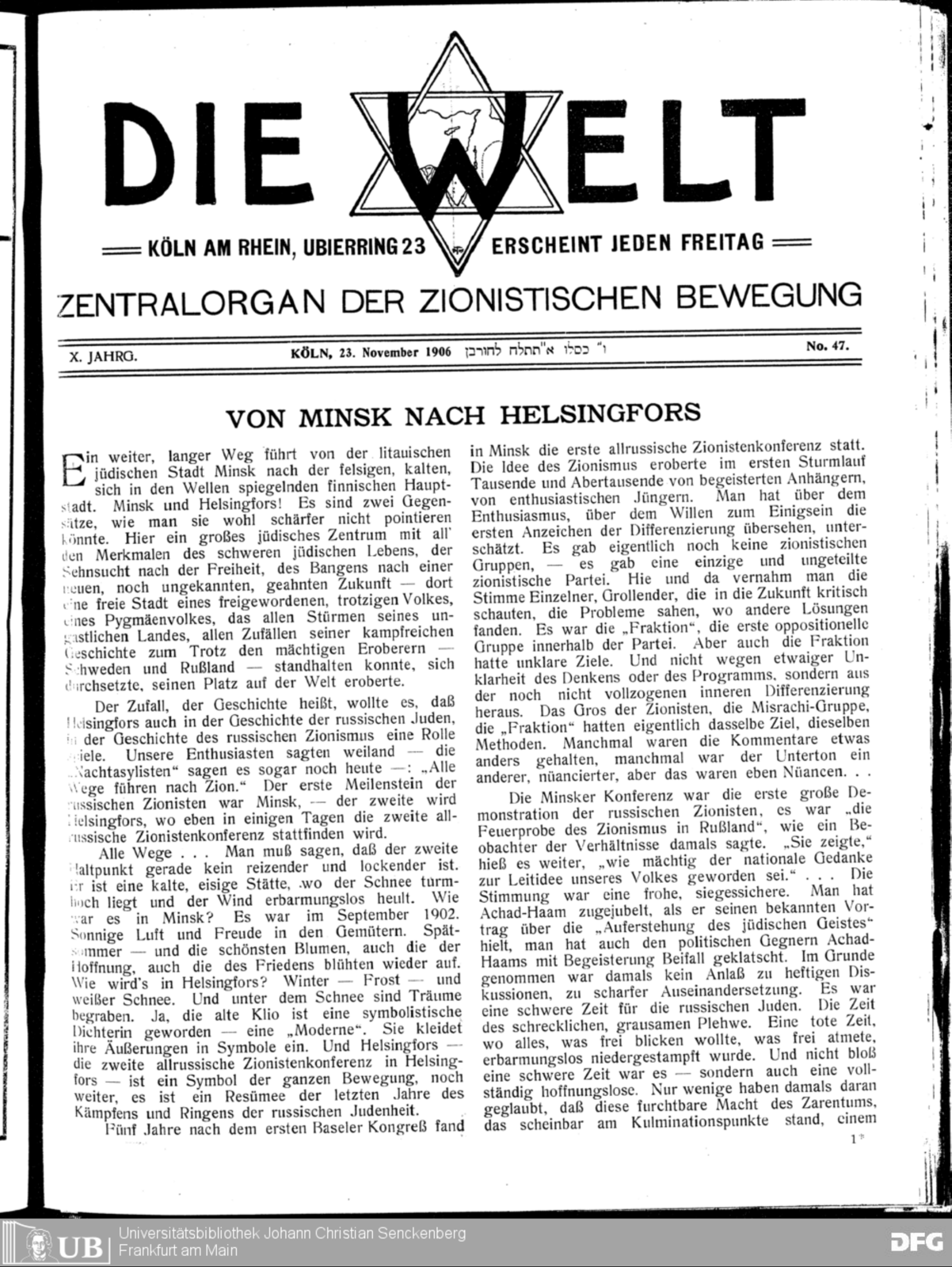
DIE WELT
== COLOGNE ON THE RHINE, UBIERRING 23 —— APPEARS EVERY FRIDAY ==
CENTRAL ORGAN OF THE ZIONIST MOVEMENT
YEAR X. COLOGNE, 23 November 1906 ו" כסלו א"תתלח לחורבן No. 47.
FROM MINSK TO HELSINGFORS
A long, far road leads from the Lithuanian Jewish town of Minsk to the rocky, cold Finnish capital that mirrors itself in the waves. Minsk and Helsingfors! They are two opposites that could hardly be pointed more sharply. Here, a great Jewish centre with all the marks of the hard Jewish life, of the yearning for freedom, of the anxious longing for a new, still unknown, dimly divined future — there, a free city of a people grown free, a defiant people, a pygmy people which, in spite of all the storms of its inhospitable land and all the chances of its embattled history, was able to stand firm against its mighty conquerors — Sweden and Russia — held its own, and won its place in the world.
The chance that is called history willed that Helsingfors should also play a part in the history of the Russian Jews, in the history of Russian Zionism. Our enthusiasts used to say of old — the "Night-Asylum" men say it even today —: "All roads lead to Zion." The first milestone of the Russian Zionists was Minsk — the second will be Helsingfors, where in a few days the second All-Russian Zionist Conference is to take place.
All roads . . . It must be said that the second halting-place is not exactly a charming or an inviting one. It is a cold, icy spot, where the snow lies tower-high and the wind howls without mercy. How was it in Minsk? It was in September 1902. Sunny air and joy in men's hearts. Late summer — and the loveliest flowers, those of hope too, those of peace too, were blooming once more. How will it be in Helsingfors? Winter — frost — and white snow. And beneath the snow dreams lie buried. Yes, old Clio has become a symbolist poetess — a "Modern." She clothes her utterances in symbols. And Helsingfors — the second All-Russian Zionist Conference in Helsingfors — is a symbol of the whole movement; more than that, it is a summing-up of the last years of fighting and struggling of the Russian Jews.
Five years after the first Basle Congress the first All-Russian Zionist Conference took place in Minsk. In its first onrush the idea of Zionism conquered thousands upon thousands of ardent adherents, of enthusiastic disciples. Amid the enthusiasm, amid the will to be united, the first signs of differentiation were overlooked, underestimated. There were, properly speaking, no Zionist groups as yet — there was one single and undivided Zionist party. Here and there one heard the voice of individuals, of grumblers, who looked critically into the future, who saw problems where others found solutions. This was the "Fraction," the first oppositional group within the party. But the Fraction too had unclear aims. And not because of any unclearness of thought or of programme, but because the inner differentiation had not yet been accomplished. The bulk of the Zionists, the Misrachi group, the "Fraction" had in truth the same aim, the same methods. Sometimes the commentaries were couched somewhat differently, sometimes the undertone was another, more nuanced one; but these were just nuances. . .
The Minsk Conference was the first great demonstration of the Russian Zionists; it was "the ordeal by fire of Zionism in Russia," as an observer of affairs said at the time. "It showed," he went on, "how mightily the national idea had become the guiding idea of our people." . . . The mood was a glad one, confident of victory. Achad-Haam was acclaimed when he delivered his well-known address on the "Resurrection of the Jewish Spirit"; the political opponents of Achad-Haam were applauded with enthusiasm too. At bottom there was then no occasion for heated discussions, for sharp disputes. It was a hard time for the Russian Jews. The time of the terrible, cruel Plehwe. A dead time, when everything that sought to look about it freely, that breathed freely, was mercilessly trampled down. And it was not merely a hard time — it was also an utterly hopeless one. Few believed then that this fearful power of Tsardom, which seemed to stand at its culminating point, to a
1*