No. 46 — "Die Welt" — 11
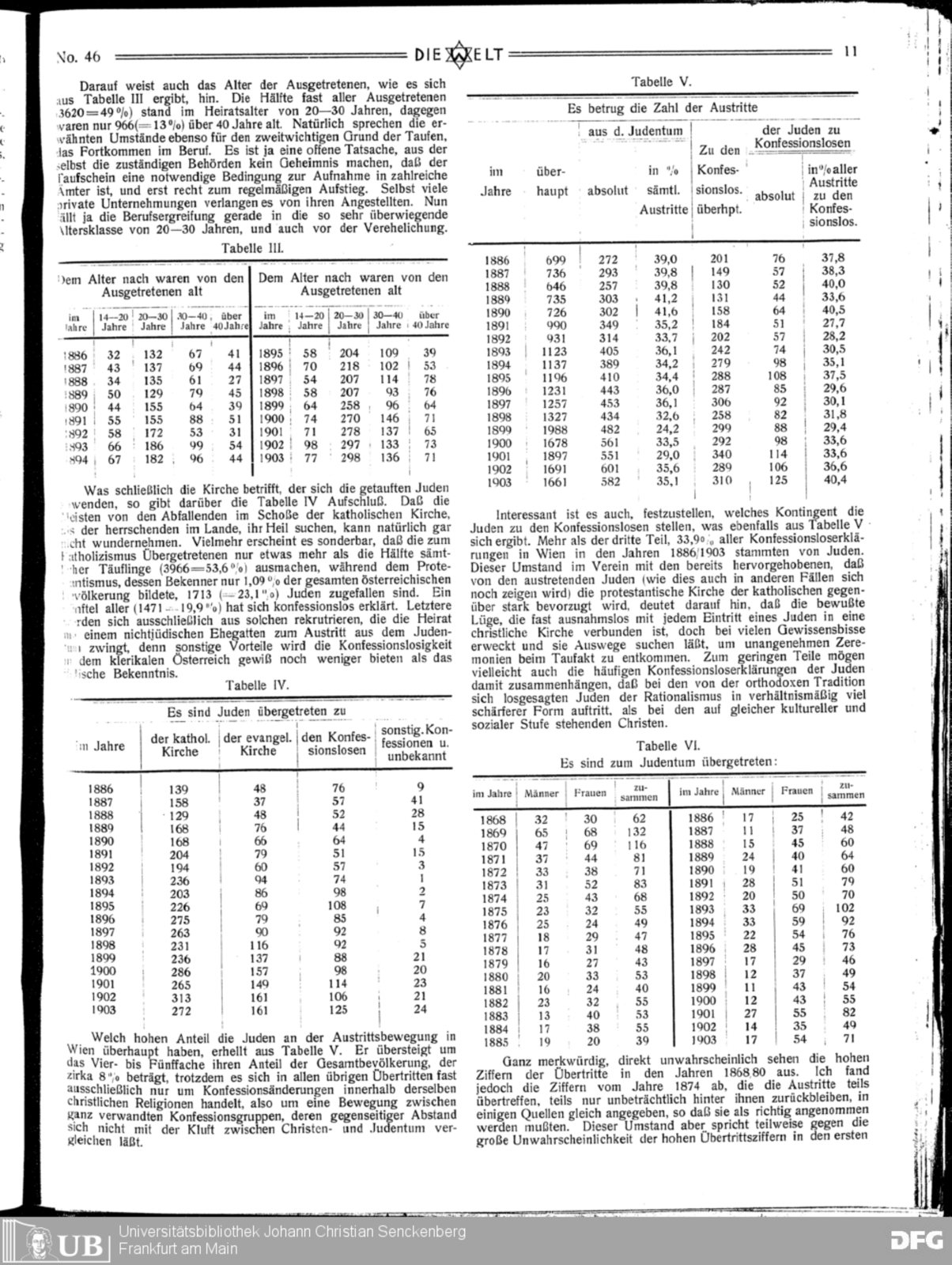
The age of those who left, as shown in Table III, points the same way. Almost half of all who left (3620 = 49%) were of the marrying age of 20—30 years, whereas only 966 (= 13%) were over 40 years old. Naturally, the circumstances mentioned speak equally for the second most important ground for baptism, advancement in one's profession. It is, after all, an open fact, of which even the competent authorities make no secret, that the baptismal certificate is a necessary condition for admission to numerous public offices, and all the more so for regular promotion. Even many private undertakings demand it of their employees. Now the choice of a profession falls precisely within the greatly predominant age-class of 20—30 years, and also before marriage.
Table III.
| By age, those who left were | By age, those who left were |
|---|---|
| in the year | 14—20 years |
| 1886 | 32 |
| 1887 | 43 |
| 1888 | 34 |
| 1889 | 50 |
| 1890 | 44 |
| 1891 | 55 |
| 1892 | 58 |
| 1893 | 66 |
| 1894 | 67 |
As to the church, finally, to which the baptized Jews turn, Table IV gives information. That most of the apostates seek their salvation in the bosom of the Catholic Church, as the dominant church in the land, can of course be no cause for wonder. It seems rather strange that those who went over to Catholicism make up only somewhat more than half of all the baptized (3966 = 53.6%), while Protestantism, whose adherents formed only 1.09% of the whole Austrian population, has gained 1713 (= 23.1%) Jews. A fifth of all (1471 = 19.9%) declared themselves of no confession. These last will be recruited exclusively from those whom marriage with a non-Jewish spouse compels to leave Judaism, for in clerical Austria the want of any confession will certainly offer other advantages even less than the Christian profession does.
Table IV.
| Jews went over to | |||
|---|---|---|---|
| in the year | the Catholic Church | the Protestant Church | the non-denominational |
| 1886 | 139 | 48 | 76 |
| 1887 | 158 | 37 | 57 |
| 1888 | 129 | 48 | 52 |
| 1889 | 168 | 76 | 44 |
| 1890 | 168 | 66 | 64 |
| 1891 | 204 | 79 | 51 |
| 1892 | 194 | 60 | 57 |
| 1893 | 236 | 94 | 74 |
| 1894 | 203 | 86 | 98 |
| 1895 | 226 | 69 | 108 |
| 1896 | 275 | 79 | 85 |
| 1897 | 263 | 90 | 92 |
| 1898 | 231 | 116 | 92 |
| 1899 | 236 | 137 | 88 |
| 1900 | 286 | 157 | 98 |
| 1901 | 265 | 149 | 114 |
| 1902 | 313 | 161 | 106 |
| 1903 | 272 | 161 | 125 |
How large a share the Jews have in the movement of secession in Vienna generally is made clear by Table V. It exceeds by four to five times their share of the total population, which amounts to about 8%, although all the other changes of faith are almost exclusively changes of confession within the same Christian religions, that is, a movement between quite kindred confessional groups, whose distance from one another cannot be compared with the gulf between Christianity and Judaism.
Table V.
| The number of secessions was | |||||
|---|---|---|---|---|---|
| from Judaism | To the non-denominational | of Jews to the non-denominational | |||
| in the year | in all | absolute | in % of all secessions | absolute | in % of all secessions to the non-denomin. |
| 1886 | 699 | 272 | 39.0 | 201 | 76 |
| 1887 | 736 | 293 | 39.8 | 149 | 57 |
| 1888 | 646 | 257 | 39.8 | 130 | 52 |
| 1889 | 735 | 303 | 41.2 | 131 | 44 |
| 1890 | 726 | 302 | 41.6 | 158 | 64 |
| 1891 | 990 | 349 | 35.2 | 184 | 51 |
| 1892 | 931 | 314 | 33.7 | 202 | 57 |
| 1893 | 1123 | 405 | 36.1 | 242 | 74 |
| 1894 | 1137 | 389 | 34.2 | 279 | 98 |
| 1895 | 1196 | 410 | 34.4 | 288 | 108 |
| 1896 | 1231 | 443 | 36.0 | 287 | 85 |
| 1897 | 1257 | 453 | 36.1 | 306 | 92 |
| 1898 | 1327 | 434 | 32.6 | 258 | 82 |
| 1899 | 1988 | 482 | 24.2 | 299 | 88 |
| 1900 | 1678 | 561 | 33.5 | 292 | 98 |
| 1901 | 1897 | 551 | 29.0 | 340 | 114 |
| 1902 | 1691 | 601 | 35.6 | 289 | 106 |
| 1903 | 1661 | 582 | 35.1 | 310 | 125 |
It is interesting also to establish what contingent the Jews furnish to the non-denominational, which likewise appears from Table V. More than a third, 33.90%, of all declarations of no confession in Vienna in the years 1886/1903 came from Jews. This circumstance, together with the one already pointed out, that the Jews who leave (as will appear in other cases too) strongly prefer the Protestant Church to the Catholic, indicates that the conscious lie which is bound up, almost without exception, with every entry of a Jew into a Christian church does after all awaken pangs of conscience in many, and makes them seek ways out, so as to escape disagreeable ceremonies at the act of baptism. In small part, perhaps, the frequent declarations of no confession among Jews may also be connected with the fact that among Jews who have broken away from the orthodox tradition rationalism appears in a relatively far sharper form than among Christians standing on the same cultural and social level.
Table VI.
There went over to Judaism:
| in the year | men | women | together | in the year | men | women | together |
|---|---|---|---|---|---|---|---|
| 1868 | 32 | 30 | 62 | 1886 | 17 | 25 | 42 |
| 1869 | 65 | 68 | 132 | 1887 | 11 | 37 | 48 |
| 1870 | 47 | 69 | 116 | 1888 | 15 | 45 | 60 |
| 1871 | 37 | 44 | 81 | 1889 | 24 | 40 | 64 |
| 1872 | 33 | 38 | 71 | 1890 | 19 | 41 | 60 |
| 1873 | 31 | 52 | 83 | 1891 | 28 | 51 | 79 |
| 1874 | 25 | 43 | 68 | 1892 | 20 | 50 | 70 |
| 1875 | 23 | 32 | 55 | 1893 | 33 | 69 | 102 |
| 1876 | 25 | 24 | 49 | 1894 | 33 | 59 | 92 |
| 1877 | 18 | 29 | 47 | 1895 | 22 | 54 | 76 |
| 1878 | 17 | 31 | 48 | 1896 | 28 | 45 | 73 |
| 1879 | 16 | 27 | 43 | 1897 | 17 | 29 | 46 |
| 1880 | 20 | 33 | 53 | 1898 | 12 | 37 | 49 |
| 1881 | 16 | 24 | 40 | 1899 | 11 | 43 | 54 |
| 1882 | 23 | 32 | 55 | 1900 | 12 | 43 | 55 |
| 1883 | 13 | 40 | 53 | 1901 | 27 | 55 | 82 |
| 1884 | 17 | 38 | 55 | 1902 | 14 | 35 | 49 |
| 1885 | 19 | 20 | 39 | 1903 | 17 | 54 | 71 |
Quite remarkable, downright improbable, look the high figures of conversions in the years 1868/80. I found, however, the figures from the year 1874 onward, which partly exceed the secessions and partly fall only inconsiderably short of them, given identically in several sources, so that they had to be accepted as correct. This circumstance, however, speaks in part against the great improbability of the high conversion figures in the first