"Die Welt" — Page 10. — No. 40.
(continued from page 9)
…can become a power. Might goes before right! And if we are to speak with Lassalle: "The whole art of practical success consists in concentrating all one's force at every moment upon one point, the most important point" ... That must also be the principle of Zionist work. (Lively applause.) Despite the lateness of the hour Herr Witebsky was permitted to reply. The speaker turned chiefly against the last part of Kaplansky's remarks. Thereupon the resolution of the programme committee was put to the vote; it reads:
The Party Congress accepts the draft programme as a basis for discussion in the party.
In view of the fact that the programme debate opened at the Party Congress could not be exhausted, the Party Congress submits the draft of Comrade Kaplansky-Kaplan to free discussion in party meetings and in the party press.—The resolution was adopted.
A vote is taken only on the name of the party. The proposal of the rapporteur is adopted unanimously. To the party leadership were elected: 5 gentlemen from Cracow, who form the party executive—L. Schußheim, chairman, Dr. Margulies, J. Nußbaum, Heilpern, Meller—and 6 members from outside—N. Groß (Vienna), Herz (Lemberg), Drimmer (Stanislau), Kin (Tarnopol), Rosenfeld (Drohobycz), Schechner (Czernowitz). The Party Congress came to its close with a series of fine speeches, one of which was delivered in Hebrew. The warmly felt speeches of farewell unleashed a storm of enthusiasm, and in this mood the Party Congress was closed on Saturday, the 13th of October, at 4 o'clock in the night.
BAPTISM AND MIXED MARRIAGES IN AUSTRIA AND GERMANY
By Dr. JAKOB THON, BERLIN
I.
The Baptismal Movement
Concerning the baptismal plague of the last decades, to which all the parties of Jewry quite naturally devote the greatest interest as the most dreaded danger to our continued existence, relatively few reliable and exhaustive data have hitherto reached the public. Unfortunately figures on withdrawals from Judaism are not available in all cases, and the completely exact drawing-up of our account of losses and gains is therefore impossible. It is therefore important, for two countries with so considerable a Jewish population, and with dangers of "submerging" already very greatly increased in consequence of their advanced civil equality and culture, to summarise the chief data of the baptismal movement, so as to gain a reliable basis for measuring the devastating effects of the whole phenomenon.
For Austria the most important source is the "Austrian Municipal Year-Book," a collection of statistical reports of Austrian towns, appearing since 1887 under the direction of the Imperial-Royal Central Statistical Commission in Vienna. On the basis of the Year-Book, as well as of the statistical communications of individual towns published separately, the baptismal movement can be traced back in many places to the year 1868. For in that year the Austrian fundamental laws of the State appeared, in particular the law on religious freedom of 25 May 1868, which here concerns us, according to which "everyone, without distinction of sex, upon completing his fourteenth year, has free choice of religious confession according to his own conviction, and is, if necessary, to be protected by the authorities in this free choice." "In order, however, that withdrawal from a Church or religious community may have its legal effect, the person withdrawing must report it to the political authority, which transmits the notification to the head or pastor of the Church or religious community abandoned. Entry into the newly chosen Church etc. must be declared by the person entering personally to the head or pastor concerned." "In the event of a change of religion by one or both parents, or by the unmarried mother, the existing children who have not yet completed their seventh year are, in respect of religious confession, to be treated, without regard to any contract concluded before the parents' change of religion, as if they had been born only after the parents' change of religion." Thus the withdrawal of children under 7 years takes place ipso jure together with the change of confession of the parents, and need not be reported separately to the political authority. The confession of children between the 7th and the 14th year of life cannot be changed.
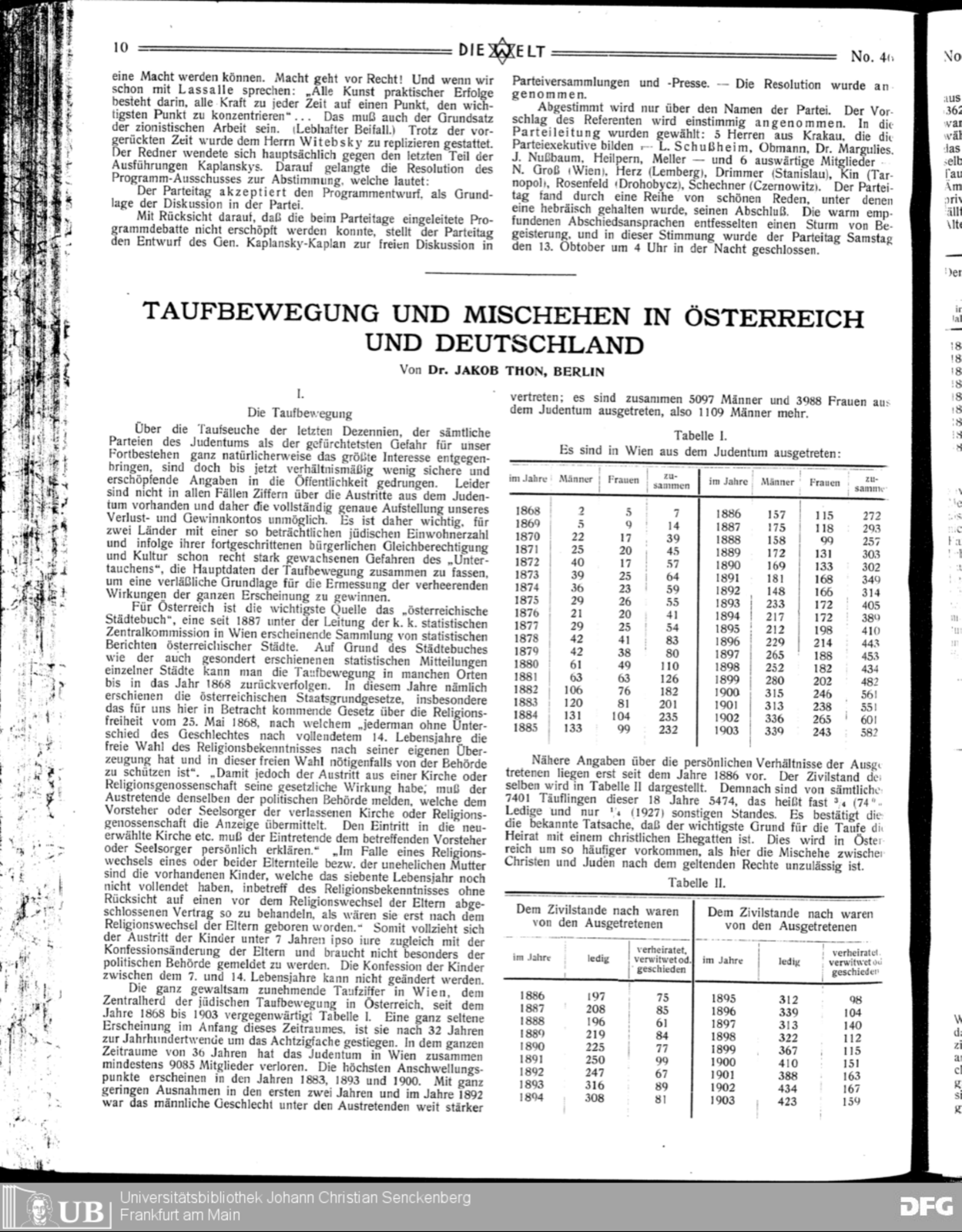
The quite violently increasing figure of baptisms in Vienna, the central hearth of the Jewish baptismal movement in Austria, from the year 1868 to 1903, is shown in Table I. A quite rare phenomenon at the beginning of this period, after 32 years, at the turn of the century, it has risen eightyfold. In the whole period of 36 years Jewry in Vienna has lost altogether at least 9085 members. The highest points of swelling appear in the years 1883, 1893 and 1900. With quite slight exceptions in the first two years and in the year 1892, the male sex was far more strongly represented among those withdrawing; altogether 5097 men and 3988 women withdrew from Judaism, thus 1109 more men.
Table I.
There withdrew from Judaism in Vienna:
| in the year | men | women | together | in the year | men | women | together |
|---|---|---|---|---|---|---|---|
| 1868 | 2 | 5 | 7 | 1886 | 157 | 115 | 272 |
| 1869 | 5 | 9 | 14 | 1887 | 175 | 118 | 293 |
| 1870 | 22 | 17 | 39 | 1888 | 158 | 99 | 257 |
| 1871 | 25 | 20 | 45 | 1889 | 172 | 131 | 303 |
| 1872 | 40 | 17 | 57 | 1890 | 169 | 133 | 302 |
| 1873 | 39 | 25 | 64 | 1891 | 181 | 168 | 349 |
| 1874 | 36 | 23 | 59 | 1892 | 148 | 166 | 314 |
| 1875 | 29 | 26 | 55 | 1893 | 233 | 172 | 405 |
| 1876 | 21 | 20 | 41 | 1894 | 217 | 172 | 389 |
| 1877 | 29 | 25 | 54 | 1895 | 212 | 198 | 410 |
| 1878 | 42 | 41 | 83 | 1896 | 229 | 214 | 443 |
| 1879 | 42 | 38 | 80 | 1897 | 265 | 188 | 453 |
| 1880 | 61 | 49 | 110 | 1898 | 252 | 182 | 434 |
| 1881 | 63 | 63 | 126 | 1899 | 280 | 202 | 482 |
| 1882 | 106 | 76 | 182 | 1900 | 315 | 246 | 561 |
| 1883 | 120 | 81 | 201 | 1901 | 313 | 238 | 551 |
| 1884 | 131 | 104 | 235 | 1902 | 336 | 265 | 601 |
| 1885 | 133 | 99 | 232 | 1903 | 339 | 243 | 582 |
Fuller particulars on the personal circumstances of those who withdrew are available only from the year 1886. Their civil status is shown in Table II. Accordingly, of all the 7401 baptised persons of these 18 years, 5474, that is almost 3/4 (74%), were single, and only 1/4 (1927) of other status. This confirms the well-known fact that the most important reason for baptism is marriage with a Christian spouse. This will occur all the more frequently in Austria because here mixed marriage between Christians and Jews is inadmissible under the law in force.
Table II.
| By civil status, of those who withdrew there were | By civil status, of those who withdrew there were |
|---|---|
| in the year | single | married, widowed or divorced |
|---|---|---|
| 1886 | 197 | 75 |
| 1887 | 208 | 85 |
| 1888 | 196 | 61 |
| 1889 | 219 | 84 |
| 1890 | 225 | 77 |
| 1891 | 250 | 99 |
| 1892 | 247 | 67 |
| 1893 | 316 | 89 |
| 1894 | 308 | 81 |
|
| in the year | single | married, widowed or divorced |
|---|---|---|
| 1895 | 312 | 98 |
| 1896 | 339 | 104 |
| 1897 | 313 | 140 |
| 1898 | 322 | 112 |
| 1899 | 367 | 115 |
| 1900 | 410 | 151 |
| 1901 | 388 | 163 |
| 1902 | 434 | 167 |
| 1903 | 423 | 159 |
|