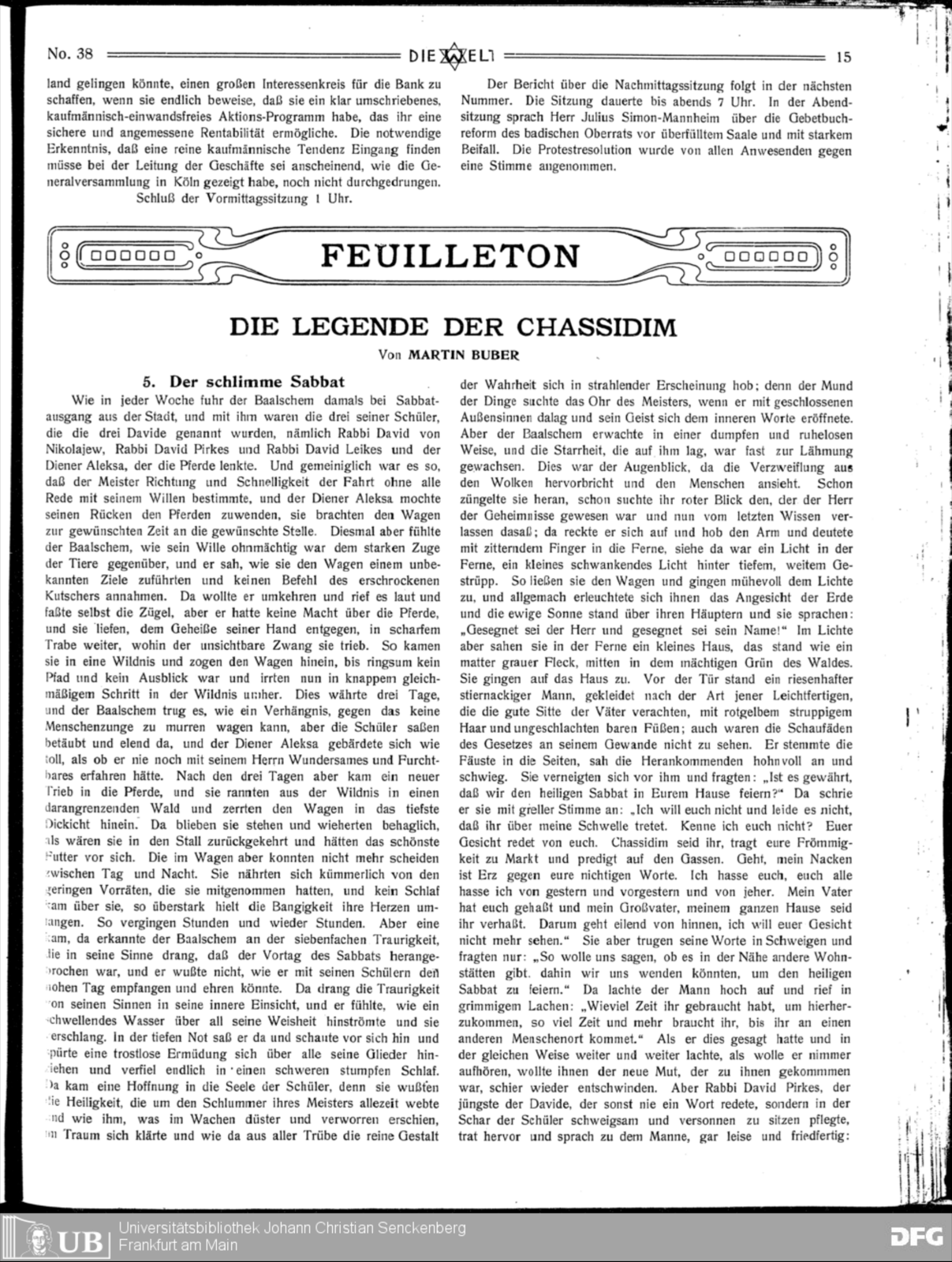
No. 38 — "Die Welt" — 15
(continued from page 14)
…many it might prove possible to create a wide circle of interest for the Bank, if it would at last prove that it had a clearly defined, commercially unimpeachable programme of action, one that would assure it a secure and adequate return. The necessary recognition that a purely commercial tendency must find entry into the management of its affairs had apparently, as the General Meeting at Cologne had shown, not yet made its way.
Close of the morning session, 1 o'clock.
The report of the afternoon session will follow in the next number. The session lasted until 7 o'clock in the evening. At the evening session Mr. Julius Simon-Mannheim spoke on the prayer-book reform of the Baden Supreme Council before an overcrowded hall and to loud applause. The resolution of protest was adopted by all present against one vote.
FEUILLETON
THE LEGEND OF THE CHASSIDIM
By MARTIN BUBER
5. The Evil Sabbath
As in every week, the Baalschem at that time drove out of the town at the going-out of the Sabbath, and with him were the three of his disciples who were called the three Davids, namely Rabbi David of Nikolajew, Rabbi David Pirkes and Rabbi David Leikes, and the servant Aleksa, who drove the horses. And commonly it was so, that the Master determined the direction and the speed of the journey by his will alone, without any word, and the servant Aleksa might turn his back upon the horses: they brought the carriage at the desired time to the desired place. This time, however, the Baalschem felt how his will was powerless against the strong pull of the beasts, and he saw how they were bearing the carriage toward an unknown goal and would heed no command of the frightened coachman. Then he wished to turn back, and cried it aloud, and himself seized the reins; but he had no power over the horses, and they ran on at a sharp trot, against the bidding of his hand, whither the invisible compulsion drove them. So they came into a wilderness and drew the carriage into it, until round about there was no path and no prospect, and now they wandered about in the wilderness at a short, even pace. This lasted three days, and the Baalschem bore it as a doom against which no human tongue may dare to murmur; but the disciples sat there stunned and wretched, and the servant Aleksa behaved as one distracted, as though he had never yet experienced things wondrous and terrible with his master. After the three days, however, a new impulse came into the horses, and they raced out of the wilderness into a forest that bordered upon it and dragged the carriage into the deepest thicket. There they stood still and whinnied contentedly, as though they had returned to the stable and had the finest fodder before them. But those in the carriage could no longer tell day from night. They nourished themselves meagrely from the scanty provisions they had brought with them, and no sleep came upon them, so overpoweringly did dread hold their hearts in its embrace. So hours passed, and again hours. But there came a time when the Baalschem knew, by the sevenfold sadness that pressed into his senses, that the eve of the Sabbath had dawned, and he knew not how he might receive and honour the high day with his disciples. Then the sadness pressed from his senses into his inward insight, and he felt how a swelling water streamed over all his wisdom and swallowed it up. In this deep distress he sat and gazed before him, and felt a comfortless weariness spreading through all his limbs, and fell at last into a heavy, dull sleep. Then a hope came into the souls of the disciples, for they knew the holiness that ever wove about the slumber of their Master, and how what seemed dark and confused to him in waking grew clear to him in dream, and how then out of all turbidity the pure form of Truth arose in radiant appearance; for the mouth of things sought the ear of the Master when he lay with his outward senses closed and his spirit opened itself to the inner Word. But the Baalschem awoke in a dull and restless manner, and the rigidity that lay upon him had grown almost to paralysis. This was the moment when despair breaks forth from the clouds and looks upon man. Already it came licking near, already its red gaze sought him who had been the lord of mysteries and now sat forsaken by the last knowledge; then he drew himself up and raised his arm and pointed with trembling finger into the distance, and behold, there was a light in the distance, a small wavering light behind deep, wide undergrowth. So they left the carriage and went laboriously toward the light, and little by little the face of the earth grew bright before them, and the eternal sun stood above their heads, and they said: "Blessed be the Lord and blessed be His Name!" In the light, however, they saw in the distance a small house, which stood like a dull grey spot in the midst of the mighty green of the forest. They went toward the house. Before the door stood a gigantic, bull-necked man, clad after the manner of those frivolous ones who despise the good custom of the fathers, with shaggy red-yellow hair and uncouth bare feet; nor were the fringes of the Law to be seen upon his garment. He set his fists upon his hips, looked scornfully at those approaching, and was silent. They bowed before him and asked: "Is it granted us to keep the holy Sabbath in your house?" Then he shouted at them in a shrill voice: "I want none of you, and I will not suffer you to cross my threshold. Do I not know you? Your faces speak of you. Chassidim you are; you carry your piety to market and preach in the streets. Go; my neck is brass against your empty words. I hate you, all of you I hate, from yesterday and the day before and from of old. My father hated you, and my grandfather; to my whole house you are hateful. Therefore go hence in haste; I will see your faces no more." But they bore his words in silence and asked only: "Then be pleased to tell us whether there are other dwellings near by, whither we might turn to keep the holy Sabbath." Then the man laughed aloud and cried in grim laughter: "As much time as you needed to come hither, so much time and more will you need before you come to another place of men." When he had said this, and went on laughing in the same way, on and on, as though he would never cease, the new courage that had come to them was well-nigh about to vanish again. But Rabbi David Pirkes, the youngest of the Davids, who otherwise never spoke a word, but was wont to sit silent and lost in thought among the band of disciples, stepped forth and spoke to the man, very softly and peaceably: