DIE WELT
CENTRAL ORGAN OF THE ZIONIST MOVEMENT
COLOGNE (GERMANY), UBIERRING 23
— PUBLISHED EVERY FRIDAY —
EDITORS: BERTHOLD FEIWEL, A. CORALNIK
Year X. | Cologne, Passover 1906 פסה א' התלו לחורבן | No. 15.
LESCHONOH HABOHO
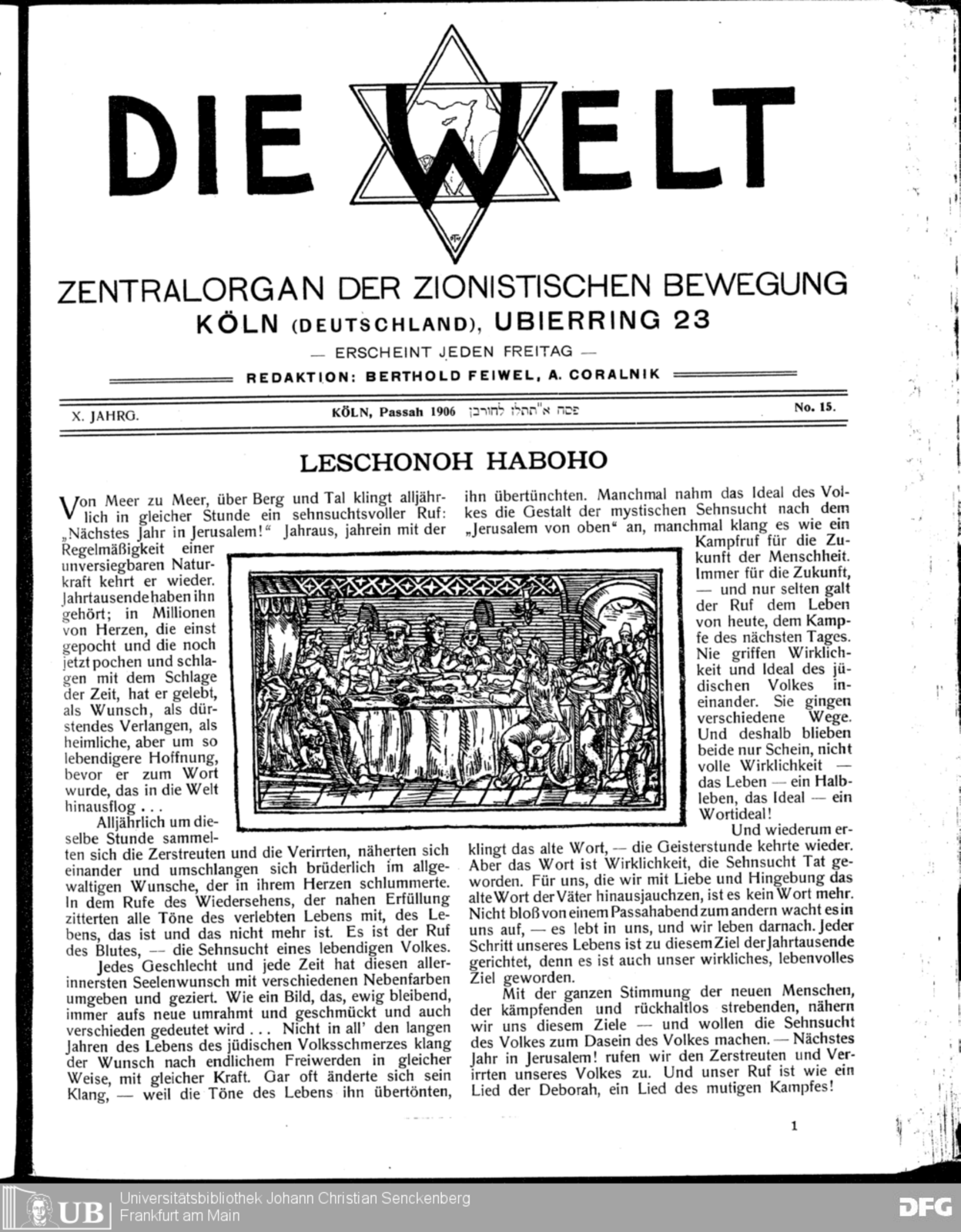
From sea to sea, over mountain and valley, there rings out every year at the same hour a cry full of longing: "Next year in Jerusalem!" Year in, year out, with the regularity of an inexhaustible force of nature, it returns. Millennia have heard it; in millions of hearts that once beat, and that still beat and throb with the beat of the time, it has lived, as a wish, as a thirsting desire, as a secret but all the more living hope, before it became the word that flew out into the world . . .
Every year at the same hour the dispersed and the strayed gathered, drew near to one another and embraced like brothers in the all-powerful wish that slumbered in their hearts. In the cry of reunion, of near fulfilment, there trembled all the tones of the life that had been lived, of the life that is and that is no more. It is the call of the blood, — the longing of a living people.
Every generation and every age has surrounded and adorned this innermost wish of the soul with different secondary colours. Like a picture which, remaining for ever, is framed and decked ever anew and also interpreted in different ways . . . Not in all the long years of the life of the Jewish people's sorrow did the wish for final liberation sound in the same manner, with the same force. Very often its sound changed, — because the tones of life drowned it, painted it over. Sometimes the ideal of the people took the form of the mystical longing for the "Jerusalem on high"; sometimes it sounded like a battle-cry for the future of mankind. Always for the future, — and only seldom was the cry meant for the life of to-day, for the struggle of the next day. Never did the reality and the ideal of the Jewish people interlock. They went different ways. And therefore both remained mere semblance, not full reality — the life a half-life, the ideal an ideal of words!
And once again the old word rings out, — the hour of spirits has returned. But the word has become reality, the longing has become deed. For us, who with love and devotion shout forth the old word of our fathers, it is no longer a word. It does not merely awaken in us from one Passover eve to the next, — it lives in us, and we live by it. Every step of our life is directed towards this goal of the millennia, for it has become our own real, living goal as well.
With the whole temper of the new men, those who fight and strive without reserve, we approach this goal — and mean to make the longing of the people into the existence of the people. — Next year in Jerusalem! we cry to the dispersed and strayed of our people. And our cry is like a song of Deborah, a song of courageous struggle!
1