No. 4 — "Die Welt" — 19
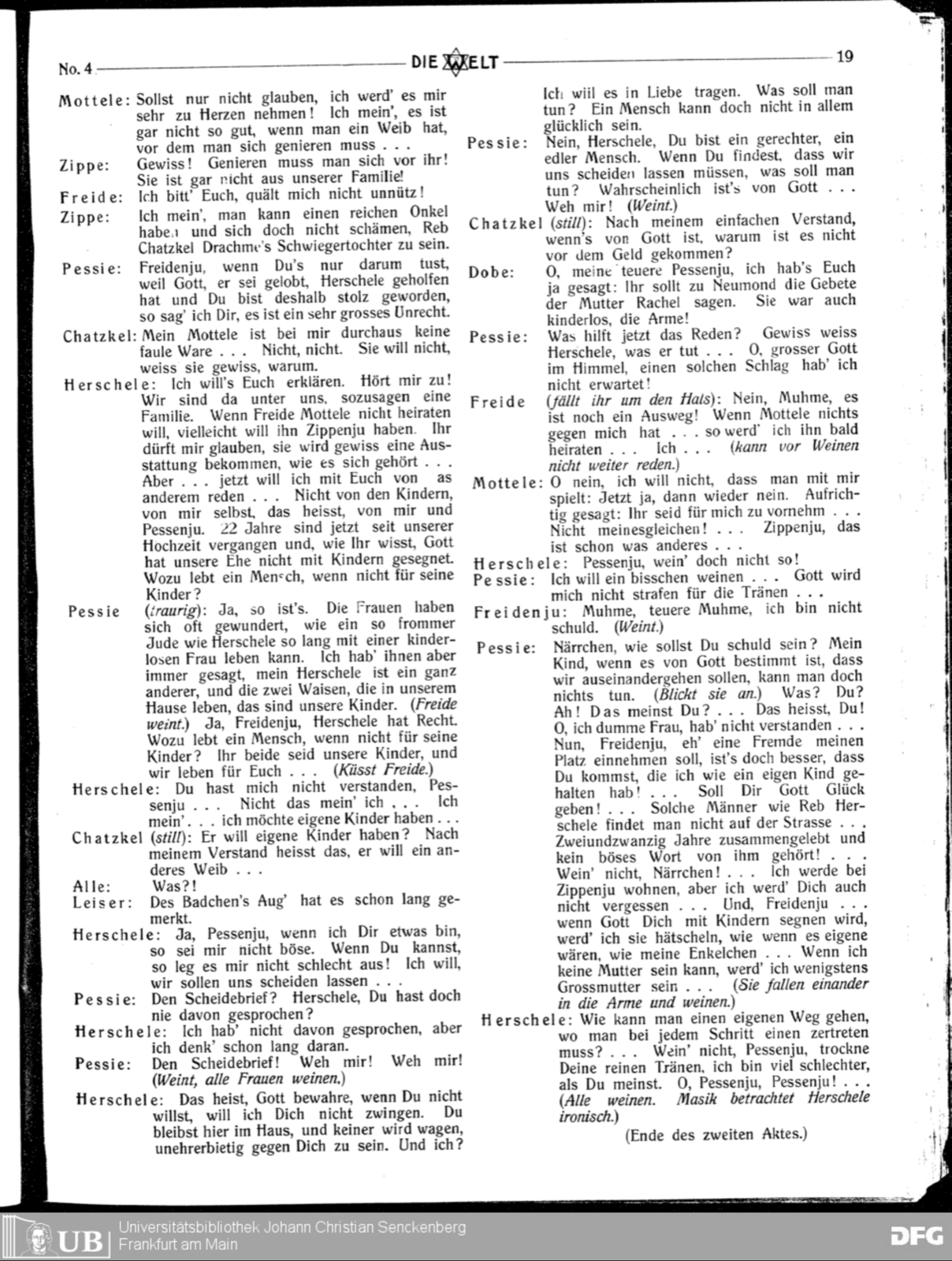
Mottele: Only don't you think I shall take it very much to heart! I mean, it's not so good at all to have a wife before whom one must feel ashamed . . . Zippe: Of course! One has to feel ashamed before her! She's not of our family at all! Freide: I beg you, do not torment me for nothing! Zippe: I mean, one can have a rich uncle and still not be ashamed to be Reb Chatzkel Drachme's daughter-in-law. Pessie: Freidenju, if you do it only because God, praised be He, has helped Herschele, and you have grown proud on that account, then I tell you it is a very great wrong. Chatzkel: My Mottele is by no means spoiled goods to me . . . No, no. She does not want to, she surely knows why. Herschele: I will explain it to you. Listen to me! We are among ourselves here, one family, so to speak. If Freide does not want to marry Mottele, perhaps Zippenju will have him. You may believe me, she will certainly receive a dowry as is fitting . . . But . . . now I want to speak with you of something else . . . Not of the children, of myself, that is, of me and Pessenju. Twenty-two years have now passed since our wedding and, as you know, God has not blessed our marriage with children. What does a man live for, if not for his children? Pessie (sadly): Yes, so it is. The women have often wondered how so pious a Jew as Herschele can live so long with a childless wife. But I have always told them, my Herschele is quite another sort, and the two orphans who live in our house, they are our children. (Freide weeps.) Yes, Freidenju, Herschele is right. What does a man live for, if not for his children? You two are our children, and we live for you . . . (Kisses Freide.) Herschele: You have not understood me, Pessenju . . . That is not what I mean . . . I mean . . . I should like to have children of my own . . . Chatzkel (quietly): He wants children of his own? To my understanding that means he wants another wife . . . All: What?! Leiser: The Badchen's eye noticed it long ago. Herschele: Yes, Pessenju, if I am anything to you, do not be angry with me. If you can, do not think ill of me for it! I want us to be divorced . . . Pessie: The bill of divorce? Herschele, you never spoke of it? Herschele: I did not speak of it, but I have been thinking of it a long while. Pessie: The bill of divorce! Woe is me! Woe is me! (Weeps; all the women weep.) Herschele: That is to say, God forbid, if you do not wish it, I will not force you. You remain here in the house, and no one will dare to be disrespectful to you. And I? I will bear it in love. What is one to do? A man cannot be fortunate in everything. Pessie: No, Herschele, you are a righteous, a noble man. If you find that we must be divorced, what is one to do? Very likely it is from God . . . Woe is me! (Weeps.) Chatzkel (quietly): To my simple understanding, if it is from God, why did it not come before the money? Dobe: Oh, my dear Pessenju, I told you so: you should have said the prayers of Mother Rachel at the New Moon. She too was childless, the poor thing! Pessie: What use is talking now? Surely Herschele knows what he is doing . . . Oh, great God in Heaven, such a blow I did not expect! Freide (falls on her neck): No, Aunt, there is still a way out! If Mottele has nothing against me . . . then I will marry him soon . . . I . . . (cannot go on for weeping.) Mottele: Oh no, I won't be played with: now yes, then no again. To speak frankly: you are too grand for me . . . Not my equal! . . . Zippenju, that's something else again . . . Herschele: Pessenju, do not weep so! Pessie: I want to weep a little . . . God will not punish me for the tears . . . Freidenju: Aunt, dear Aunt, it is not my fault. (Weeps.) Pessie: Little fool, how should it be your fault? My child, if it is ordained by God that we shall part, there is nothing to be done. (Looks at her.) What? You? Ah! That is what you mean? . . . That is, you! Oh, foolish woman that I am, I did not understand . . . Well, Freidenju, rather than a stranger should take my place, it is better after all that you should come, whom I have kept like a child of my own . . . May God give you happiness! . . . Such men as Reb Herschele one does not find in the street . . . Twenty-two years we have lived together and never heard a harsh word from him! . . . Don't weep, little fool! . . . I shall live with Zippenju, but I shall not forget you either . . . And, Freidenju . . . when God blesses you with children, I will pet them as if they were my own, like my little grandchildren . . . If I cannot be a mother, at least I shall be a grandmother . . . (They fall into each other's arms and weep.) Herschele: How can one go one's own way, when at every step one must trample someone underfoot? . . . Don't weep, Pessenju, dry your pure tears; I am much worse than you think. Oh, Pessenju, Pessenju! . . . (All weep. Masik regards Herschele ironically.)
(End of the Second Act.)