Page 6 — "Die ✡ Welt" — Separate Edition No. 6
(continued from page 5)
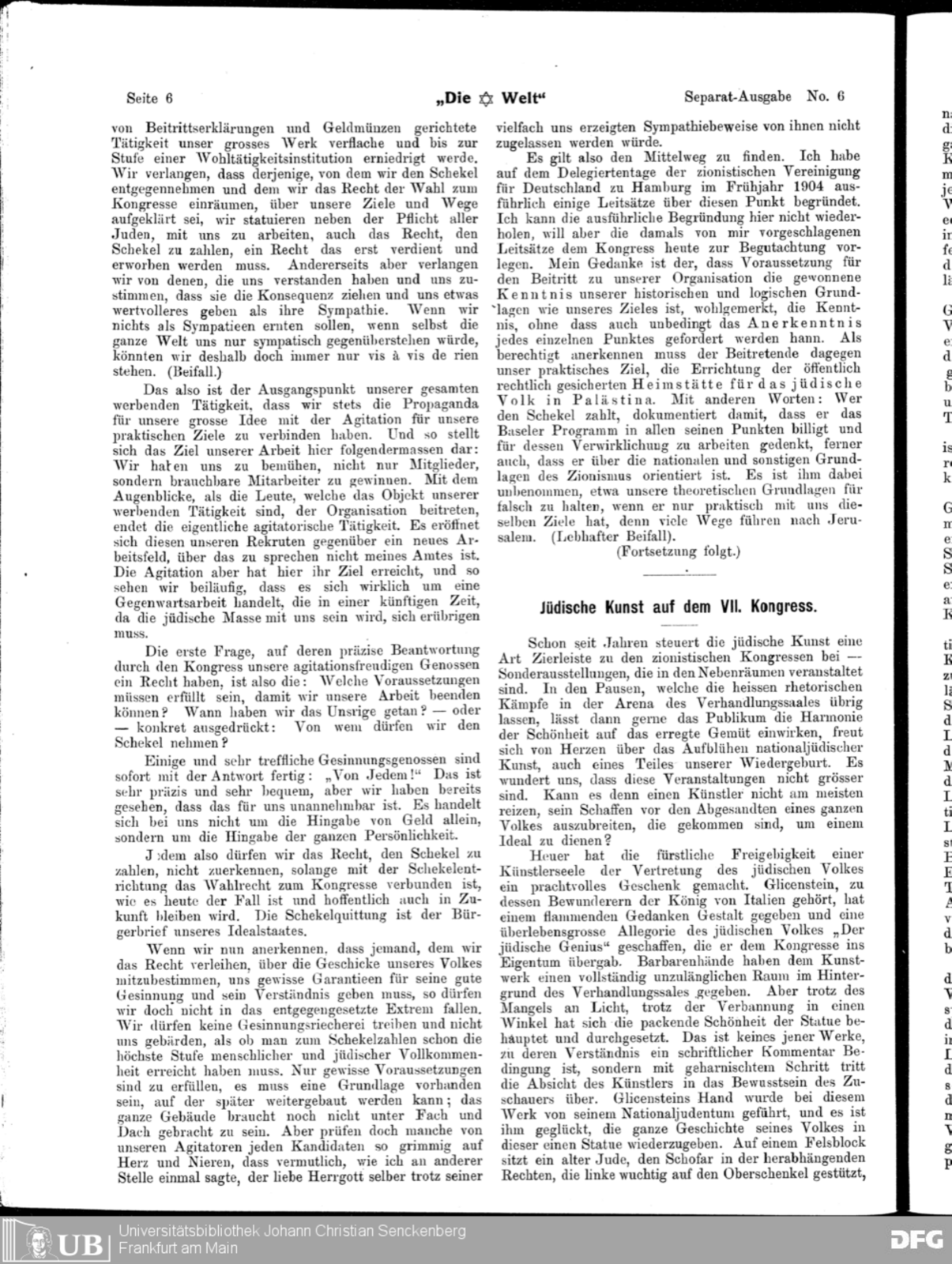
...of declarations of membership and coins directed activity, our great work should be made shallow and degraded to the level of a charitable institution. We demand that he from whom we accept the shekel, and to whom we grant the right of election to the Congress, be enlightened as to our aims and ways; alongside the duty of all Jews to work with us we establish also the right to pay the shekel, a right that must first be earned and acquired. On the other hand, however, we demand of those who have understood us and agree with us that they draw the consequence and give us something more valuable than their sympathy. If we are to reap nothing but sympathies, then even were the whole world to regard us with nothing but sympathy, we should nevertheless always stand only vis à vis de rien. (Applause.)
This, then, is the starting-point of our entire recruiting activity: that we must always combine propaganda for our great idea with agitation for our practical aims. And so the goal of our work here presents itself as follows: We must endeavour to win not merely members but useful fellow-workers. From the moment when the people who are the object of our recruiting activity join the organization, the agitational activity proper comes to an end. With regard to these recruits of ours a new field of work opens, of which it is not my office to speak. Agitation, however, has here reached its goal, and so we see incidentally that this really is a present-day work, one which in a future time, when the Jewish masses are with us, must become superfluous.
The first question, then, to which our comrades eager for agitation have a right to a precise answer from the Congress, is this: What conditions must be fulfilled for us to be able to conclude our work? When have we done our part? — or — expressed concretely: From whom may we take the shekel?
Some fellow Zionists, and very excellent ones, are ready with the answer at once: "From everyone!" That is very precise and very convenient, but we have already seen that it is unacceptable to us. With us it is not a matter of the giving of money alone, but of the giving of the whole personality.
To everyone, then, we may not grant the right to pay the shekel, so long as the right of election to the Congress is bound up with the payment of the shekel, as is the case today and, it is to be hoped, will remain so in future too. The shekel receipt is the certificate of citizenship of our ideal state.
Now if we acknowledge that anyone on whom we confer the right to share in deciding the destinies of our people must give us certain guarantees of his good disposition and his understanding, we must nevertheless not fall into the opposite extreme. We must not go sniffing after people's convictions, nor behave as though one must already have attained the highest degree of human and Jewish perfection in order to pay the shekel. Only certain conditions are to be fulfilled; there must be a foundation on which one can later build further; the whole edifice need not yet be brought under roof. Yet some of our agitators examine every candidate so grimly, heart and reins, that presumably, as I once said elsewhere, the good Lord Himself, despite the many proofs of sympathy He has shown us, would not be admitted by them.
The thing, then, is to find the middle way. At the Delegates' Conference of the Zionist Federation for Germany at Hamburg in the spring of 1904 I set out at length the grounds for certain guiding principles on this point. I cannot repeat the detailed reasoning here, but I will lay before the Congress today, for its judgment, the guiding principles I proposed at that time. My idea is this: that the prerequisite for joining our organization is an acquired knowledge of our historical and logical foundations as well as of our aim — knowledge, mark you, without its being possible to demand unconditional acknowledgment of every single point as well. On the other hand, the one who joins must acknowledge as justified our practical aim, the establishment of a publicly and legally secured home for the Jewish people in Palestine. In other words: whoever pays the shekel thereby attests that he approves the Basle Programme in all its points and intends to work for its realization, and further, that he is informed as to the national and other foundations of Zionism. He remains free, for instance, to hold our theoretical foundations to be false, provided only that in practice he has the same aims as we, for many roads lead to Jerusalem. (Lively applause.)
(To be continued.)
Jewish Art at the Seventh Congress.
For years now Jewish art has contributed a kind of ornamental border to the Zionist Congresses: special exhibitions arranged in the adjoining rooms. In the intervals left by the hot rhetorical battles in the arena of the debating hall, the public is then glad to let the harmony of beauty work upon its agitated mind, and rejoices heartily in the flowering of national-Jewish art, which is also a part of our rebirth. We wonder that these exhibitions are not larger. Can anything tempt an artist more than to spread out his work before the envoys of an entire people, who have come to serve an ideal?
This year the princely generosity of an artist's soul has made a splendid gift to the representation of the Jewish people. Glicenstein, among whose admirers is the King of Italy, has given form to a flaming thought and created a more than life-size allegory of the Jewish people, "The Jewish Genius", which he handed over to the Congress as its property. Barbarian hands have given the work of art a wholly inadequate place at the back of the debating hall. But despite the want of light, despite its banishment to a corner, the gripping beauty of the statue has held its own and prevailed. This is not one of those works whose understanding requires a written commentary as its condition; rather, the artist's intent passes with mailed tread into the consciousness of the beholder. Glicenstein's hand was guided in this work by his national Judaism, and he has succeeded in rendering the whole history of his people in this one statue. On a block of rock sits an old Jew, the shofar in his hanging right hand, the left planted heavily on his thigh,