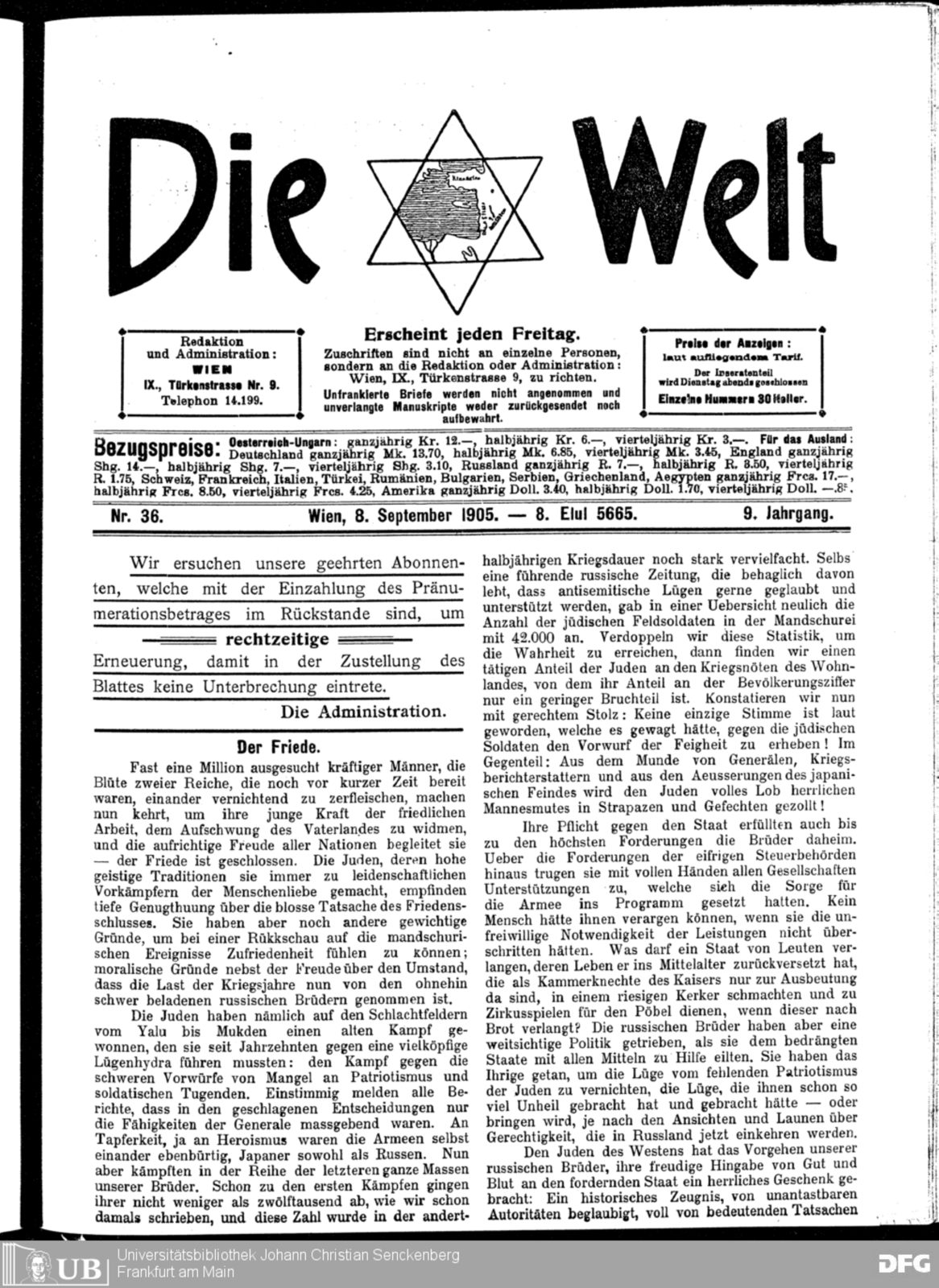
Die Welt
Editorial Office and Administration: VIENNA, IX., Türkenstrasse No. 9. Telephone 14.199.
Published every Friday. Correspondence is to be addressed not to individual persons but to the Editorial Office or the Administration: Vienna, IX., Türkenstrasse 9. Unstamped letters will not be accepted, and unsolicited manuscripts will be neither returned nor kept.
Advertising rates: according to the published tariff. The advertisement section closes on Tuesday evening. Single numbers 30 Heller.
Subscription rates: Austria-Hungary: yearly Kr. 12.—, half-yearly Kr. 6.—, quarterly Kr. 3.—. Abroad: Germany yearly Mk. 13.70, half-yearly Mk. 6.85, quarterly Mk. 3.45; England yearly Shg. 14.—, half-yearly Shg. 7.—, quarterly Shg. 3.10; Russia yearly R. 7.—, half-yearly R. 3.50, quarterly R. 1.75; Switzerland, France, Italy, Turkey, Roumania, Bulgaria, Servia, Greece, Egypt yearly Frcs. 17.—, half-yearly Frcs. 8.50, quarterly Frcs. 4.25; America yearly Doll. 3.40, half-yearly Doll. 1.70, quarterly Doll. —.85.
No. 36. Vienna, 8 September 1905. — 8 Elul 5665. 9th Year.
We request those of our esteemed subscribers who are in arrears with the payment of their subscription to make timely renewal, so that no interruption may occur in the delivery of the paper.
The Administration.
The Peace.
Close upon a million picked and vigorous men, the flower of two empires, who but a short while ago stood ready to tear one another to pieces, now turn homeward to devote their young strength to peaceful labour and to the advancement of the fatherland, and the sincere rejoicing of all nations goes with them — peace has been concluded. The Jews, whose lofty spiritual traditions have ever made them passionate champions of the love of mankind, feel a deep satisfaction at the mere fact of the conclusion of peace. But they have yet other weighty reasons for feeling content as they look back upon the events in Manchuria; moral reasons, besides their joy that the burden of the war years is now lifted from their Russian brethren, already so heavily laden.
For on the battlefields from the Yalu to Mukden the Jews have won an old fight, one which for decades they have been obliged to wage against a many-headed hydra of lies: the fight against the grave reproach of a want of patriotism and of soldierly virtues. All the reports agree that in the decisive battles fought it was the abilities of the generals alone that turned the scale. In bravery, nay, in heroism, the armies themselves were each other's equals, Japanese and Russians alike. Now in the ranks of the latter there fought whole masses of our brethren. To the very first engagements no fewer than twelve thousand of them went out, as we wrote at the time, and in the year and a half that the war lasted this number was greatly multiplied. Even a leading Russian newspaper, which lives comfortably on the readiness with which antisemitic lies are believed and supported, lately gave in a survey the number of Jewish soldiers in the field in Manchuria as 42,000. Let us double this statistic in order to arrive at the truth, and we find an active share of the Jews in the hardships of the war of the land they dwell in, of which their share in the population figure is but a small fraction. Let us then declare with just pride: not a single voice has been raised that dared to bring the reproach of cowardice against the Jewish soldiers! On the contrary: from the mouths of generals and war correspondents, and in the utterances of the Japanese enemy, the Jews are paid full praise for splendid manly courage in hardships and in battle!
Their brethren at home, too, fulfilled their duty towards the State to the utmost of its demands. Beyond the demands of the zealous tax authorities they gave with full hands to all the societies that had made the care of the army a part of their programme. No one could have held it against them had they not gone beyond what the involuntary necessity of these contributions required. What may a State ask of people whose life it has thrust back into the Middle Ages, who as chamber-serfs of the Emperor exist only to be exploited, who languish in a vast prison and serve as circus games for the rabble whenever it cries for bread? Yet our Russian brethren have pursued a far-sighted policy in hastening with every means to the aid of the hard-pressed State. They have done their part to destroy the lie of the Jews' want of patriotism, the lie that has already brought them so much misfortune and would have brought it — or will bring it, according to the views and the whims concerning justice that are now to make their entry into Russia.
To the Jews of the West the conduct of our Russian brethren, their joyful surrender of goods and blood to the demanding State, has brought a splendid gift: a historic testimony, attested by unimpeachable authorities, full of significant facts