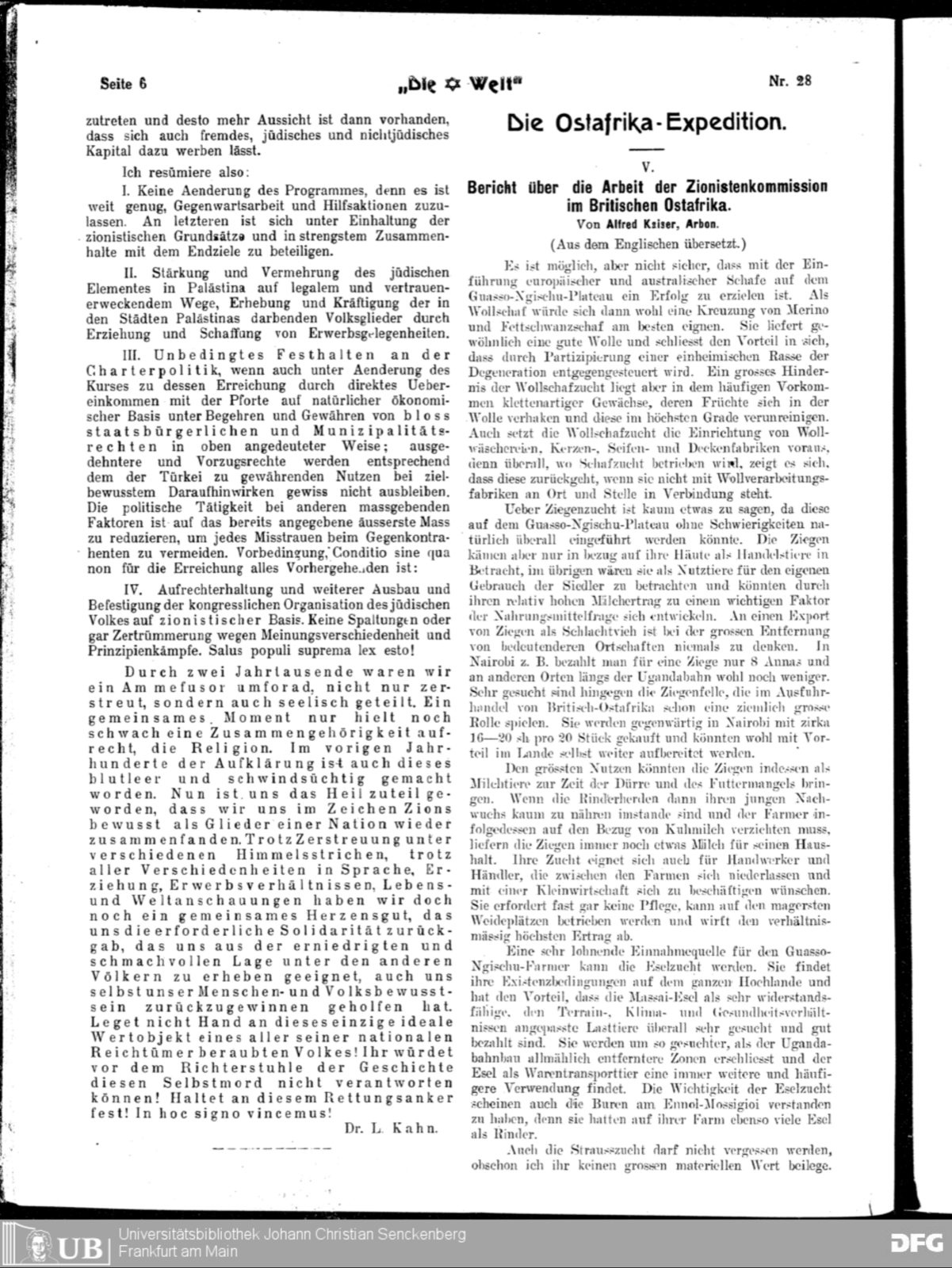
Page 6 — "Die Welt" — No. 28
(continued from page 5)
…cede, and the greater then the prospect that outside capital, Jewish and non-Jewish, may also be enlisted for it.
I sum up, therefore:
I. No change in the programme, for it is wide enough to admit present-day work and relief actions. In the latter we are to take part, while observing Zionist principles and in the strictest connection with the final goal.
II. Strengthening and increase of the Jewish element in Palestine by legal ways that inspire confidence; the raising and invigorating of those members of our people who languish in the towns of Palestine, through education and the creation of opportunities to earn a living.
III. Unconditional adherence to the Charter policy, albeit with a change of course for attaining it, by direct agreement with the Porte on a natural economic basis, asking and granting merely civic and municipal rights in the manner indicated above; more extensive and preferential rights, commensurate with the advantage to be granted to Turkey, will certainly not fail to follow if purposefully worked for. Political activity with other authoritative factors is to be reduced to the utmost limit already indicated, in order to avoid any mistrust on the part of the other contracting party. The precondition, the conditio sine qua non, for attaining all that precedes is:
IV. The maintenance and further development and consolidation of the Congress organisation of the Jewish people on a Zionist basis. No schisms, still less a shattering, on account of differences of opinion and struggles over principle. Salus populi suprema lex esto!
For two thousand years we were an Ammefusor umforad, not only dispersed but also divided in soul. one common element alone still feebly upheld a sense of belonging together: religion. In the past century of Enlightenment this too has been made bloodless and consumptive. Now the salvation has been granted us that, under the sign of Zion, we have consciously found one another again as members of one nation. In spite of dispersion under diverse skies, in spite of all differences in language, education, conditions of livelihood, and views of life and of the world, we still have a common treasure of the heart, which has given us back the needful solidarity, which is fitted to raise us out of our degraded and shameful position among the other peoples, and which has helped us ourselves to win back our consciousness as men and as a people. Lay no hand upon this one ideal object of value belonging to a people robbed of all its national riches! You could not answer for this suicide before the judgment seat of history! Hold fast to this sheet-anchor! In hoc signo vincemus!
Dr. L. Kahn.
The East Africa Expedition.
V.
Report on the Work of the Zionist Commission in British East Africa.
By Alfred Kaiser, Arbon. (Translated from the English.)
It is possible, but not certain, that success may be achieved with the introduction of European and Australian sheep on the Guasso-Ngischu Plateau. As a wool sheep, a cross between the merino and the fat-tailed sheep would then probably be best suited. It usually yields a good wool and carries with it the advantage that, through the participation of a native breed, degeneration is counteracted. A great obstacle to wool-sheep breeding, however, lies in the frequent occurrence of burr-like plants, whose fruits catch in the wool and foul it in the highest degree. Wool-sheep breeding also presupposes the establishment of wool-washing works and of candle, soap and blanket factories, for wherever sheep-farming is carried on it is found that it declines unless it is connected with wool-working factories on the spot.
Of goat-breeding there is scarcely anything to say, since it could naturally be introduced everywhere on the Guasso-Ngischu Plateau without difficulty. Goats would come into consideration as articles of trade only with respect to their skins; for the rest they would be regarded as useful animals for the settlers' own use, and through their relatively high yield of milk they could develop into an important factor in the question of food supply. An export of goats as slaughter-cattle is never to be thought of, given the great distance from the more considerable places. In Nairobi, for example, one pays only 8 annas for a goat, and at other places along the Uganda Railway probably even less. Goatskins, on the other hand, are much sought after, and already play a fairly large part in the export trade of British East Africa. They are at present bought in Nairobi at about 16—20 sh per 20 pieces, and could probably be further dressed with advantage in the country itself.
The greatest use of goats, however, might be as milch animals in times of drought and scarcity of fodder. When the herds of cattle are then scarcely able to nourish their young, and the farmer must in consequence forgo the supply of cow's milk, the goats still provide some milk for his household. Their breeding is suitable, too, for craftsmen and traders who settle among the farms and wish to occupy themselves with a small holding. It requires almost no care at all, can be carried on upon the leanest pastures, and yields relatively the highest return.
Donkey-breeding may become a very profitable source of income for the Guasso-Ngischu farmer. It finds the conditions of its existence over the whole highland, and has the advantage that the Masai donkeys, as very hardy pack-animals adapted to the conditions of terrain, climate and health, are everywhere much sought after and well paid for. They become all the more sought after as the building of the Uganda Railway gradually opens up more distant zones and the donkey finds an ever wider and more frequent use as a beast of burden for goods. The Boers on the Ennol-Mossigioi also appear to have understood the importance of donkey-breeding, for they had as many donkeys as cattle on their farm.
Ostrich-farming, too, must not be forgotten, although I attach no great material value to it.