Page 2. — "Die Welt"
(continued from page 1)
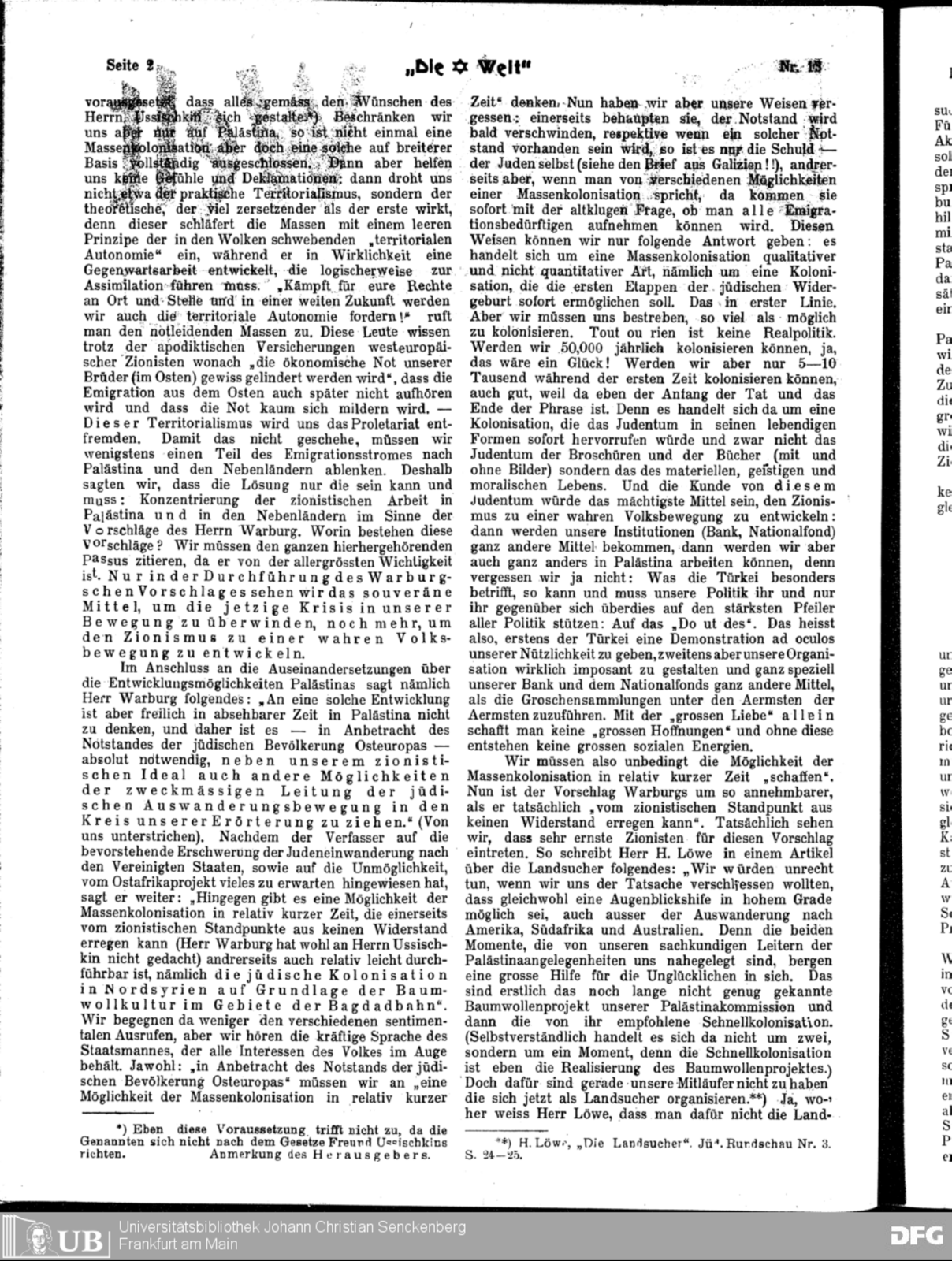
…provided that everything shapes itself according to the wishes of Herr Ussischkin.*) But if we confine ourselves to Palestine alone, then not even a mass colonisation, but even one on a broader basis, is entirely ruled out. And then no feelings and declamations will help us; then what threatens us is not, say, practical Territorialism but the theoretical kind, which works far more corrosively than the first, for it lulls the masses to sleep with an empty principle of a "territorial autonomy" floating in the clouds, while in reality it develops a work-for-the-present that must logically lead to assimilation. "Fight for your rights on the spot, and in a distant future we too shall demand territorial autonomy!" so the suffering masses are told. These people know, in spite of the apodictic assurances of West European Zionists according to which "the economic distress of our brethren (in the East) will certainly be relieved," that emigration from the East will not cease later on either, and that the distress will hardly abate. — This Territorialism will estrange the proletariat from us. That this may not happen, we must divert at least a part of the stream of emigration to Palestine and the neighbouring lands. Therefore we said that the solution can and must be only this: concentration of Zionist work in Palestine and in the neighbouring lands in the sense of the proposals of Herr Warburg. In what do these proposals consist? We must quote the whole passage belonging here, since it is of the very greatest importance. Only in the carrying out of the Warburg proposal do we see the sovereign means of overcoming the present crisis in our movement, and more than that, of developing Zionism into a true popular movement.
Following upon his discussion of the possibilities of Palestine's development, Herr Warburg namely says the following: "Such a development, however, is admittedly not to be thought of in Palestine within any foreseeable time, and it is therefore — in view of the distress of the Jewish population of Eastern Europe — absolutely necessary, alongside our Zionist ideal, to draw other possibilities of the purposeful direction of the Jewish emigration movement into the circle of our discussion as well." (Underlined by us.) After the author has pointed to the impending obstruction of Jewish immigration into the United States, as well as to the impossibility of expecting much from the East Africa project, he goes on to say: "On the other hand there exists a possibility of mass colonisation in a relatively short time which, on the one hand, can arouse no opposition from the Zionist standpoint (Herr Warburg surely did not think of Herr Ussischkin), and on the other hand is also relatively easy to carry out, namely Jewish colonisation in Northern Syria on the basis of cotton culture in the territory of the Bagdad Railway." Here we meet less with the various sentimental exclamations, but we hear the vigorous language of the statesman who keeps all the interests of the people in view. Yes indeed: "in view of the distress of the Jewish population of Eastern Europe" we must think of "a possibility of mass colonisation in a relatively short
*) Precisely this presupposition does not hold, since the parties named do not order themselves by the law of friend Ussischkin. Note of the Publisher.
time." Now, however, we have forgotten our wise men; on the one hand they assert that the distress will soon vanish, or rather, if such distress shall exist, it is only the fault — of the Jews themselves (see the letter from Galicia!!); on the other hand, however, when one speaks of various possibilities of a mass colonisation, they come at once with the precocious question whether it will be possible to take in all who need to emigrate. To these wise men we can give only the following answer: it is a question of a mass colonisation of a qualitative and not a quantitative kind, namely of a colonisation that is to make the first stages of the Jewish renaissance possible at once. That in the first place. But we must strive to colonise as much as possible. Tout ou rien is no practical politics. If we shall be able to colonise 50,000 yearly — why, that would be good fortune! But if in the first period we shall be able to colonise only 5 to 10 thousand, that too is well, because there precisely lies the beginning of the deed and the end of the phrase. For it is here a question of a colonisation that would at once call forth Judaism in its living forms, and that not the Judaism of pamphlets and books (with and without pictures), but that of material, intellectual and moral life. And the tidings of this Judaism would be the mightiest means of developing Zionism into a true popular movement; then our institutions (Bank, National Fund) will obtain quite other means, then too we shall be able to work quite differently in Palestine, for let us by no means forget: as regards Turkey in particular, our policy can and must, towards her and her alone, rest moreover upon the strongest pillar of all policy: upon "Do ut des." That is to say, first, to give Turkey a demonstration ad oculos of our usefulness, and secondly, to make our organisation truly imposing and, quite especially, to bring to our Bank and to the National Fund quite other means than the penny collections among the poorest of the poor. With "great love" alone one creates no "great hopes," and without these no great social energies arise.
We must therefore by all means "create" the possibility of mass colonisation in a relatively short time. Now Warburg's proposal is all the more acceptable in that it can in fact "arouse no opposition from the Zionist standpoint." Indeed we see that very earnest Zionists stand up for this proposal. Thus Herr H. Löwe, in an article on the land-seekers, writes as follows: "We should do wrong if we were to close our eyes to the fact that an immediate help is nevertheless possible in a high degree, even apart from emigration to America, South Africa and Australia. For the two factors which our expert leaders in Palestine affairs have urged upon us hold within them a great help for the unfortunate. These are, first, the cotton project of our Palestine Commission, which is still far from sufficiently known, and then the rapid colonisation recommended by it. (It is self-evident that here it is a question not of two factors but of one, for rapid colonisation is precisely the realisation of the cotton project.) But for this, precisely, our fellow-travellers who are now organising themselves as land-seekers are not to be had.**) Indeed, how does Herr Löwe know that one, for this, not the land-
**) H. Löwe, "Die Landsucher" ("The Land-Seekers"). Jüd. Rundschau No. 3. pp. 24—25.