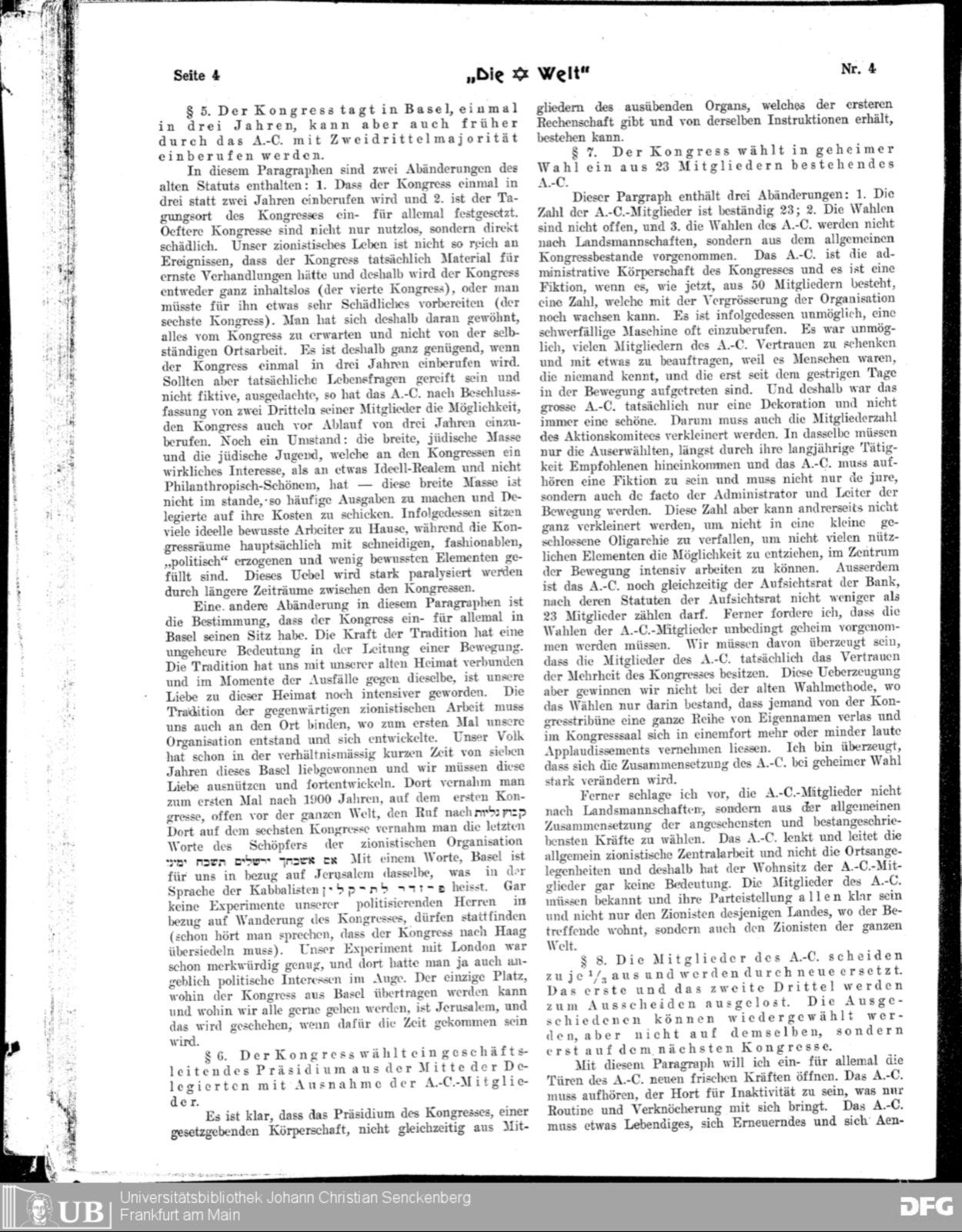
Page 4. — "Die Welt" — No. 4.
§ 5. The Congress meets in Basle, once in three years, but may also be convened earlier by the A.-C. with a two-thirds majority.
In this paragraph two alterations of the old statute are contained: 1. That the Congress is convened once in three instead of two years, and 2. the place of meeting of the Congress is fixed once and for all. More frequent Congresses are not only useless, but directly harmful. Our Zionist life is not so rich in events that the Congress would really have material for serious deliberations, and therefore the Congress becomes either wholly devoid of content (the Fourth Congress), or something very harmful would have to be prepared for it (the Sixth Congress). People have therefore grown accustomed to expect everything from the Congress and not from independent local work. It is therefore quite sufficient if the Congress is convened once in three years. Should, however, real vital questions have ripened, and not fictitious, invented ones, the A.-C. has, after a resolution of two-thirds of its members, the possibility of convening the Congress even before the lapse of three years. One circumstance more: the broad Jewish mass and the Jewish youth, which has a real interest in the Congresses, as in something ideal and real and not philanthropic and pretty — this broad mass is not in a position to incur such frequent expenses and to send delegates at its own cost. In consequence many idealistic, conscious workers sit at home, while the halls of the Congress are filled chiefly with dashing, fashionable, "politically" educated and little conscious elements. This evil will be greatly paralysed by longer intervals between the Congresses.
Another alteration in this paragraph is the provision that the Congress shall have its seat in Basle once and for all. The force of tradition has an immense significance in the guidance of a movement. Tradition has bound us to our old home, and at the moment of the attacks upon it our love for this home has become still more intense. The tradition of the present Zionist work must also bind us to the place where our organisation first arose and developed. Our people has already, in the comparatively short time of seven years, grown fond of this Basle, and we must make use of this love and develop it further. There was heard for the first time after 1900 years, at the First Congress, openly before the whole world, the call for קבוץ גליות. There at the Sixth Congress were heard the last words of the creator of the Zionist organisation, אם אשכחך ירושלים תשכח ימיני. In a word, Basle is for us in relation to Jerusalem the same as that which in the language of the Kabbalists is called פ-ו-ד-ר ל-ת-ת-ק-ל-ן. No experiments whatever on the part of our politicising gentlemen in regard to a migration of the Congress may take place (already one hears it said that the Congress must remove to The Hague). Our experiment with London was already strange enough, and there too, after all, political interests were allegedly in view. The only place to which the Congress can be transferred from Basle, and whither we shall all gladly go, is Jerusalem, and that will come to pass when the time for it shall have come.
§ 6. The Congress elects a managing Presidency from the midst of the delegates, with the exception of the members of the A.-C.
It is clear that the Presidency of the Congress, a legislative body, cannot at the same time consist of members of the executive organ, which renders account to the former and receives instructions from it.
§ 7. The Congress elects by secret ballot an A.-C. consisting of 23 members.
This paragraph contains three alterations: 1. The number of the members of the A.-C. is constantly 23; 2. The elections are not open, and 3. the elections of the A.-C. are made not according to national groups, but from the general body of the Congress. The A.-C. is the administrative body of the Congress, and it is a fiction when, as now, it consists of 50 members, a number which may yet grow with the enlargement of the organisation. It is in consequence impossible to convene a cumbrous machine often. It was impossible to place confidence in many members of the A.-C. and to charge them with anything, because they were men whom nobody knows and who have appeared in the movement only since yesterday. And therefore the great A.-C. was in fact only a decoration, and not always a handsome one. For that reason too the number of members of the Actions Committee must be reduced. Into it only the chosen, those long since recommended by their activity of many years, must enter, and the A.-C. must cease to be a fiction and must become not only de jure, but also de facto the administrator and director of the movement. This number, however, cannot on the other hand be reduced altogether, in order not to lapse into a small closed oligarchy, in order not to deprive many useful elements of the possibility of working intensively at the centre of the movement. Besides, the A.-C. is at the same time the Board of Supervision of the Bank, according to whose statutes the Board of Supervision may not number fewer than 23 members. Further, I demand that the elections of the members of the A.-C. must unconditionally be made in secret. We must be convinced that the members of the A.-C. really possess the confidence of the majority of the Congress. This conviction, however, we do not gain by the old method of election, where the electing consisted only in this, that someone read out from the Congress tribune a whole series of proper names and in the Congress hall more or less loud applause was heard continually. I am convinced that the composition of the A.-C. will change greatly with a secret election.
Further, I propose that the members of the A.-C. be elected not according to national groups, but from the general body of the most respected and most highly regarded forces. The A.-C. guides and directs the general Zionist central work and not local affairs, and therefore the place of residence of the members of the A.-C. has no significance whatever. The members of the A.-C. must be known and their party position clear to all, and not only to the Zionists of that country where the person concerned lives, but also to the Zionists of the whole world.
§ 8. The members of the A.-C. retire one-third at a time and are replaced by new ones. The first and the second third are drawn by lot for retirement. Those who have retired may be re-elected, but not at the same Congress, only at the next.
With this paragraph I wish to open once and for all the doors of the A.-C. to new, fresh forces. The A.-C. must cease to be the stronghold of inactivity, which brings with it only routine and ossification. The A.-C. must something living, self-renewing and self-chang-