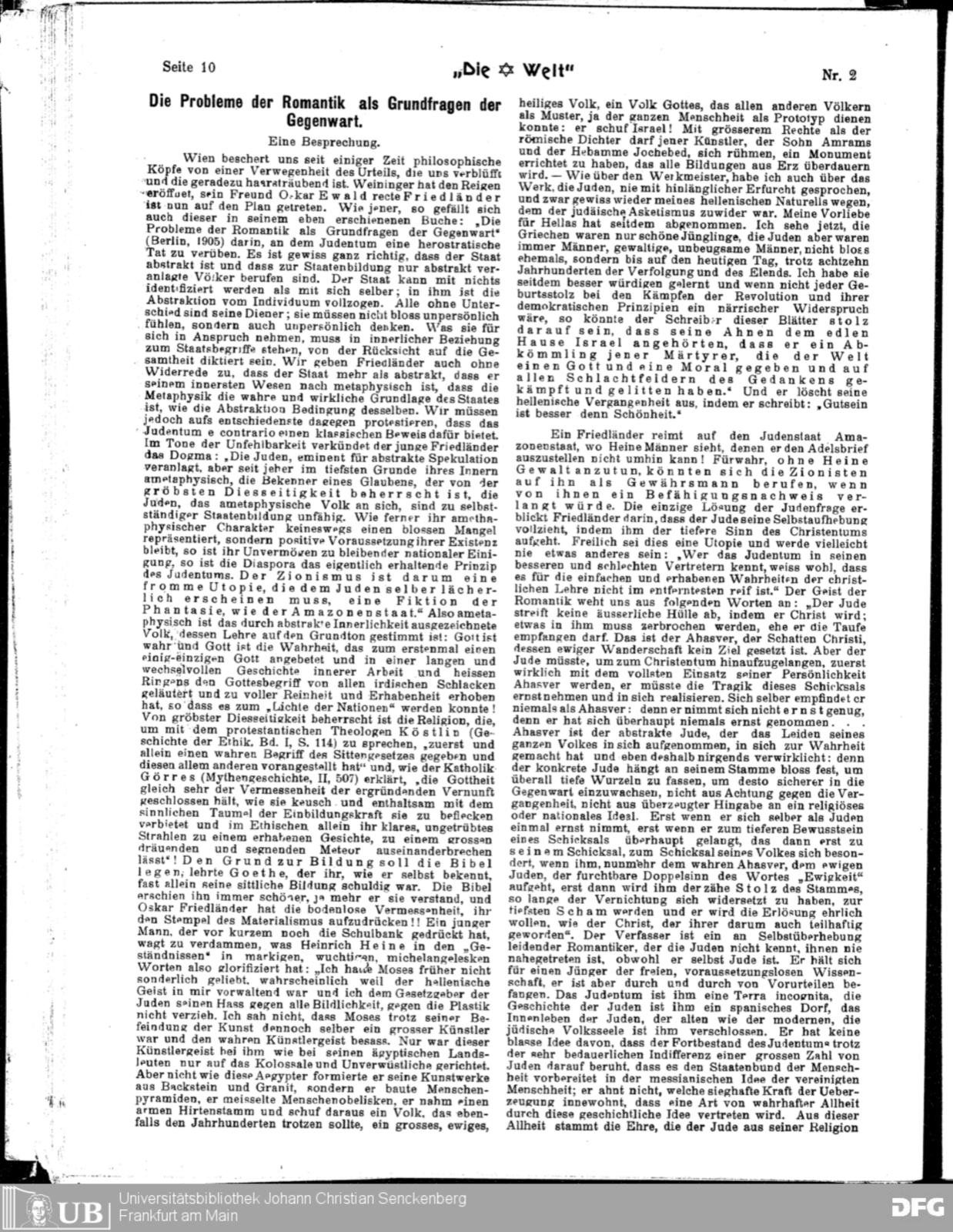
Page 10. — "Die Welt" — No. 2.
The Problems of Romanticism as Fundamental Questions of the Present.
A Review.
Vienna has for some time past been bestowing upon us philosophical heads of an audacity of judgment which astounds us and which is positively hair-raising. Weininger opened the dance; his friend Oskar Ewald, recte Friedländer, has now entered the lists. Like the former, so the latter too, in his book just published, "The Problems of Romanticism as Fundamental Questions of the Present" (Berlin, 1905), takes pleasure in perpetrating a Herostratic deed upon Judaism. It is certainly quite correct that the State is abstract and that only peoples of an abstract disposition are called to the forming of States. The State can be identified with nothing but itself; in it the abstraction from the individual is accomplished. All without distinction are its servants; they must not merely feel impersonally, but also think impersonally. What they claim for themselves must stand in inward relation to the conception of the State, must be dictated by regard for the whole. We concede to Friedländer also without demur that the State is more than abstract, that in its innermost essence it is metaphysical, that metaphysics is the true and real foundation of the State, as abstraction is the condition of the same. We must, however, protest most decidedly against the assertion that Judaism offers e contrario a classical proof of this. In the tone of infallibility young Friedländer proclaims the dogma: "The Jews, eminently endowed for abstract speculation, but from of old in the deepest ground of their inner being ametaphysical, the confessors of a faith which is dominated by the grossest this-worldliness, the Jews, the ametaphysical people in itself, are incapable of independent State-formation. As, further, their ametaphysical character by no means represents a mere defect, but remains the positive presupposition of their existence, so their incapacity for lasting national union, so the Diaspora, is the really preserving principle of Judaism. Zionism is therefore a pious Utopia, which must appear ridiculous to the Jew himself, a fiction of the fancy, like the State of the Amazons." Ametaphysical, then, is the people distinguished by abstract inwardness, whose teaching is tuned to the keynote: God is true and God is the truth; which for the first time worshipped a one and only God, and in a long and chequered history of inward labour and ardent wrestling purified the conception of God from all earthly dross and raised it to full purity and sublimity, so that it could become the "light of the nations"! Dominated by the grossest this-worldliness is the religion which, to speak with the Protestant theologian Köstlin (History of Ethics, Vol. I, p. 114), "first and alone gave a true conception of the moral law and set this before all else", and which, as the Catholic Görres (History of Myths, II, 507) declares, "keeps the Godhead closed to the presumption of fathoming reason just as much as, chaste and continent, it forbids its defilement by the sensual delirium of the imagination, and in the ethical alone lets its clear, untroubled radiance break asunder into a sublime vision, into a great meteor, threatening and blessing"! The Bible is to lay the foundation of culture, taught Goethe, who, as he himself confesses, owed to it almost alone his moral culture. The Bible appeared to him ever more beautiful the more he understood it, and Oskar Friedländer has the bottomless presumption to stamp it with the mark of materialism!! A young man who but a short while ago still sat on the school bench dares to condemn what Heinrich Heine, in the "Confessions", in pithy, weighty, Michelangelesque words has thus glorified: "I did not formerly love Moses particularly, probably because the Hellenic spirit was predominant in me and I did not forgive the lawgiver of the Jews his hatred of all imagery, of the plastic art. I did not see that Moses, in spite of his hostility to art, was nevertheless himself a great artist and possessed the true spirit of the artist. Only, this artist-spirit was in him, as in his Egyptian countrymen, directed solely to the colossal and the indestructible. But not like these Egyptians did he form his works of art out of brick and granite; rather he built pyramids of men, he chiselled obelisks of men, he took a poor shepherd tribe and created from it a people which likewise was to defy the centuries, a great, eternal, holy people, a people of God, which could serve all other peoples as a pattern, nay, the whole of mankind as a prototype: he created Israel! With greater right than the Roman poet may that artist, the son of Amram and of the midwife Jochebed, boast of having erected a monument which will outlast all formations of bronze. — As of the master-workman, so also of the work, the Jews, I have never spoken with sufficient reverence, and that again assuredly on account of my Hellenic temperament, to which Judaic asceticism was repugnant. My predilection for Hellas has since then diminished. I see now, the Greeks were only beautiful youths, but the Jews were always men, mighty, unbending men, not merely of old, but down to the present day, in spite of eighteen centuries of persecution and misery. I have since learned to appreciate them better, and if all pride of birth were not, amid the struggles of the Revolution and its democratic principles, a foolish contradiction, the writer of these pages might be proud that his ancestors belonged to the noble house of Israel, that he is a descendant of those martyrs who gave the world a God and a morality and who have fought and suffered on all the battlefields of thought." And he blots out his Hellenic past in writing: "To be good is better than beauty."
A Friedländer rhymes the State of the Jews with the State of the Amazons, where Heine sees men to whom he cannot but issue the patent of nobility! Truly, without doing violence to Heine, the Zionists could appeal to him as their authority, if a certificate of qualification were demanded of them. The only solution of the Jewish question Friedländer beholds in this, that the Jew accomplishes his self-annulment, in that the deeper meaning of Christianity dawns upon him. To be sure, this is a Utopia, he says, and will perhaps never be anything else: "Whoever knows Jewry in its better and its bad representatives knows well that it is not in the remotest degree ripe for the simple and sublime truths of the Christian doctrine." The spirit of Romanticism breathes upon us from the following words: "The Jew strips off no outward husk in becoming a Christian; something in him must be broken before he may receive baptism. That is Ahasuerus, the shadow of Christ, to whose eternal wandering no goal is set. But the Jew, in order to rise up to Christianity, would first really have to become Ahasuerus with the fullest stake of his personality; he would have to take the tragedy of this fate seriously and realise it in himself. Himself he never feels to be Ahasuerus: for he does not take himself seriously enough, for he has never taken himself seriously at all. . . Ahasuerus is the abstract Jew, who has taken up into himself the suffering of his whole people, has made it truth in himself, and for that very reason is nowhere realised: for the concrete Jew clings fast to his stock merely in order to strike deep roots everywhere, in order to grow the more securely into the present, not out of respect for the past, not out of convinced devotion to a religious or national ideal. Only when he once takes himself seriously as a Jew, only when he attains to the deeper consciousness of a destiny at all, which then first particularises itself into his destiny, into the destiny of his people, when to him, now the true Ahasuerus, the eternal Jew, the fearful double meaning of the word 'eternity' dawns, only then will the tenacious pride of the stock in having so long resisted annihilation become to him the deepest shame, and he will honestly will redemption, like the Christian, who for that reason has also become partaker of it". The author is a Romantic suffering from self-conceit, who does not know the Jews, has never come near to them, although he is himself a Jew. He takes himself for a disciple of free science without presuppositions, but he is through and through possessed by prejudices. Judaism is to him a terra incognita, the history of the Jews is Greek to him, the inner life of the Jews, the ancient as of the modern, the soul of the Jewish people is closed to him. He has not the faintest idea that the continued existence of Judaism, in spite of the very regrettable indifference of a great number of Jews, rests upon this, that it prepares the federation of the States of mankind in the Messianic idea of united mankind; he does not divine what victorious power dwells in the conviction that a kind of true totality is represented by this historical idea. From this totality springs the honour which the Jew, from his religion,