Page 6 — "Die Welt" — No. 14
A Palestine Exhibition in Vienna.
What we strive for and champion in word and writing is justified and supported by an undertaking that is meeting with a lively response in all circles of the Jewish population: a Palestine Exhibition in Vienna.
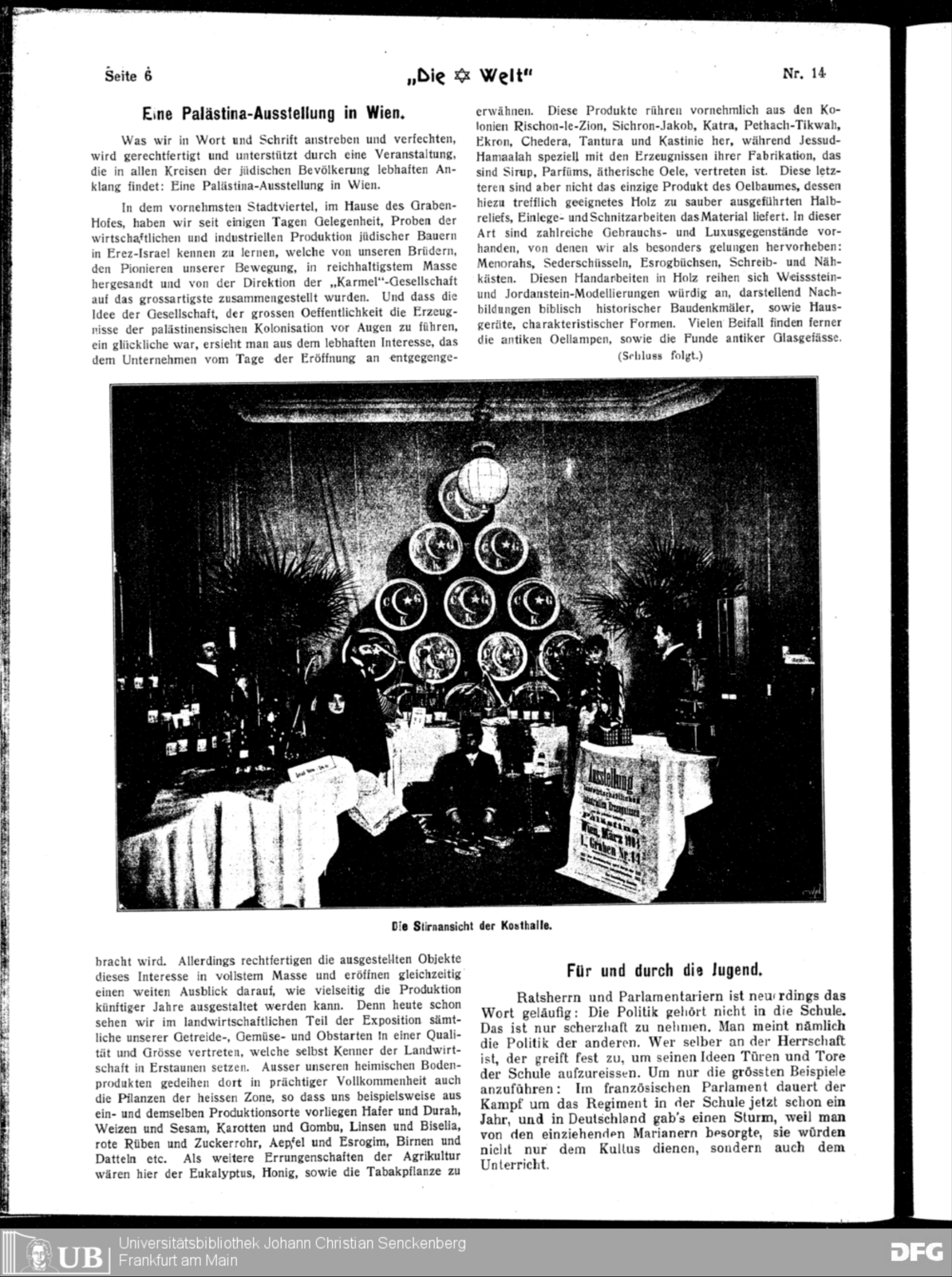
In the most fashionable quarter of the city, in the building of the Graben-Hof, we have had occasion for some days past to become acquainted with specimens of the agricultural and industrial production of Jewish farmers in Erez-Israel, which have been sent here in the richest abundance by our brethren, the pioneers of our movement, and have been assembled in the most splendid manner by the directorate of the "Karmel" Company. And that the Company's idea of placing the products of Palestinian colonization before the eyes of the great public was a happy one is to be seen from the lively interest that has been shown in the undertaking from the day of its opening. The objects exhibited, indeed, justify this interest in the fullest measure, and at the same time open a wide prospect of how many-sided the production of future years may be made. For already to-day we see in the agricultural section of the exhibition all our kinds of grain, vegetables and fruit represented in a quality and size that astonish even connoisseurs of agriculture. Besides the products of our native soil, the plants of the torrid zone also thrive there in splendid perfection, so that, for example, we have before us from one and the same place of production oats and durah, wheat and sesame, carrots and gombu, lentils and biselia, beetroots and sugar-cane, apples and esrogim, pears and dates, etc. As further achievements of agriculture the eucalyptus, honey, and the tobacco plant should be mentioned here. These products come chiefly from the colonies Rischon-le-Zion, Sichron-Jakob, Katra, Pethach-Tikwah, Ekron, Chedera, Tantura and Kastinie, while Jessud-Hamaalah is represented especially by the products of its manufacture, namely syrup, perfumes and essential oils. These last, however, are not the only product of the olive tree, whose wood, admirably suited to the purpose, supplies the material for neatly executed half-reliefs, inlay and carving. Numerous articles of use and of luxury in this style are on view, of which we single out as particularly successful: menorahs, Seder dishes, esrog boxes, writing-cases and work-boxes. Worthily ranged beside these handicrafts in wood are modellings in white stone and Jordan stone, representing reproductions of biblical-historical monuments, as well as household utensils of characteristic forms. Much approval is further accorded to the ancient oil-lamps, as well as to the finds of ancient glass vessels.
(To be concluded.)
The front view of the tasting hall.
For and Through the Young.
Among town councillors and parliamentarians the saying has lately become current: Politics does not belong in the school. That is only to be taken in jest. What is meant, namely, is the politics of others. He who is himself in power takes a firm grip, in order to fling open the doors and gates of the school to his ideas. To cite only the greatest examples: in the French Parliament the struggle for the rule of the school has now lasted a year, and in Germany there was a storm because it was feared of the incoming Marianists that they would serve not only worship but instruction as well.