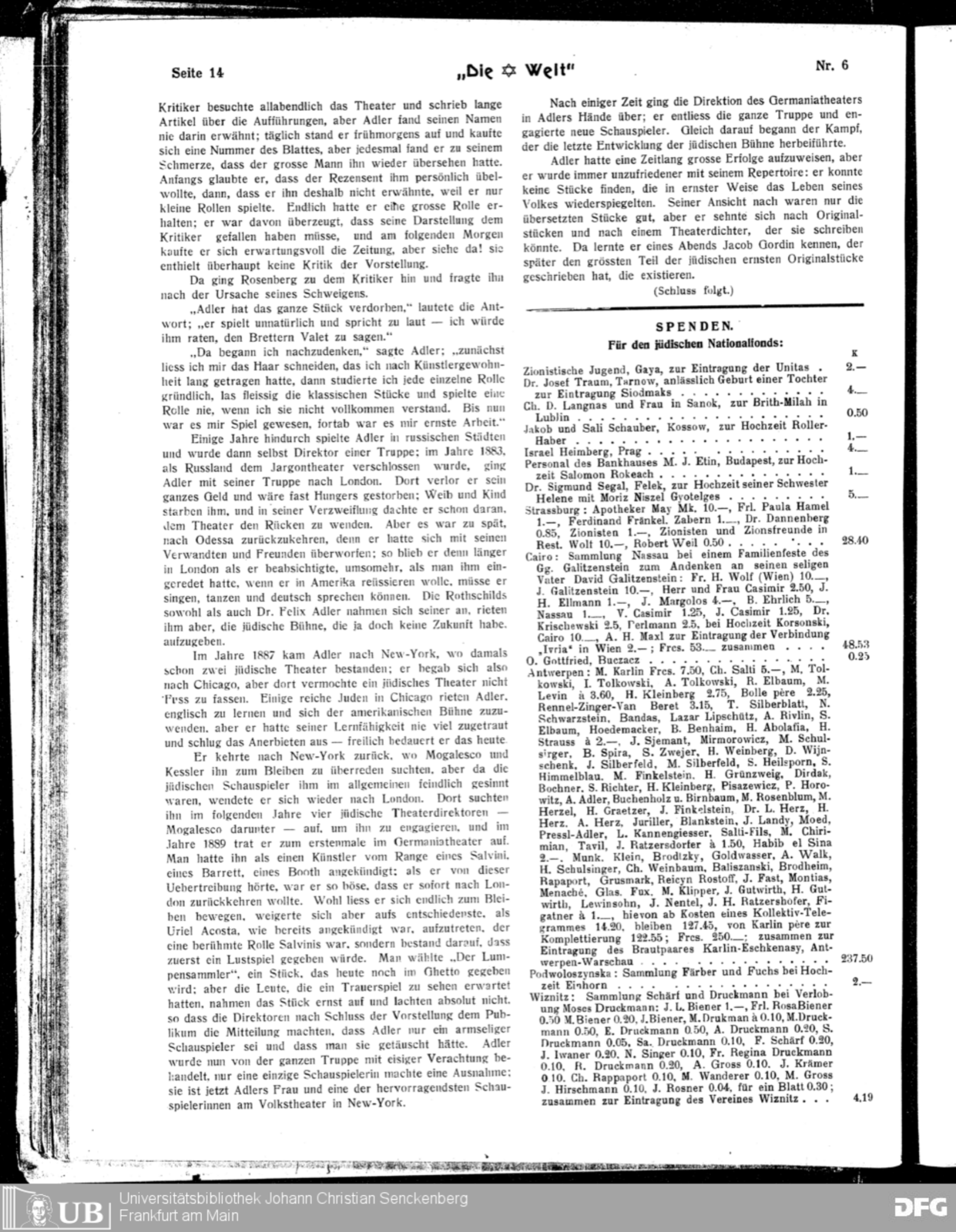
Page 14 — "Die ✡ Welt" — No. 6
(continued from page 13)
…critic attended the theatre every evening and wrote long articles on the performances, but Adler never found his name mentioned in them; every day he rose early in the morning and bought himself a copy of the paper, but each time he found, to his sorrow, that the great man had overlooked him once more. At first he believed that the reviewer bore him a personal grudge, then that he did not mention him because he played only small parts. At last he had been given a large part; he was convinced that his performance must have pleased the critic, and on the following morning he bought the newspaper full of expectation, but behold! it contained no notice of the performance at all.
Then Rosenberg went to the critic and asked him the reason for his silence.
"Adler spoilt the whole piece," ran the answer; "he acts unnaturally and speaks too loud — I should advise him to bid farewell to the boards."
"Then I began to reflect," said Adler; "first I had my hair cut, which I had worn long after the fashion of artists; then I studied every single part thoroughly, the classical plays diligently, and never played a part unless I understood it completely. Until then it had been play to me; from then on it was earnest work."
For some years Adler played in Russian towns and then himself became the director of a company; in the year 1883, when Russia was closed to the Jargon theatre, Adler went with his company to London. There he lost all his money and very nearly died of hunger; his wife and child died, and in his despair he was already thinking of turning his back on the theatre. But it was too late to return to Odessa, for he had fallen out with his relations and friends; so he remained longer in London than he had intended, the more so since he had been persuaded that if he wished to succeed in America he must be able to sing, dance and speak German. The Rothschilds as well as Dr. Felix Adler took an interest in him, but advised him to give up the Jewish stage, which after all had no future.
In the year 1887 Adler came to New York, where there were already two Jewish theatres at that time; he therefore betook himself to Chicago, but there a Jewish theatre was unable to gain a footing. Some rich Jews in Chicago advised Adler to learn English and turn to the American stage, but he had never had much confidence in his capacity for learning and declined the offer — a thing he certainly regrets today.
He returned to New York, where Mogalesco and Kessler sought to persuade him to stay, but as the Jewish actors were in general hostile to him, he turned once more to London. There, in the following year, four Jewish theatre directors — Mogalesco among them — sought him out in order to engage him, and in the year 1889 he appeared for the first time at the Germania Theatre. He had been announced as an artist of the rank of a Salvini, a Barrett, a Booth; when he heard of this exaggeration he was so angry that he wished to return to London at once. He did at last allow himself to be persuaded to stay, but refused most decidedly to appear, as had already been announced, as Uriel Acosta, which was one of Salvini's famous parts, and insisted instead that a comedy be given first. "The Rag-Picker" was chosen, a piece which is still given in the Ghetto today; but the people, who had expected to see a tragedy, took the piece seriously and did not laugh at all. so that after the close of the performance the directors informed the public that Adler was only a wretched actor and that they had been deceived. Adler was now treated by the whole company with icy contempt; one actress alone made an exception; she is now Adler's wife and one of the most distinguished actresses at the People's Theatre in New York.
After some time the management of the Germania Theatre passed into Adler's hands; he dismissed the whole company and engaged new actors. Immediately thereupon began the struggle which brought about the latest development of the Jewish stage.
For a time Adler had great successes to show, but he grew ever more dissatisfied with his repertoire: he could find no plays which reflected the life of his people in an earnest manner. In his view only the translated plays were good, but he longed for original plays and for a playwright who could write them. Then one evening he made the acquaintance of Jacob Gordin, who later wrote the greater part of the serious original Jewish plays that exist.
(Conclusion follows.)
DONATIONS.
For the Jewish National Fund:
| K | |
|---|---|
| Zionist Youth, Gaya, for the inscription of the Unitas | 2.— |
| Dr. Josef Traum, Tarnow, on the birth of a daughter, for the inscription of Siodmak | 4.— |
| Ch. D. Langnas and wife in Sanok, on the Brith-Milah in Lublin | 0.50 |
| Jakob and Sali Schauber, Kossow, on the Roller-Haber wedding | 1.— |
| Israel Heimberg, Prague | 4.— |
| Staff of the banking house M. J. Etin, Budapest, on the wedding of Salomon Rokeach | 1.— |
| Dr. Sigmund Segal, Felek, on the wedding of his sister Helene to Moriz Niszel Gyotelges | 5.— |
| Strasburg: Apothecary May Mk. 10.—, Miss Paula Hamel 1.—, Ferdinand Fränkel, Zabern 1.—, Dr. Dannenberg 0.85, Zionists 1.—, Zionists and Friends of Zion in Rest. Wolt 10.—, Robert Weil 0.50 | 28.40 |
| Cairo: collection by Nassau at a family celebration of Gg. Galitzenstein in memory of his late father David Galitzenstein: Mrs. H. Wolf (Vienna) 10.—, J. Galitzenstein 10.—, Mr. and Mrs. Casimir 2.50, J. H. Ellmann 1.—, J. Margolos 4.—, B. Ehrlich 5.—, Nassau 1.—, V. Casimir 1.25, J. Casimir 1.25, Dr. Krischewski 2.5, Perlmann 2.5, at the Korsonski wedding, Cairo 10.—, A. H. Maxl for the inscription of the fraternity "Ivria" in Vienna 2.—; Frcs. 53.— in all | 48.53 |
| O. Gottfried, Buczacz | 0.25 |
| Antwerp: M. Karlin Frcs. 7.50, Ch. Salti 5.—, M. Tolkowski, I. Tolkowski, A. Tolkowski, R. Elbaum, M. Levin à 3.60, H. Kleinberg 2.75, Bolle père 2.25, Rennel-Zinger-Van Beret 3.15, T. Silberblatt, N. Schwarzstein, Bandas, Lazar Lipschütz, A. Rivlin, S. Elbaum, Hoedemacker, B. Benhaim, H. Abolafia, H. Strauss à 2.—, J. Sjemant, Mirmorowicz, M. Schulsinger, B. Spira, S. Zwejer, H. Weinberg, D. Wijnschenk, J. Silberfeld, M. Silberfeld, S. Heilsporn, S. Himmelblau, M. Finkelstein, H. Grünzweig, Dirdak, Bochner, S. Richter, H. Kleinberg, Pisazewicz, P. Horowitz, A. Adler, Buchenholz and Birnbaum, M. Rosenblum, M. Herzel, H. Graetzer, J. Finkelstein, Dr. L. Herz, H. Herz, A. Herz, Juriller, Blankstein, J. Landy, Moed, Pressl-Adler, L. Kannengiesser, Salti-Fils, M. Chirimian, Tavil, J. Ratzersdorfer à 1.50, Habib el Sina 2.—, Munk, Klein, Brodizky, Goldwasser, A. Walk, H. Schulsinger, Ch. Weinbaum, Baliszanski, Brodheim, Rapaport, Grusmark, Reicyn Rostoff, J. Fast, Montias, Menaché, Glas, Fux, M. Klipper, J. Gutwirth, H. Gutwirth, Lewinsohn, J. Nentel, J. H. Ratzershofer, Figatner à 1.—, less the cost of a collective telegram 14.20, leaving 127.45, from Karlin père to make up the sum 122.55; Frcs. 250.—; in all, for the inscription of the betrothed couple Karlin-Eschkenasy, Antwerp-Warsaw | 237.50 |
| Podwoloczyska: collection by Färber and Fuchs at the Einhorn wedding | 2.— |
| Wiznitz: collection by Schärf and Druckmann at the engagement of Moses Druckmann: J. L. Biener 1.—, Miss Rosa Biener 0.50, M. Biener 0.20, J. Biener, M. Drukman à 0.10, M. Druckmann 0.50, E. Druckmann 0.50, A. Druckmann 0.20, S. Druckmann 0.05, Sa. Druckmann 0.10, F. Schärf 0.20, J. Iwaner 0.20, N. Singer 0.10, Mrs. Regina Druckmann 0.10, R. Druckmann 0.20, A. Gross 0.10, J. Krämer 0.10, Ch. Rappaport 0.10, M. Wanderer 0.10, M. Gross, J. Hirsehmann 0.10, J. Rosner 0.04, for a sheet 0.30; in all, for the inscription of the Wiznitz Society | 4.19 |