No. 1. — "Die Welt" — Page 13.
(continued from page 12)
…negligence, between the dolus and the culpa, which were so sharply distinguished in Roman law. What, then, is the logical framework, the structure of this legislation? The first five paragraphs deal with the order of procedure. § 1 runs: "If a man, having accused another (declared him under ban), and having charged him with killing (by sorcery), does not convict him (of it), he who accused him shall be put to death." The second paragraph indicates the means by which the proof in such a case may be furnished, and this means is our long-familiar means of proof — the ordeal, or judgment of God. We meet with this primitive usage at all the lower stages of culture, and we also find traces of it in several ordinances of Jewish law, as, for example, in the law of the Sota, and in several narratives of Biblical literature. That this paragraph stands at the head of the Code proves the whole importance of the belief in sorcery among the Babylonian people. From the whole remaining structure of the law-book, however, it is evident that this superstition belonged to a much earlier time and was merely incorporated into the Code. For we nowhere see a trace of the belief in sorcery in the other laws, which would unquestionably be the case had sorcery enjoyed official application, had it been a factor of the State, as is the case, for instance, in African jurisprudence, and likewise in ancient Egyptian law. (Cf. Revillout: le droit egyptien.) Close upon this follows the highly important legal rule concerning false witnesses. It is laid down, namely, that the false witness, if he has appeared in a "suit touching life," shall be put to death; but if it is merely a civil suit
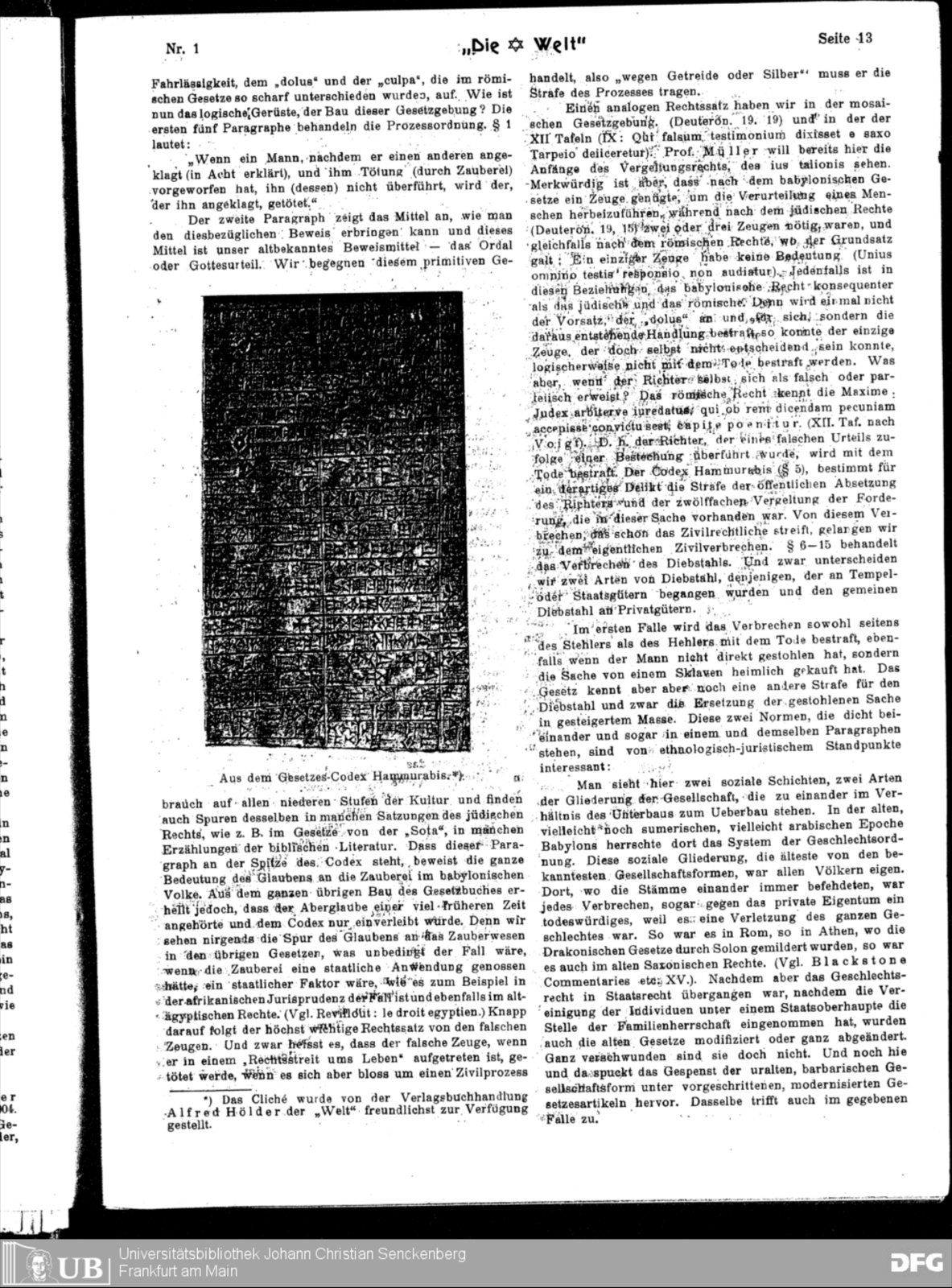
Out of the Law-Code of Hammurabi.*)
*) The block was most kindly placed at the disposal of "Die Welt" by the publishing house of Alfred Hölder.
that is in question, that is, "concerning grain or silver," he must bear the penalty of the suit. We have an analogous legal rule in the Mosaic legislation (Deuteron. 19, 19) and in that of the Twelve Tables (Fx: Qui falsum testimonium dixisset e saxo Tarpeio deiiceretur). Prof. Müller would already see here the beginnings of the law of retaliation, the ius talionis. It is remarkable, however, that according to the Babylonian law one witness sufficed to bring about the condemnation of a man, whereas according to Jewish law (Deuteron. 19, 15) two or three witnesses were necessary, and likewise according to Roman law, where the principle held good that a single witness is of no account (Unius omnino testis responsio non audiatur). In any case, in these respects Babylonian law is more consistent than the Jewish and the Roman. For once it is not the intent, the dolus in and of itself, but the act arising from it that is punished, then the single witness, who after all could himself decide nothing, could not logically be punished with death. But what if the judge himself proves false or partial? Roman law knows the maxim: Judex arbiterve iure datus, qui ob rem dicendam pecuniam accepisse convictus est, capite poenitur. (XII Tables, after Volgt). That is, the judge who is convicted of a false judgment in consequence of bribery is punished with death. The Code of Hammurabi (§ 5) prescribes for an offence of this kind the penalty of the judge's public removal from office and of twelvefold restitution of the claim that was at issue in the matter. From this crime, which already borders on the civil sphere, we come to the civil crime proper. §§ 6–15 deal with the crime of theft. And here we distinguish two kinds of theft: that committed against the goods of the temple or the State, and common theft of private goods.
In the first case the crime is punished with death, on the part of the thief as well as of the receiver, and likewise when the man has not stolen directly but has secretly bought the thing from a slave. But but the law knows yet another penalty for theft, namely, the restitution of the stolen thing in an increased measure. These two norms, which stand close together and even within one and the same paragraph, are interesting from the ethnological-juridical standpoint. One sees here two social strata, two kinds of organisation of society, which stand to one another in the relation of substructure to superstructure. In the old, perhaps still Sumerian, perhaps Arabian, epoch of Babylon the system of the clan order prevailed there. This social organisation, the oldest of the best-known forms of society, was proper to all peoples. Where the tribes were constantly at feud with one another, every crime, even one against private property, was a capital one, because it was an injury to the whole clan. So it was in Rome, so in Athens, where the Draconian laws were mitigated by Solon, and so it was also in the old Saxon law. (Cf. Blackstone, Commentaries etc., XV.) But after the law of the clan had passed over into the law of the State, after the union of individuals under one head of State had taken the place of the rule of the family, the old laws too were modified or altogether changed. Yet they have not wholly disappeared. And here and there the spectre of the primeval, barbarous form of society still peers forth from beneath advanced, modernised articles of law. The same holds true in the present case.