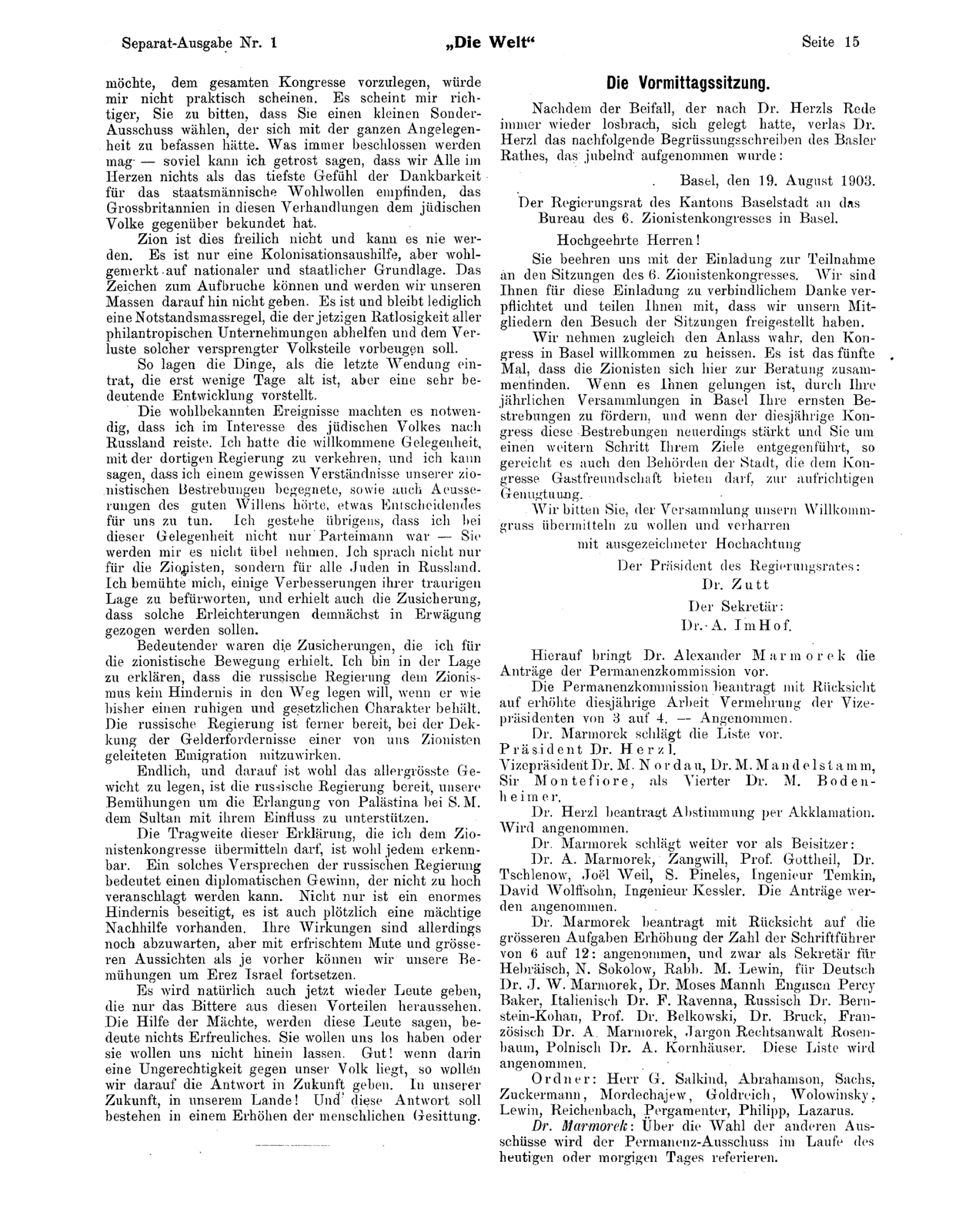
Special Edition No. 1 — "Die Welt" — Page 15
(continued from page 14)
…to lay before the entire Congress would not seem to me practical. It seems to me more proper to ask you to elect a small special committee, which would have to deal with the whole matter. Whatever may be resolved — this much I can confidently say, that we all feel in our hearts nothing but the deepest sense of gratitude for the statesmanlike goodwill which Great Britain has shown towards the Jewish people in these negotiations.
This, to be sure, is not Zion and can never become it. It is only an expedient of colonisation, but, be it well noted, on a national and state basis. We cannot and shall not give our masses the signal for departure on the strength of it. It is and remains merely an emergency measure, intended to remedy the present helplessness of all philanthropic undertakings and to prevent the loss of such scattered fragments of our people.
So matters stood when the latest turn took place, which is only a few days old but represents a very significant development.
The well-known events made it necessary for me to travel to Russia in the interest of the Jewish people. I had the welcome opportunity of communicating with the Government there, and I can say that I met with a certain understanding of our Zionist aspirations, and also heard expressions of goodwill to do something decisive for us. I confess, moreover, that on this occasion I was not merely a party man — you will not take it amiss of me — I spoke not only for the Zionists, but for all the Jews in Russia. I endeavoured to advocate some improvements in their sad situation, and also received the assurance that such alleviations are shortly to be taken into consideration.
More important were the assurances I received for the Zionist movement. I am in a position to declare that the Russian Government will place no obstacle in the way of Zionism, so long as it retains, as hitherto, a quiet and lawful character. The Russian Government is further prepared to co-operate in covering the financial requirements of an emigration directed by us Zionists.
Finally — and upon this the very greatest weight is surely to be laid — the Russian Government is prepared to support with its influence our efforts to obtain Palestine from H. M. the Sultan.
The import of this declaration, which I am permitted to convey to the Zionist Congress, is surely evident to everyone. Such a promise from the Russian Government signifies a diplomatic gain that cannot be rated too highly. Not only has an enormous obstacle been removed; a powerful aid is suddenly at hand as well. Its effects, it is true, remain to be seen, but with refreshed courage and greater prospects than ever before we can continue our efforts for Erez Israel.
There will naturally be people now once again who see only the bitter in these advantages. The help of the Powers, these people will say, signifies nothing gratifying. They want to be rid of us, or they do not want to let us in. Very well! If there lies in this an injustice towards our people, we will give the answer to it in the future. In our future, in our own land! And this answer shall consist in a raising of human civilisation.
The Morning Session.
When the applause, which broke out again and again after Dr. Herzl's speech, had subsided, Dr. Herzl read the following letter of greeting from the Council of Basle, which was received with jubilation:
Basle, 19th August 1903.
The Executive Council of the Canton of Basle-City to the Bureau of the 6th Zionist Congress at Basle.
Most honoured Gentlemen!
You honour us with an invitation to attend the sittings of the 6th Zionist Congress. We are obliged to you with sincere thanks for this invitation, and inform you that we have left it open to our members to attend the sittings.
We take this occasion at the same time to bid the Congress welcome to Basle. It is the fifth time that the Zionists have met here for deliberation. If you have succeeded, through your annual assemblies in Basle, in furthering your earnest aspirations, and if this year's Congress strengthens these aspirations anew and brings you a further step towards your goal, it is also a matter of sincere satisfaction to the authorities of the city which is privileged to offer the Congress its hospitality.
We beg you to convey our greeting of welcome to the assembly, and remain with the highest esteem
The President of the Executive Council: Dr. Zutt
The Secretary: Dr. A. Im Hof.
Dr. Alexander Marmorek then brings forward the motions of the Standing Committee.
The Standing Committee moves, in view of the increased work this year, an increase in the number of Vice-Presidents from 3 to 4. — Adopted.
Dr. Marmorek proposes the list. President Dr. Herzl, Vice-Presidents Dr. M. Nordau, Dr. M. Mandelstamm, Sir Montefiore, and as fourth Dr. M. Bodenheimer.
Dr. Herzl moves a vote by acclamation. Adopted.
Dr. Marmorek further proposes as assessors: Dr. A. Marmorek, Zangwill, Prof. Gottheil, Dr. Tschlenow, Joël Weil, S. Pineles, Engineer Temkin, David Wolffsohn, Engineer Kessler. The motions are adopted.
Dr. Marmorek moves, in view of the greater tasks, an increase in the number of secretaries from 6 to 12: adopted, namely, as secretaries for Hebrew, N. Sokolow, Rabbi M. Lewin; for German Dr. J. W. Marmorek, Dr. Moses Mannh Engusen Percy Baker; Italian Dr. F. Ravenna; Russian Dr. Bernstein-Kohan, Prof. Dr. Belkowski, Dr. Bruck; French Dr. A. Marmorek; Jargon, Advocate Rosenbaum; Polish Dr. A. Kornhäuser. This list is adopted.
Stewards: Messrs. G. Salkind, Abrahamson, Sachs, Zuckermann, Mordechajew, Goldreich, Wolowinsky, Lewin, Reichenbach, Pergamenter, Philipp, Lazarus.
Dr. Marmorek: The Standing Committee will report on the election of the other committees in the course of today or tomorrow.