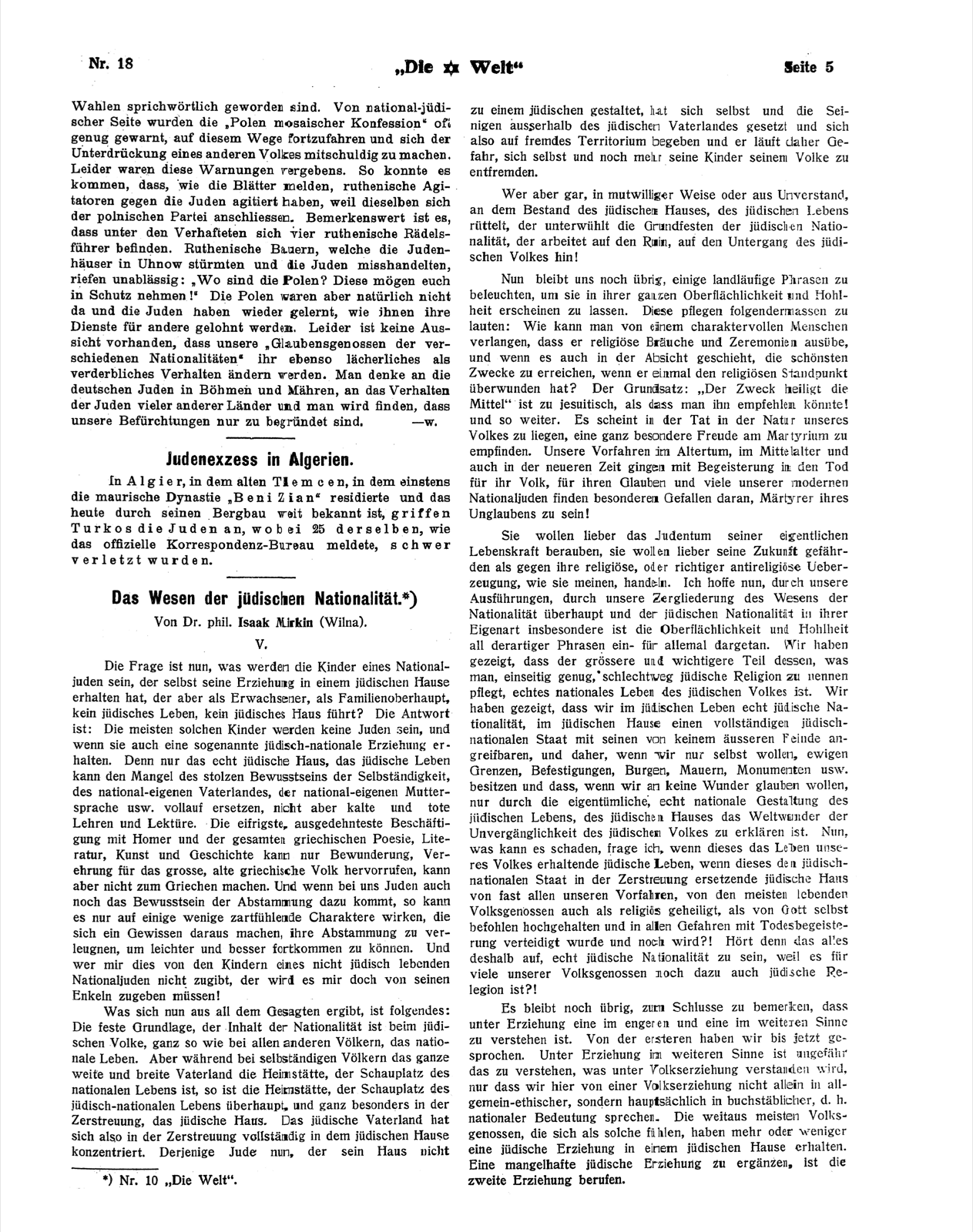
No. 18. — "Die Welt" — Page 5.
(continued from page 4)
…elections have become proverbial. From the national-Jewish side the "Poles of the Mosaic persuasion" were warned often enough against continuing along this path and making themselves accomplices in the oppression of another people. Unhappily these warnings were in vain. Thus it could come about that, as the papers report, Ruthenian agitators have agitated against the Jews because the latter attach themselves to the Polish party. It is noteworthy that among those arrested are four Ruthenian ringleaders. Ruthenian peasants, who stormed the Jewish houses in Uhnow and ill-used the Jews, cried out incessantly: "Where are the Poles? Let them protect you!" The Poles, of course, were not there, and the Jews have learned once again how their services to others are rewarded. Unhappily there is no prospect that our "co-religionists of the various nationalities" will change their conduct, which is as ridiculous as it is ruinous. One need only think of the German Jews in Bohemia and Moravia, of the conduct of the Jews of many other countries, and one will find that our apprehensions are only too well founded. —w.
Anti-Jewish Outbreak in Algeria.
In Algiers, in the ancient Tlemcen, where the Moorish dynasty of the "Beni Zian" once resided and which is today widely known for its mining, Turcos attacked the Jews, whereby 25 of them, as the official Correspondence Bureau reported, were severely injured.
The Essence of Jewish Nationality.*)
By Dr. phil. Isaak Mirkin (Vilna).
V.
The question now is: what will the children of a national Jew be, who himself received his upbringing in a Jewish home, but who as a grown man, as head of a family, leads no Jewish life and keeps no Jewish home? The answer is: most such children will not be Jews, even though they receive a so-called Jewish-national education. For only the genuinely Jewish home, the Jewish life, can fully make good the want of the proud consciousness of independence, of a nation's own fatherland, of a nation's own mother tongue, and so forth — not cold and lifeless doctrines and reading. The most zealous and extensive occupation with Homer and the whole of Greek poetry, literature, art and history can call forth only admiration and veneration for the great ancient Greek people, but cannot make one a Greek. And if with us Jews the consciousness of descent is added besides, it can act only upon a few sensitive characters who make it a matter of conscience not to deny their descent for the sake of getting on more easily and better. And whoever will not grant me this of the children of a national Jew who does not live as a Jew, will surely have to grant it me of his grandchildren!
What follows from all that has been said is this: the firm foundation, the substance of nationality among the Jewish people, exactly as among all other peoples, is the national life. But whereas among independent peoples the whole broad fatherland is the home and the stage of national life, the home and stage of Jewish-national life in general, and most especially in the Dispersion, is the Jewish house. The Jewish fatherland, then, has in the Dispersion concentrated itself entirely in the Jewish home. The Jew who does not make his home a Jewish one has placed himself and his family outside the Jewish fatherland, has thus betaken himself to foreign territory, and therefore runs the danger of estranging himself, and still more his children, from his people.
But whoever, wantonly or from want of understanding, goes so far as to shake the existence of the Jewish home and of Jewish life, undermines the very foundations of Jewish nationality and works towards the ruin, towards the destruction of the Jewish people!
It now remains for us to throw light upon certain current phrases, so as to show them in all their superficiality and hollowness. These commonly run as follows: How can one demand of a man of character that he practise religious customs and ceremonies — even if it be done with the intention of attaining the finest ends — once he has outgrown the religious standpoint? The principle "The end justifies the means" is too Jesuitical to be recommended! and so forth. It seems indeed to lie in the nature of our people to take a quite peculiar delight in martyrdom. Our forefathers in antiquity, in the Middle Ages and in modern times as well went to their deaths with enthusiasm for their people, for their faith; and many of our modern national Jews take particular pleasure in being martyrs to their unbelief!
They would rather rob Judaism of its real vital force, they would rather endanger its future, than act against their religious — or, more correctly, anti-religious — conviction, as they conceive it. I now hope that by our exposition, by our analysis of the essence of nationality in general and of Jewish nationality in its peculiar character in particular, the superficiality and hollowness of all such phrases has been demonstrated once and for all. We have shown that the greater and more important part of what is, one-sidedly enough, commonly called simply the Jewish religion is the genuine national life of the Jewish people. We have shown that in Jewish life we possess genuine Jewish nationality, and in the Jewish home a complete Jewish-national state, with frontiers, fortifications, castles, walls, monuments, etc., that no outward enemy can assail, and that are therefore eternal if only we ourselves so will; and that, if we will believe in no miracles, the world-wonder of the imperishability of the Jewish people can be explained only by the peculiar, genuinely national shaping of Jewish life and of the Jewish home. Now, what harm can it do, I ask, if this Jewish life that preserves the life of our people, if this Jewish home that replaces the Jewish-national state in the Dispersion, was and still is held high by almost all our forefathers and by most of our living fellow-countrymen as religiously hallowed as well, as commanded by God Himself, and defended in every peril with an enthusiasm unto death?! Does all this therefore cease to be genuine Jewish nationality because for many of our people it is Jewish religion into the bargain?!
It remains, in conclusion, to observe that education is to be understood in a narrower and in a wider sense. Of the former we have spoken hitherto. By education in the wider sense is to be understood roughly what is understood by popular education, except that here we speak of a popular education not only in the general ethical sense, but chiefly in the literal, that is, the national meaning. By far the greater number of our people who feel themselves to be such have received, more or less, a Jewish upbringing in a Jewish home. To supplement a defective Jewish upbringing is the office of this second education.
*) No. 10, "Die Welt".