Page 14 — "Die Welt" — No. 16
The cheque receipts will be published in the L.C.'s report of proceedings to the next Party Conference.
The Inner Austrian, Bohemian, East Galician and Bukovina L.C.s are requested to send in their outstanding reports of proceedings, for the completion of the register of societies and of confidential agents.
Dr. Bernhardt, chairman of the Inner Austrian D.C., will undertake in the coming weeks an agitation tour through Lower Austria, and will speak at Korneuburg, Mistelbach, Oberhollabrunn, Mödling, Baden and St. Pölten.
The legally protected Zion matches published by the L.C. will shortly appear.
The Third Austrian Zionist Conference will definitely take place on the 28th and 29th of June (not July) 1903 in Vienna.
The first preliminary conference will be held as early as the 26th of April in Vienna, and at it the order of the day and the allotment of reports will be provisionally settled. The D.C.s and all party comrades are requested to communicate their proposals on this matter to the L.C. in good time. — To the preliminary conference itself the D.C.s will send delegates of their own free choice.
For articles for sale (see last cover page) apply to the Secretary, Adolf Pollak.
Feuilleton.
Dr. Salomon Rubin
(on his 80th birthday.)
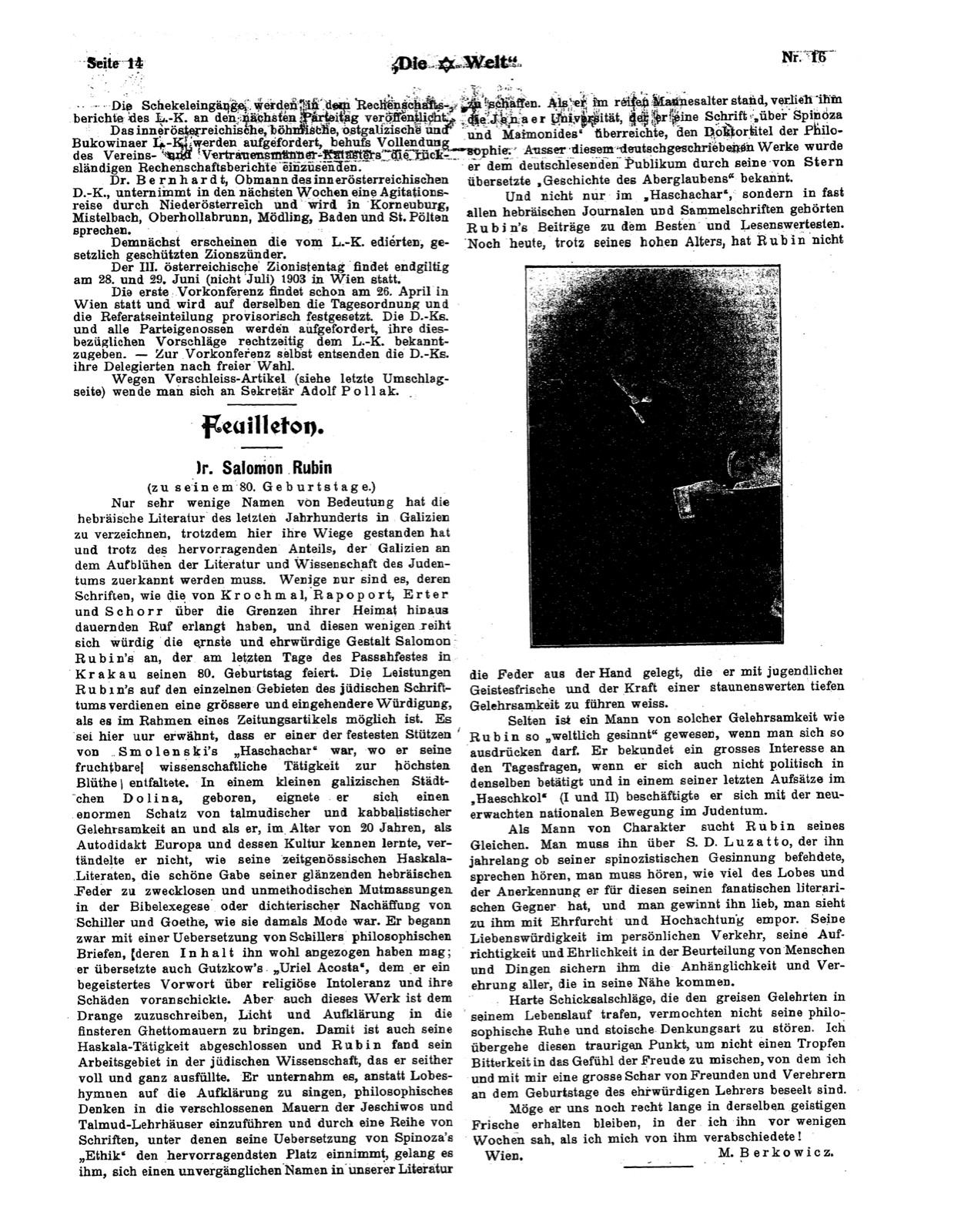
Very few names of importance are to be recorded in the Hebrew literature of the last century in Galicia, although its cradle stood here, and notwithstanding the eminent share which must be accorded to Galicia in the flowering of the literature and science of Judaism. Only few are they whose writings, like those of Krochmal, Rapoport, Erter and Schorr, have attained a lasting reputation beyond the borders of their homeland; and to these few is worthily added the earnest and venerable figure of Salomon Rubin, who on the last day of the Passover festival celebrates his 80th birthday in Cracow. Rubin's achievements in the several fields of Jewish letters deserve a larger and more thorough appreciation than is possible within the compass of a newspaper article. Let it only be mentioned here that he was one of the firmest pillars of Smolenski's "Haschachar," where he brought his fruitful scholarly activity to its highest flowering. Born in a small Galician town, Dolina, he acquired an enormous treasure of Talmudic and Cabbalistic learning, and when, at the age of twenty, he came to know Europe and its culture as a self-taught man, he did not, like his contemporary Haskala men of letters, trifle away the fine gift of his brilliant Hebrew pen upon aimless and unmethodical conjectures in Biblical exegesis, or upon poetical aping of Schiller and Goethe, such as was then the fashion. He began, it is true, with a translation of Schiller's philosophical letters, whose contents may well have attracted him; he also translated Gutzkow's "Uriel Acosta," to which he prefixed an enthusiastic preface on religious intolerance and its evils. But this work too must be ascribed to the urge to bring light and enlightenment within the gloomy walls of the Ghetto. With it his Haskala activity likewise came to an end, and Rubin found his field of labour in Jewish science, which he has since filled wholly and completely. Instead of singing hymns of praise to enlightenment, he undertook to introduce philosophical thought within the closed walls of the Yeshivas and Talmud schools, and through a series of writings, among which his translation of Spinoza's "Ethics" takes the foremost place, he succeeded in making for himself an imperishable name in our literature. When he stood in the prime of manhood, the University of Jena, to which he presented a treatise on Spinoza and Maimonides, conferred upon him the degree of Doctor of Philosophy. Besides this work written in German, he became known to the German-reading public through his "History of Superstition," translated by Stern.
And not only in "Haschachar," but in almost all the Hebrew journals and miscellanies, Rubin's contributions were among the best and most worth reading. Even to-day, despite his great age, Rubin has not laid down the pen, which he knows how to wield with youthful freshness of mind and with the strength of an astonishingly deep learning.
Seldom has a man of such learning as Rubin been so "worldly-minded," if one may so express it. He shows a great interest in the questions of the day, even if he takes no political part in them, and in one of his latest essays in "Haeschkol" (I and II) he dealt with the newly awakened national movement in Judaism.
As a man of character Rubin has few equals. One must hear him speak of S. D. Luzzatto, who for years assailed him on account of his Spinozist views; one must hear how much praise and recognition he has for this fanatical literary opponent of his, and one grows fond of him, one looks up to him with reverence and esteem. His amiability in personal intercourse, his sincerity and honesty in judging men and things, secure him the attachment and veneration of all who come near him.
Hard blows of fate, which befell the aged scholar in the course of his life, have been unable to disturb his philosophical calm and Stoic cast of mind. I pass over this sad point, so as not to mingle a drop of bitterness in the feeling of joy with which I, and with me a great host of friends and admirers, are filled on the birthday of the venerable teacher.
May he long be preserved to us in the same freshness of mind in which I saw him a few weeks ago, when I took my leave of him!
Vienna. M. Berkowicz.