No. 41. — "Die Welt" — Page 15.
(continued from page 14)
…that the Zionist idea has not yet penetrated adequately into the deepest strata of the people. Nor must it be left out of account that the hard conditions of life tear the Jewish woman away from her domestic peace, from her hearth, and set her in the very midst of the turmoil of socio-economic questions and of the struggle for existence. Without speaking of the Jewish women who for a long time past have taken part in trade in very considerable numbers, the number of women employed in handicraft and in factory industry is also growing daily.
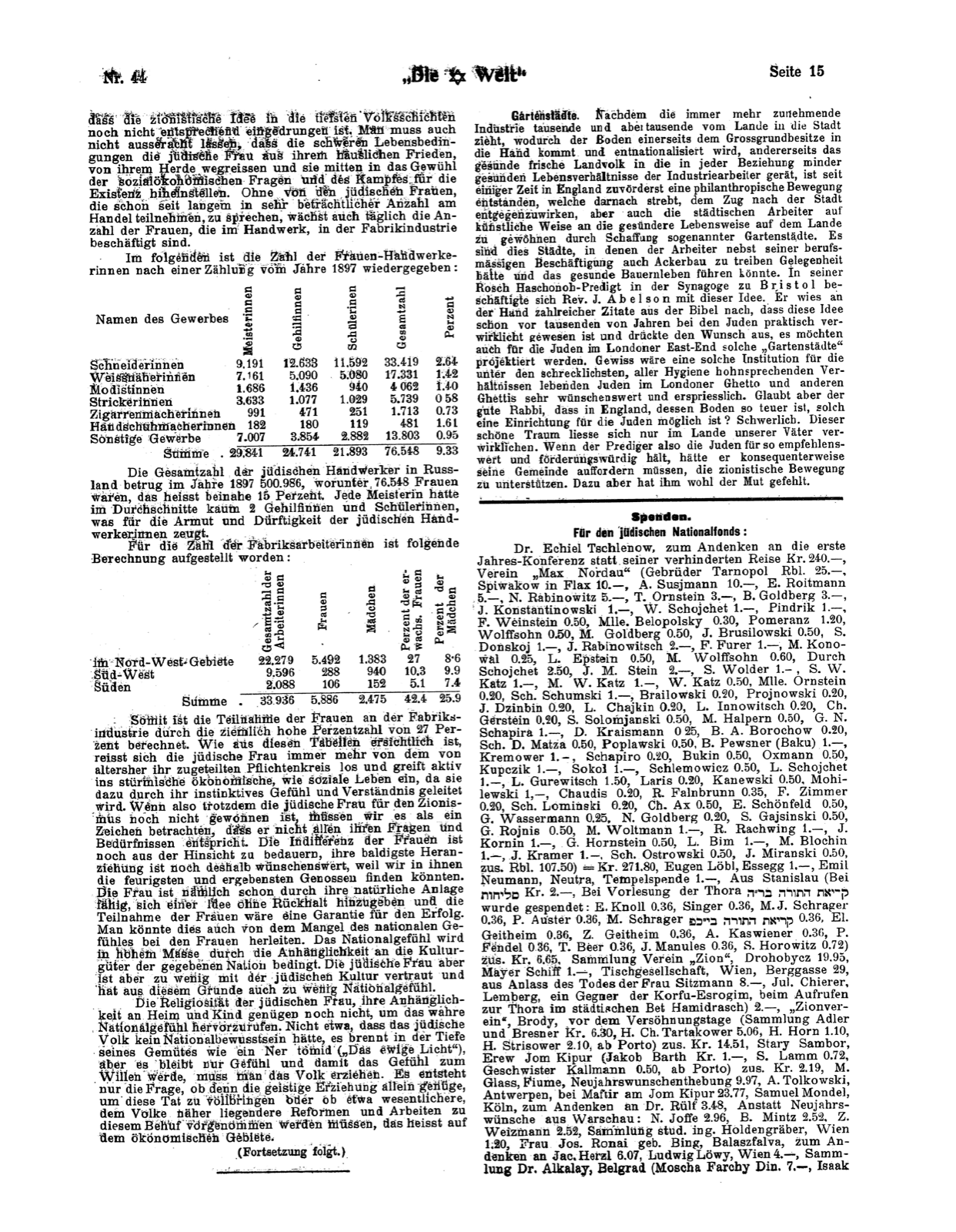
The number of women artisans according to a census of the year 1897 is given below:
| Trade | Mistresses | Assistants | Apprentices | Total | Per cent |
|---|---|---|---|---|---|
| Dressmakers | 9.191 | 12.633 | 11.592 | 33.419 | 2.64 |
| Seamstresses (white goods) | 7.161 | 5.090 | 5.080 | 17.331 | 1.42 |
| Milliners | 1.686 | 1.436 | 940 | 4.062 | 1.40 |
| Knitters | 3.633 | 1.077 | 1.029 | 5.739 | 0.58 |
| Cigar-makers | 991 | 471 | 251 | 1.713 | 0.73 |
| Glove-makers | 182 | 180 | 119 | 481 | 1.61 |
| Other trades | 7.007 | 3.854 | 2.882 | 13.803 | 0.95 |
| Total | 29.841 | 24.741 | 21.893 | 76.548 | 9.33 |
The total number of Jewish artisans in Russia in the year 1897 was 500.986, among whom were 76.548 women, that is to say nearly 15 per cent. Each mistress had on the average barely 2 assistants and apprentices, which bears witness to the poverty and indigence of the Jewish women artisans.
For the number of women factory workers the following calculation has been drawn up:
| Total number of women workers | Women | Girls | Per cent of adult women | Per cent of girls | |
|---|---|---|---|---|---|
| in the North-West Region | 22.279 | 5.492 | 1.383 | 27 | 8.6 |
| South-West | 9.596 | 288 | 940 | 10.3 | 9.9 |
| South | 2.088 | 106 | 152 | 5.1 | 7.4 |
| Total | 33.936 | 5.886 | 2.475 | 42.4 | 25.9 |
Thus the share of women in factory industry is reckoned at the fairly high figure of 27 per cent. As is evident from these tables, the Jewish woman is tearing herself more and more away from the circle of duties allotted to her from of old, and is taking an active part in the stormy economic as well as social life, being guided thereto by her instinctive feeling and understanding. If, then, the Jewish woman has nevertheless not yet been won for Zionism, we must regard it as a sign that it does not answer to all her questions and needs. The indifference of women is to be regretted in yet another respect; their speediest enlistment is desirable for this further reason, that in them we might find the most ardent and devoted comrades. For woman is, by her very natural disposition, capable of giving herself to an idea without reserve, and the participation of women would be a guarantee of success. One might also derive this from the lack of national feeling among women. National feeling is conditioned in high measure by attachment to the cultural possessions of the given nation. But the Jewish woman is but too little acquainted with Jewish culture, and for this reason has too little national feeling as well.
The religiousness of the Jewish woman, her attachment to home and child, do not yet suffice to call forth true national feeling. Not that the Jewish people has no national consciousness; it burns in the depths of its soul like a Ner tomid ("The Eternal Light"), but it remains mere feeling, and in order that feeling may become will, the people must be educated. The only question that arises is whether spiritual education alone suffices to accomplish this deed, or whether more essential reforms and labours, lying nearer to the people, must be undertaken to this end — that is to say, in the economic field.
(To be continued.)
Garden Cities. Since ever-increasing industry draws thousands upon thousands from the country into the town — whereby, on the one hand, the land passes into the hands of the great landowners and is denationalised, and on the other hand the healthy, fresh country folk fall into the in every respect less healthy conditions of life of the industrial workers — there has arisen for some time past, in England first of all, a philanthropic movement which strives to counteract the drift to the town, and also to accustom the town workers artificially to the healthier mode of life of the country, by the creation of so-called garden cities. These are towns in which the workman, besides his professional occupation, would also have the opportunity of practising agriculture and could lead the healthy life of the peasant. In his Rosh Hashonoh sermon in the synagogue at Bristol, the Rev. J. Abelson dealt with this idea. With the aid of numerous quotations from the Bible he showed that this idea had already been practically realised among the Jews thousands of years ago, and expressed the wish that such "garden cities" might be projected for the Jews of London's East End as well. Assuredly such an institution would be very desirable and beneficial for the Jews living in the London ghetto and in other ghettos under the most dreadful conditions, a mockery of all hygiene. But does the good Rabbi believe that in England, where land is so dear, such an institution is possible for the Jews? Hardly. This beautiful dream could be realised only in the land of our fathers. If, then, the preacher considers the Jews so deserving of recommendation and furtherance, he ought in consistency to have called upon his congregation to support the Zionist movement. But for that, no doubt, courage failed him.
Donations.
For the Jewish National Fund:
Dr. Echiel Tschlenow, in memory of the first annual conference, in place of his prevented journey Kr. 240.—, Society "Max Nordau" (Brothers Tarnopol Rbl. 25.—, Spiwakow in Flax 10.—, A. Susjmann 10.—, E. Roitmann 5.—, N. Rabinowitz 5.—, T. Ornstein 3.—, B. Goldberg 3.—, J. Konstantinowski 1.—, W. Schojchet 1.—, Pindrik 1.—, F. Weinstein 0.50, Mlle. Belopolsky 0.30, Pomeranz 1.20, Wolffsohn 0.50, M. Goldberg 0.50, J. Brusilowski 0.50, S. Donskoj 1.—, J. Rabinowitsch 2.—, F. Furer 1.—, M. Konowal 0.25, L. Epstein 0.50, M. Wolffsohn 0.60, Through Schojchet 2.50, J. M. Stein 2.—, S. Wolder 1.—, S. W. Katz 1.—, M. W. Katz 1.—, W. Katz 0.50, Mlle. Ornstein 0.20, Sch. Schumski 1.—, Brailowski 0.20, Projnowski 0.20, J. Dzinbin 0.20, L. Chajkin 0.20, L. Innowitsch 0.20, Ch. Gerstein 0.20, S. Solomjanski 0.50, M. Halpern 0.50, G. N. Schapira 1.—, D. Kraismann 0.25, B. A. Borochow 0.20, Sch. D. Matza 0.50, Poplawski 0.50, B. Pewsner (Baku) 1.—, Kremower 1.—, Schapiro 0.20, Bukin 0.50, Oxmann 0.50, Kupczik 1.—, Sokol 1.—, Schlemowicz 0.50, L. Schojchet 1.—, L. Gurewitsch 1.50, Laris 0.20, Kanewski 0.51, Mohilewski 1.—, Chaudis 0.20, R. Falnbrunn 0.35, F. Zimmer 0.20, Sch. Lominski 0.20, Ch. Ax 0.50, E. Schönfeld 0.50, G. Wassermann 0.25, N. Goldberg 0.20, S. Gajsinski 0.50, G. Rojnis 0.50, M. Woltmann 1.—, R. Rachwing 1.—, J. Kornin 1.—, G. Hornstein 0.50, L. Bim 1.—, M. Blochin 1.—, J. Kramer 1.—. Sch. Ostrowski 0.50, J. Miranski 0.50, total Rbl. 107.50) = Kr. 271.80, Eugen Löbl, Essegg 1.—, Emil Neumann, Neutra, Temple donation 1.—, From Stanislau (At קריאת התורה ברית סליחות, — At the reading of the Torah קריאת התורה ברית סליחות there was donated: E. Knoll 0.36, Singer 0.36, M. J. Schrager 0.36, P. Auster 0.36, M. Schrager ברית ב״כ קריאת התורה 0.36, El. Geitheim 0.36, Z. Geitheim 0.36, A. Kaswiener 0.36, P. Fendel 0.36, T. Beer 0.36, J. Manules 0.36, S. Horowitz 0.72) total Kr. 6.65, Collection of the "Zion" Society, Drohobycz 19.95, Mayer Schiff 1.—, Table company, Vienna, Berggasse 29, on the occasion of the death of Mrs. Sitzmann 8.—, Jul. Chierer, Lemberg, an opponent of the Corfu esrogim, on being called up to the Torah in the municipal Bet Hamidrasch) 2.—, "Zion Society," Brody, before the Day of Atonement (Collection by Adler and Bresner Kr. 6.30, H. Ch. Tartakower 5.06, H. Horn 1.10, H. Strisower 2.10, less postage) total Kr. 14.51, Stary Sambor, Erew Jom Kipur (Jakob Barth Kr. 1.—, S. Lamm 0.72, Brothers and sisters Kallmann 0.50, less postage) total Kr. 2.19, M. Glass, Fiume, in lieu of New Year's greetings 9.97, A. Tolkowski, Antwerp, at Maftir on Yom Kippur 23.77, Samuel Mondel, Cologne, in memory of Dr. Rülf 3.48, In lieu of New Year's greetings from Warsaw: N. Joffe 2.96, B. Mintz 2.52, Z. Weizmann 2.52, Collection by stud. ing. Holdengräber, Vienna 1.20, Mrs. Jos. Ronai née Bing, Balaszfalva, in memory of Jac. Herzl 6.07, Ludwig Löwy, Vienna 4.—, Collection by Dr. Alkalay, Belgrade (Moscha Farchy Din. 7.—, Isaak