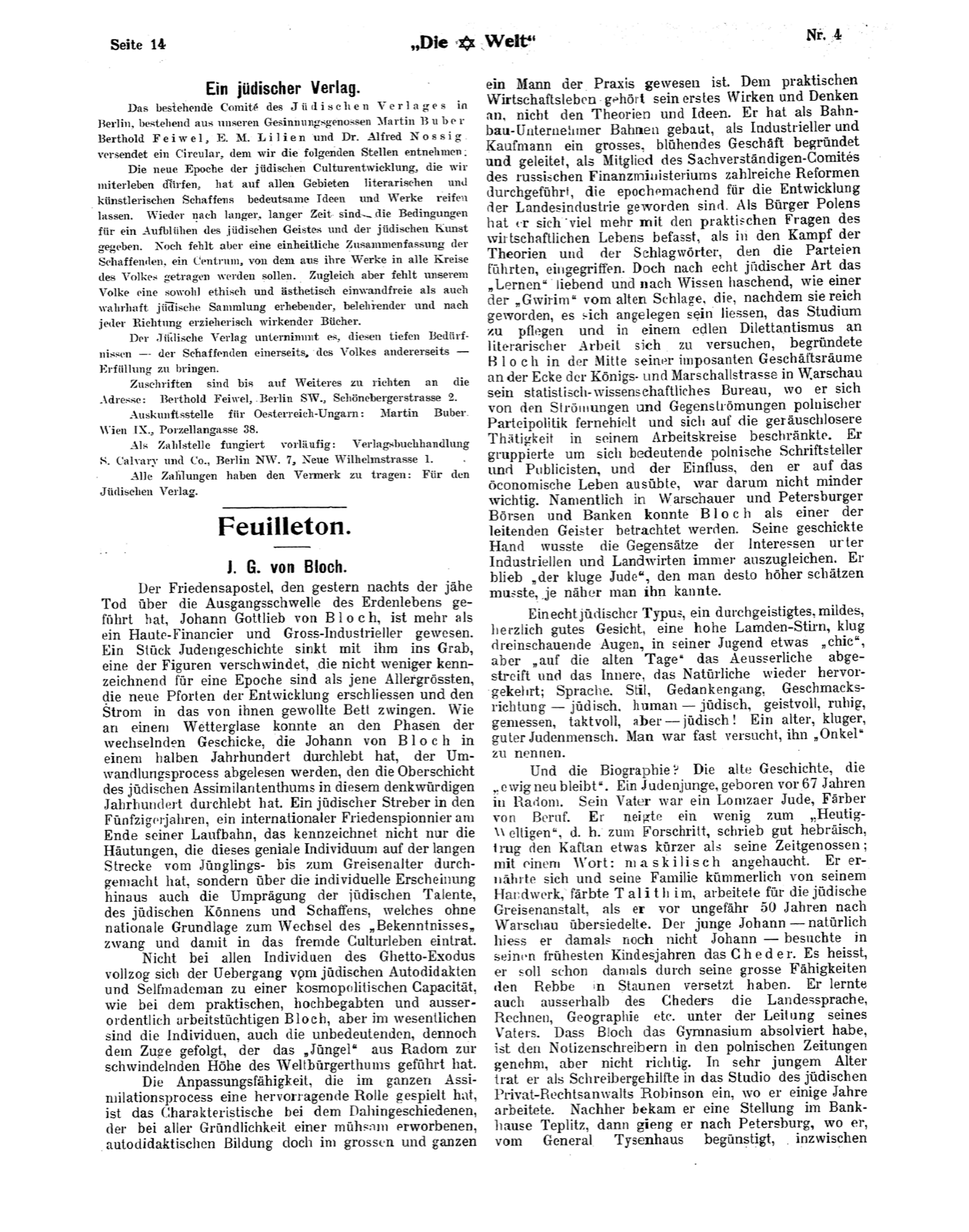
Page 14. — "Die Welt" — No. 4.
A Jewish Publishing House.
The existing committee of the Jüdischer Verlag in Berlin, consisting of our like-minded friends Martin Buber, Berthold Feiwel, E. M. Lilien and Dr. Alfred Nossig, is sending out a circular from which we take the following passages:
The new epoch of Jewish cultural development which we are privileged to witness has ripened significant ideas and works in every field of literary and artistic creation. Once again, after a long, long time, the conditions are given for a flowering of the Jewish spirit and of Jewish art. What is still lacking, however, is a unified gathering-together of those who create, a centre from which their works may be carried into every circle of the people. At the same time our people lacks a collection of uplifting, instructive and in every respect educative books that shall be both ethically and aesthetically unexceptionable and truly Jewish.
The Jüdischer Verlag undertakes to bring fulfilment to these deep needs — of the creators on the one hand, of the people on the other.
Communications are to be addressed until further notice to: Berthold Feiwel, Berlin SW., Schönebergerstrasse 2.
Information office for Austria-Hungary: Martin Buber, Vienna IX., Porzellangasse 38.
Acting provisionally as paying office: the publishing house S. Calvary and Co., Berlin NW. 7, Neue Wilhelmstrasse 1.
All payments are to bear the note: For the Jüdischer Verlag.
Feuilleton.
J. G. von Bloch.
The apostle of peace whom sudden death led last night across the threshold out of earthly life, Johann Gottlieb von Bloch, was more than a magnate of high finance and a great industrialist. A piece of Jewish history sinks with him into the grave; there vanishes one of those figures who are no less characteristic of an epoch than those very greatest who open new portals of development and force the stream into the bed they have willed for it. As on a barometer, one could read in the phases of the changing fortunes through which Johann von Bloch passed in half a century the process of transformation which the upper stratum of Jewish assimilationism underwent in this memorable century. A Jewish striver in the fifties, an international pioneer of peace at the end of his career — this marks not only the sloughings which this gifted individual went through on the long stretch from youth to old age, but, beyond the individual phenomenon, the recoining of Jewish talents, of Jewish ability and creation, which, lacking a national foundation, was compelled to change its "confession" and thereby entered into the alien life of culture.
Not with every individual of the Ghetto exodus was the transition from Jewish autodidact and self-made man to cosmopolitan capacity accomplished as with the practical, highly gifted and extraordinarily industrious Bloch; but in essence the individuals, even the insignificant ones, have nevertheless followed the current that led the "Jüngel" from Radom to the dizzy heights of world-citizenship.
The adaptability which has played an outstanding part in the whole process of assimilation is what characterises the departed, who, for all the thoroughness of a laboriously acquired, self-taught education, was on the whole a man of practice. His first activity and thought belonged to practical economic life, not to theories and ideas. As a railway contractor he built railways; as industrialist and merchant he founded and conducted a great and flourishing business; as a member of the committee of experts of the Russian Ministry of Finance he carried through numerous reforms which became epoch-making for the development of the country's industry. As a citizen of Poland he concerned himself far more with the practical questions of economic life than he intervened in the struggle of theories and catchwords which the parties waged. Yet, loving "learning" after the true Jewish fashion and eager for knowledge, like one of the "Gwirim" of the old stamp, who, having grown rich, made it their concern to cultivate study and to try their hand at literary work in a noble dilettantism, Bloch founded, in the midst of his imposing business premises at the corner of the Königsstrasse and Marschallstrasse in Warsaw, his statistical-scientific bureau, where he held aloof from the currents and counter-currents of Polish party politics and confined himself to the quieter activity within his own sphere of work. He gathered about him distinguished Polish writers and publicists, and the influence he exercised upon economic life was none the less important for that. On the Warsaw and St. Petersburg exchanges and in their banks especially, Bloch could be regarded as one of the leading spirits. His skilful hand always knew how to reconcile the conflicting interests of industrialists and agriculturists. He remained "the clever Jew," whom one had to esteem the more highly the better one knew him.
A true Jewish type: a spiritualised, gentle, heartily kind face, a high Lamden brow, shrewdly gazing eyes; somewhat "chic" in his youth, but "in his old age" having stripped off the external and turned the inner, the natural, outward again; speech, style, train of thought, bent of taste — Jewish, humane — Jewish, witty, calm, measured, tactful, but — Jewish! An old, wise, good Jewish soul. One was almost tempted to call him "Uncle."
And the biography? The old story that "remains ever new." A Jewish boy, born 67 years ago in Radom. His father was a Jew of Lomza, a dyer by trade. He inclined a little towards the "present-worldly," that is, towards progress; he wrote good Hebrew and wore his caftan somewhat shorter than his contemporaries; in a word, touched with the Haskalah. He supported himself and his family meagrely by his craft, dyed Talithim, and worked for the Jewish home for the aged, when some 50 years ago he removed to Warsaw. The young Johann — naturally he was not yet called Johann then — attended the Cheder in his earliest years of childhood. It is said that even then he astonished the Rebbe by his great abilities. Outside the Cheder, too, he learned the language of the country, arithmetic, geography, etc., under his father's guidance. That Bloch completed the gymnasium is agreeable to the paragraph-writers of the Polish newspapers, but not correct. At a very early age he entered as a clerk's assistant the chambers of the Jewish private advocate Robinson, where he worked for some years. Afterwards he obtained a position in the banking house of Teplitz, then went to St. Petersburg, where, favoured by General Tysenhaus, he in the meantime