— 23 —
(continued from page 22)
…is called Kislev, on the first day of the feast of Chanuka, the performance was to take place . . .
When the stars already shone in the heavens, Salomon took a little wax taper and set it in a silver candlestick.
An old family piece was this candlestick.
Eight knops grew upward side by side in the form of blossoming roses, so that lights might be set in the opened cups. About the flower-work a golden band wound itself and held it together. On either side stood cherubim with outspread wings, and their inner wings enclosed a surface that was divided into three fields. Into each of the fields a scene was engraved. On the right the aged Matatjahu slays beside the altar the apostate who sacrifices to the heathen idols; on the left one saw Judah, joyful as a lion that has run down its prey, marching with his brethren and his men of war toward Jerusalem; in the middle was the festival of the Temple. The people have fallen upon their faces and pray, the priests sing, play upon harps and cymbals, lay the shewbread upon the table, burn incense at the altar and offer sacrifice thereon.
. . . Salomon kindled the light and began to pray. He thanked God that by the hand of Judah He had smitten the enemy, that He had raised up again the whole house of Jacob, which was full of lamentation, and had taken the shame from it and suffered it to restore the defiled sanctuary. And in his prayer Salomon renewed the covenant with the Lord and begged His protection for himself and his family and all who had remained steadfast in the Law.
Basche Leie sat in a high chair by the table and filled the paper bags that lay before her with figs, raisins, almonds and cake. Each filled bag was laid out in order upon the table by Chajuscha, Händel's youngest daughter, who lived with her grandparents.
"There, now we should be done," said Basche Leie, and gave Chajuscha two figs and a few almonds that were left over.
She counted the bags with her eye.
"It is right," she said, and, turning to Salomon, she asked: "What o'clock is it, Salomon?"
"Half-past six," answered Salomon, "they will surely be here soon."
"They will come, Salomon," — began Basche Leie in a tearful tone — "and how do I sit here, how? I have nothing at all to put on."
She never had anything to put on, she never had anything to eat. That was her perpetual complaint.
Salomon seemed to hear it often; he answered nothing.
Basche Leie was irritated by his silence.
"The three houses I shall take with me into the grave, eh?"
"Basche," said Salomon now, quite calmly.
"For everybody you have money, and for me . . ."
She would have gone on speaking, but Salomon cut her short.
"Basche, to-day is Chanuka."
And more gently he added: "And you must not excite yourself; the doctor has strictly forbidden it."
She began again:
"Salomon, I have such a bad taste in my mouth."
"Chajuscha, bring grandmother some grapes," he said.
"The ones from Neugebauer," cried Basche.
Chajuscha brought a little basket of grapes from the other room and set it down before Basche.
Basche took each grape carefully between two fingers and carried it slowly and solemnly to her mouth.
Salomon walked up and down the room with long strides; Chajuscha took silver spoons and a tea service out of the glass cabinet.
Thus nearly a quarter of an hour went by.
Steps were heard outside.
"Put the little basket back again," said Basche Leie to Chajuscha, "I have had enough."
David came with Rebeka and with their three children. They were festively dressed; Rebeka was all in ribbons. The children kissed their grandparents' hands; Chilusch*) kissed both of Basche's hands.
Salomon talked with David in the corner; Rebeka sat down beside Basche and found her mother-in-law looking so well to-day, almost young again.
Basche Leie was flattered; Rebeka's words did her good.
*) Diminutive of Chiel.
"Grandmother," said Chilusch, "I have had nothing yet for my praying this week."
Basche Leie drew her purse out of her pocket and slowly counted out to Chilusch eight Kreuzer, one Kreuzer for the daily praying and two for the Sabbath prayer.
"And did you pray devoutly?" she asked.
Chilusch nodded, kissed Basche Leie's hands again and pocketed the eight Kreuzer . . .
Now came the guests. Bertha and Simon with four children, Händel, then two married daughters of Händel with their husbands and children, the next-door neighbour Alter Printz with his wife, and last of all Zirl — a relative — with her daughter.
They greeted one another and talked loudly all together. Basche Leie gave every child a bag. The children ran off into a corner; about Basche the elder people gathered.
"What am I to set before you?" asked Basche Leie. "There is almost nothing here; you must put up with what you find. I have been ill, you know."
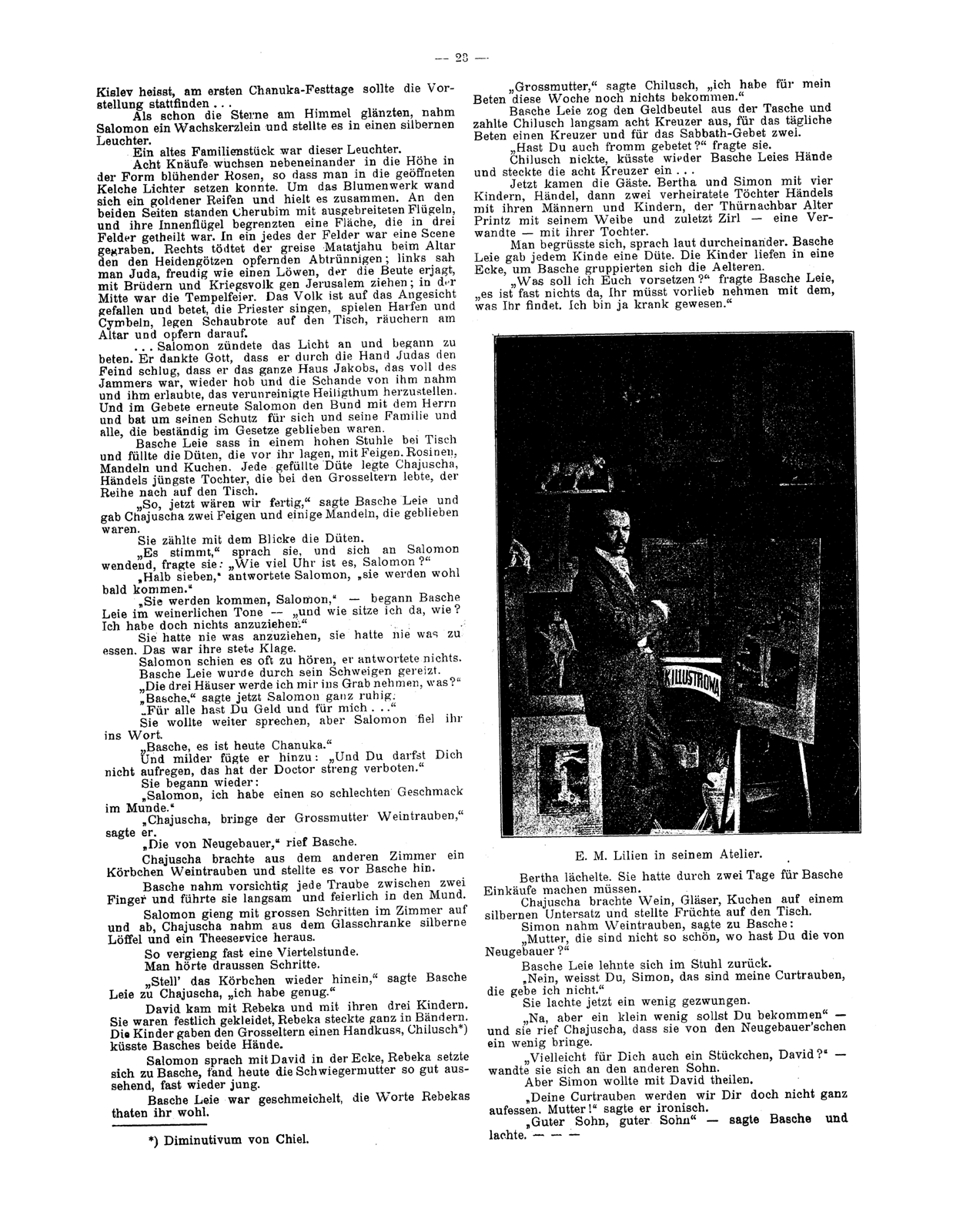
E. M. Lilien in his studio.
Bertha smiled. For two days she had had to do the shopping for Basche.
Chajuscha brought wine, glasses and cake upon a silver salver, and set fruit upon the table.
Simon took some grapes and said to Basche:
"Mother, these are not so fine; where have you the ones from Neugebauer?"
Basche Leie leaned back in her chair.
"No, you see, Simon, those are my cure-grapes; those I do not give away."
She laughed now a little constrainedly.
"Well, but a very little you shall have" — and she called Chajuscha to bring a few of the Neugebauer ones.
"Perhaps a little piece for you too, David?" — she turned to her other son.
But Simon wished to share with David.
"We shall surely not eat up all your cure-grapes, mother!" he said ironically.
"Good son, good son" — said Basche, and laughed. — — —