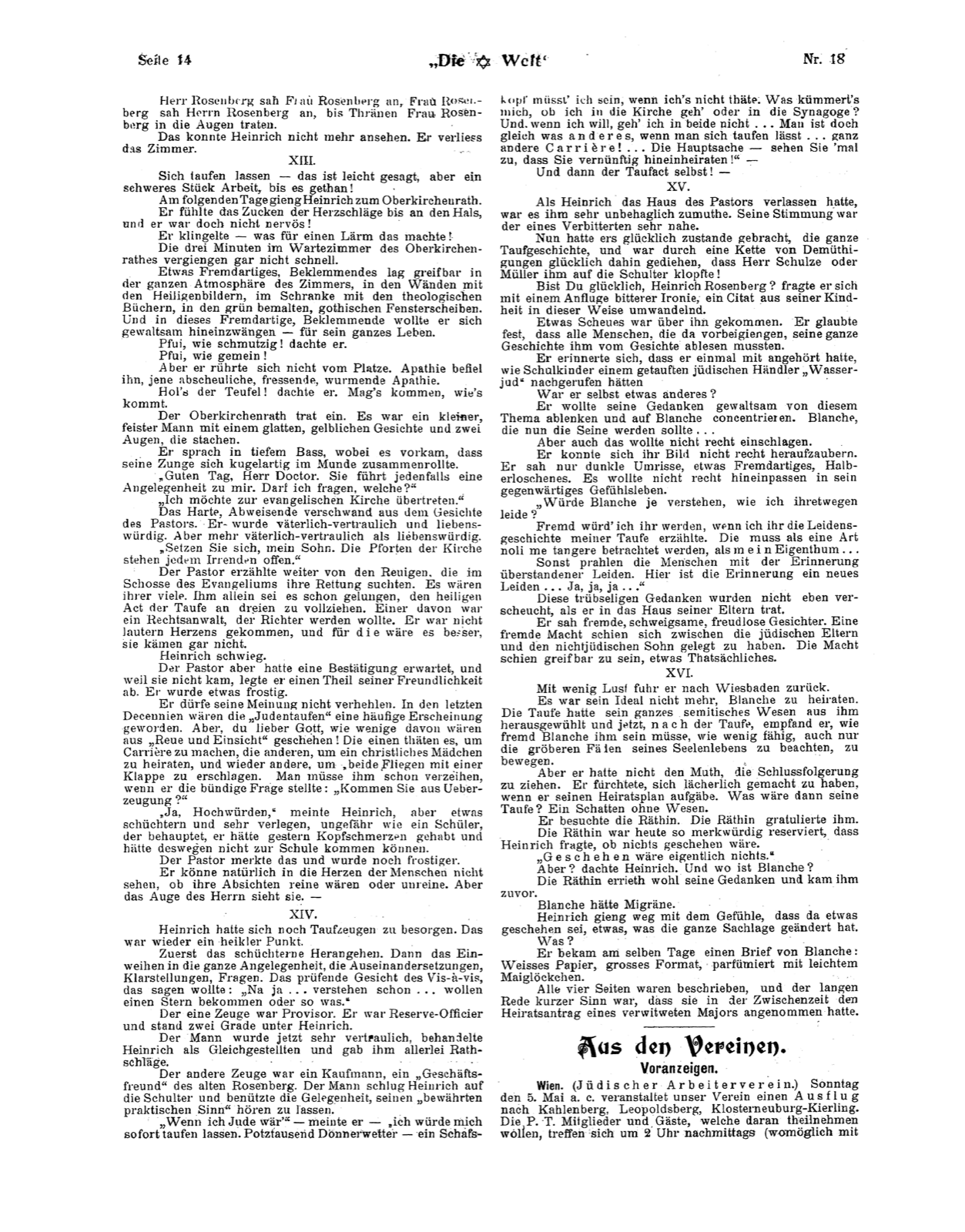
Page 14. — "Die Welt" — No. 18.
Herr Rosenberg looked at Frau Rosenberg, Frau Rosenberg looked at Herr Rosenberg, until the tears came into Frau Rosenberg's eyes.
Heinrich could look on at this no longer. He left the room.
XIII.
To have oneself baptised — that is easily said, but it is a hard piece of work before it is done!
On the following day Heinrich went to the Oberkirchenrath.
He felt the twitching of his heartbeats right up to his throat — and yet he was not nervous!
He rang — what a noise that made!
The three minutes in the Oberkirchenrath's waiting-room did not pass at all quickly.
Something alien, something oppressive lay palpably in the whole atmosphere of the room, in the walls with their pictures of saints, in the cupboard with the theological books, in the green-painted gothic window-panes. And into this alien, oppressive thing he meant to force himself by violence — for his whole life long.
Faugh, how dirty! he thought.
Faugh, how base!
But he did not stir from the spot. Apathy came over him, that hateful, devouring, gnawing apathy.
The devil take it! he thought. Let it come as it comes.
The Oberkirchenrath came in. He was a small, portly man with a smooth, yellowish face and two eyes that stabbed.
He spoke in a deep bass, and it happened at times that his tongue rolled itself up in his mouth like a ball.
"Good day, Herr Doctor. Some matter of business no doubt brings you to me. May I ask what it is?"
"I wish to go over to the Evangelical Church."
The hard, repellent look vanished from the pastor's face. He became fatherly-confidential and amiable. But more fatherly-confidential than amiable.
"Be seated, my son. The gates of the Church stand open to every one who errs."
The pastor went on to tell of the penitent who sought their salvation in the bosom of the Gospel. There were many of them. He alone had already succeeded in performing the holy act of baptism upon three. One of them was an advocate who wished to become a judge. He had not come with a pure heart, and for such as these it were better that they did not come at all.
Heinrich was silent.
But the pastor had expected some confirmation, and because it did not come he laid aside a part of his friendliness. He grew somewhat frosty.
He might not conceal his opinion. In the last decades the "Jew-baptisms" had become a frequent phenomenon. But, dear God, how few of them had come about out of "repentance and insight"! Some did it to make a career, others to marry a Christian girl, and yet others to "kill both birds with one stone. He must be forgiven if he put the plain question: "Do you come out of conviction?"
"Yes, Your Reverence," said Heinrich, but somewhat timidly and very much embarrassed, much like a schoolboy who declares that he had a headache yesterday and could not come to school on that account.
The pastor noticed it and grew frostier still.
He could not, of course, see into the hearts of men, whether their intentions were pure or impure. But the eye of the Lord sees them. —
XIV.
Heinrich had still to procure sponsors for his baptism. That was another ticklish point.
First the timid approach. Then the initiation into the whole affair, the explanations, the clearings-up, the questions. The searching face of the man vis-à-vis, which seemed to say: "Ah yes... quite understand... want to get a star or something of the sort."
The one sponsor was a dispensing chemist. He was a reserve officer and stood two grades below Heinrich.
The man now became very familiar, treated Heinrich as an equal, and gave him advice of all kinds.
The other sponsor was a merchant, a "business friend" of old Rosenberg's. The man clapped Heinrich on the shoulder and took the opportunity of letting his "tried practical sense" be heard.
"If I were a Jew" — said he — "I should have myself baptised at once. Thunder and lightning — I should have to be a sheep's-head not to do it. What does it matter to me whether I go to church or to synagogue? And if I choose, I go to neither of them... One is something quite different the moment one is baptised... a wholly different career!... The main thing — just see to it that you make a sensible marriage!" —
And then the act of baptism itself! —
XV.
When Heinrich had left the pastor's house, he felt very ill at ease. His mood came very near to that of an embittered man.
Now he had happily brought it off, the whole business of the baptism, and through a chain of humiliations had happily arrived at this: that Herr Schulze or Müller clapped him on the shoulder!
Are you happy, Heinrich Rosenberg? he asked himself with a touch of bitter irony, transforming in this manner a quotation from his childhood.
Something shy had come over him. He firmly believed that all the people who passed by must read his whole story in his face.
He remembered that he had once overheard schoolchildren calling "Water-Jew" after a baptised Jewish tradesman
Was he himself anything else?
He tried to force his thoughts away from this theme and to concentrate them upon Blanche. Blanche, who was now to become his...
But that too would not quite take effect.
He could not rightly conjure up her image. He saw only dark outlines, something alien, something half extinguished. It would not rightly fit into his present life of feeling.
"Would Blanche ever understand how I suffer for her sake?"
I should become a stranger to her if I told her the story of the sufferings of my baptism. That must be regarded as a kind of noli me tangere, as my own property...
Ordinarily men boast of the memory of sufferings endured. Here the memory is a new suffering... Yes, yes, yes..."
These gloomy thoughts were not exactly driven away when he entered the house of his parents.
He saw strange, silent, joyless faces. A strange power seemed to have laid itself between the Jewish parents and the non-Jewish son. The power seemed palpable, something actual.
XVI.
With little pleasure he travelled back to Wiesbaden.
It was no longer his ideal to marry Blanche. The baptism had rooted his whole Semitic nature up out of him, and now, after the baptism, he felt how alien Blanche must be to him, how little able even to observe, to stir, the coarser threads of his inner life.
But he had not the courage to draw the conclusion. He feared he would have made himself ridiculous if he gave up his plan of marriage. What then would his baptism be? A shadow without a substance.
He called upon the Räthin. The Räthin congratulated him.
The Räthin was to-day so remarkably reserved that Heinrich asked whether anything had happened.
"Nothing, properly speaking, had happened."
But? thought Heinrich. And where is Blanche?
The Räthin doubtless guessed his thoughts and forestalled him.
Blanche had a migraine.
Heinrich went away with the feeling that something had happened there, something that had changed the whole situation.
What?
That same day he received a letter from Blanche: white paper, large format, perfumed with a light lily-of-the-valley.
All four pages were written over, and the long and the short of it was that in the meantime she had accepted the offer of marriage of a widowed major.
From the Societies.
Advance Notices.
Vienna. (Jewish Workers' Society.) On Sunday the 5th of May of this year our Society is arranging an excursion to the Kahlenberg, the Leopoldsberg, and Klosterneuburg-Kierling. The P. T. members and guests who wish to take part in it meet at 2 o'clock in the afternoon (if possible with