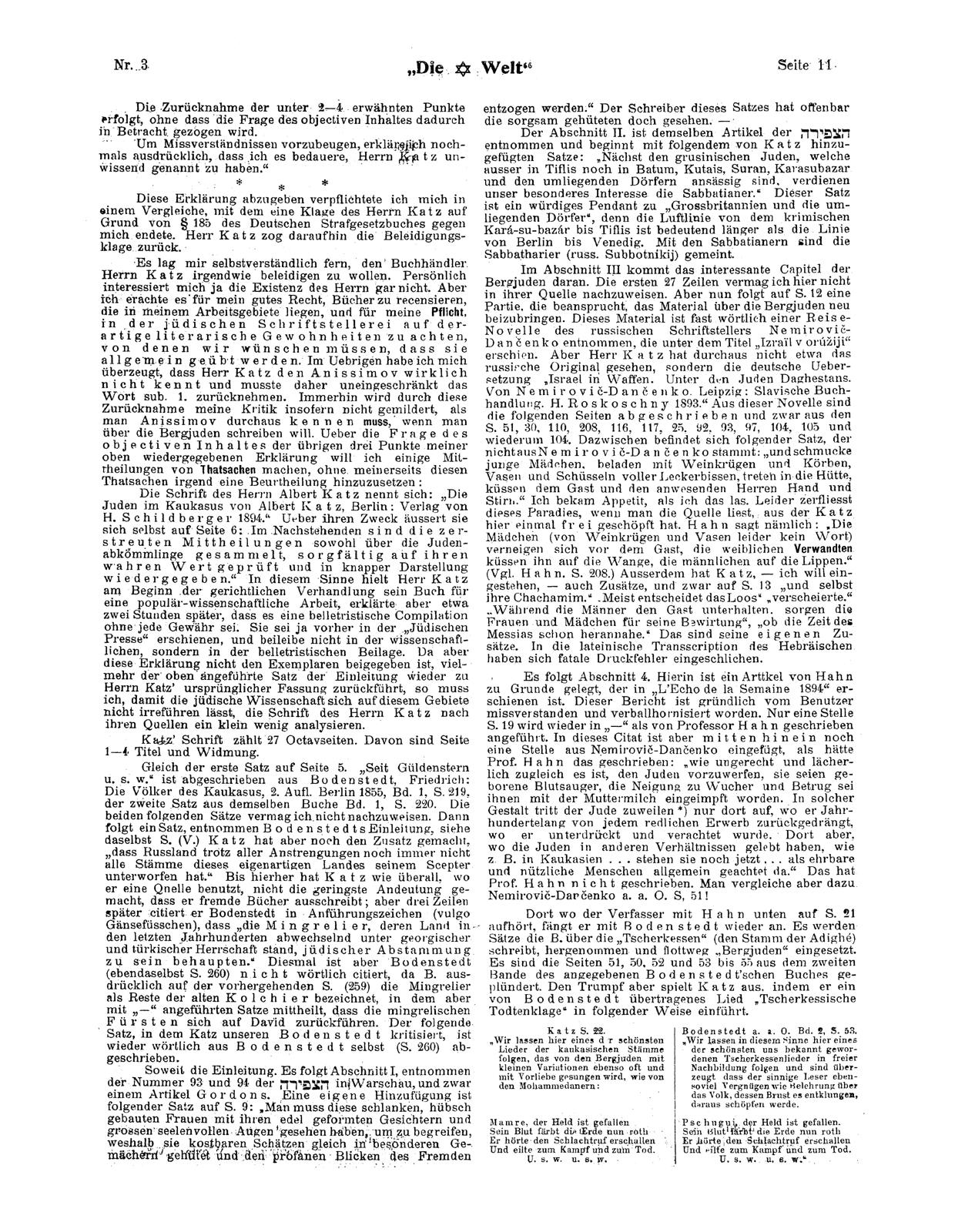
No. 3 — "Die Welt" — Page 11.
The withdrawal of the points mentioned under 2—4 takes place without the question of the objective content being thereby taken into consideration.
In order to forestall misunderstandings, I declare once more expressly that I regret having called Herr Katz ignorant."
* * *
To make this declaration I bound myself in a settlement with which an action of Herr Katz against me on the ground of § 185 of the German Penal Code came to an end. Herr Katz thereupon withdrew the action for defamation.
It was of course far from my intention to wish in any way to insult the bookseller Herr Katz. Personally the existence of the gentleman does not interest me at all. But I hold it to be my good right to review books which lie within my field of work, and my duty to have regard, in Jewish authorship, to such literary usages as we must wish to see universally practised. For the rest, I have satisfied myself that Herr Katz really does not know Anissimov, and I was therefore obliged to withdraw without reserve the words sub 1. Nevertheless my criticism is not softened by this withdrawal in so far as one absolutely must know Anissimov if one would write about the Mountain Jews. Upon the question of the objective content of the remaining three points of my declaration reproduced above I will make some communications of facts, without adding on my own part any judgment whatever upon these facts:
Herr Albert Katz's work calls itself: "The Jews in the Caucasus, by Albert Katz, Berlin: Published by H. Schildberger 1894." Upon its purpose it expresses itself on page 6: In what follows the scattered communications concerning the descendants of the Jews have been collected, carefully tested as to their true worth, and reproduced in a concise presentation." In this sense Herr Katz, at the beginning of the judicial proceedings, held his book to be a popular-scientific work, but declared about two hours later that it was a belletristic composition without any warranty whatever. It had, he said, appeared previously in the "Jüdische Presse," and by no means in the scientific, but in the belletristic supplement. But since this declaration is not appended to the copies, and since rather the sentence of the introduction cited above leads back to Herr Katz's original version, I must — so that Jewish science may not let itself be led astray in this field — analyse Herr Katz's work a very little according to its sources.
Katz's work numbers 27 octavo pages. Of these, pages 1–4 are title and dedication.
The very first sentence on page 5, "Since Güldenstern etc.," is copied out of Bodenstedt, Friedrich: The Peoples of the Caucasus, 2nd ed., Berlin 1855, vol. 1, p. 219; the second sentence out of the same book, vol. 1, p. 220. The two following sentences I am unable to trace. Then follows a sentence taken from Bodenstedt's introduction, see there p. (V.) Katz has, however, made the further addition "that Russia, in spite of all exertions, has still not subjected all the tribes of this peculiar land to its sceptre." Thus far Katz has, as everywhere where he uses a source, given not the slightest hint that he is copying out other men's books; but three lines later he quotes Bodenstedt within quotation marks (vulgo goose-feet), that "the Mingrelians, whose land in the last centuries stood alternately under Georgian and Turkish dominion, claim to be of Jewish descent." This time, however, Bodenstedt (ibid. p. 260) is not quoted verbally, since B. expressly, on the preceding p. (259), designates the Mingrelians as remnants of the ancient Colchians, while in the sentence adduced with "—" he states that the Mingrelian princes trace themselves back to David. The following sentence, in which Katz criticises our Bodenstedt, is again copied verbally out of Bodenstedt himself (p. 260).
So much for the introduction. There follows Section I, taken from Numbers 93 and 94 of the הצפירה (Ha-Zefirah) in Warsaw, and indeed from an article of Gordon's. An addition of his own is the following sentence on p. 9: "One must have seen these slender, handsomely built women with their nobly formed faces and great soulful eyes in order to comprehend why they are guarded like precious treasures in special chambers and withdrawn from the profane glances of the stranger." The writer of this sentence has evidently seen the carefully guarded ones after all. —
Section II. is taken from the same article of the הצפירה and begins with the following sentence added by Katz: "Next to the Grusinian Jews, who besides in Tiflis are settled also in Batum, Kutais, Suran, Karasubazar and the surrounding villages, the Sabbatians deserve our especial interest." This sentence is a worthy counterpart to "Great Britain and the surrounding villages," for the air-line from the Crimean Kará-su-bazár to Tiflis is considerably longer than the line from Berlin to Venice. By the Sabbatians the Sabbatarians (Russ. Subbotnikij) are meant.
In Section III comes the turn of the interesting chapter of the Mountain Jews. The first 27 lines I am here unable to trace to their source. But now there follows on p. 12 a portion which claims to bring forward afresh the material upon the Mountain Jews. This material is taken almost verbally from a travel-novel of the Russian writer Nemirovič-Dančenko which appeared under the title "Izrail v orúžiji." But Herr Katz has by no means seen the Russian original, but rather the German translation "Israel in Arms. Among the Jews of Daghestan. By Nemirovič-Dančenko. Leipzig: Slavische Buchhandlung. H. Roskoschny 1893." Out of this novel the following pages have been copied, namely out of pp. 51, 30, 110, 208, 116, 117, 25, 92, 93, 97, 104, 105 and once again 104. Between them stands the following sentence, which does not come from Nemirovič-Dančenko: "and trim young maidens, laden with wine-jars and baskets, vases and dishes full of dainties, enter the hut and kiss the hand and brow of the guest and of the gentlemen present." I got an appetite when I read that. Unhappily this paradise melts away when one reads the source out of which Katz has here for once drawn freely. For Hahn says: "The maidens (of wine-jars and vases unfortunately not a word) bow before the guest, the female relatives kiss him on the cheek, the male on the lips." (Cf. Hahn p. 208.) Besides this Katz has — I will admit it — additions of his own too, namely on p. 13 "and even their Chachamim." "Mostly the lot decides" "veiled." "While the men entertain the guest, the women and maidens see to his entertainment," "whether the time of the Messiah be already drawing near." These are his own additions. Into the Latin transcription of the Hebrew fatal misprints have crept.
There follows Section 4. Herein an article of Hahn's is laid at the foundation, which appeared in "L'Echo de la Semaine 1894." This report has been thoroughly misunderstood and garbled by the user. Only one passage on p. 19 is again adduced in "—" as written by Professor Hahn. Into this quotation, however, there is inserted right in the middle a passage from Nemirovič-Dančenko, as though Prof. Hahn had written it: "how unjust and at the same time ridiculous it is to reproach the Jews with being born bloodsuckers, with having had the inclination to usury and fraud inoculated into them with their mother's milk. In such a shape the Jew appears at times *) only there where he has been for centuries thrust back from every honest means of gain, where he was oppressed and despised. But there where the Jews have lived under other conditions, as for example in Caucasia . . . they stand even now . . . universally respected as honourable and useful men." That Prof. Hahn did not write. But let one compare thereto Nemirovič-Dančenko loc. cit. p. 51!
There where the author leaves off with Hahn at the foot of p. 21, he begins again with Bodenstedt. Sentences which B. writes about the "Circassians" (the tribe of the Adighé) are taken over and "Mountain Jews" briskly put in their place. It is pages 51, 50, 52 and 53 to 55 of the second volume of the Bodenstedt book named above that are plundered. But Katz plays his trump card by introducing in the following manner a song rendered by Bodenstedt, "Circassian Lament for the Dead."
Katz p. 22. "We let follow here one of the finest songs of the Caucasian tribes, which is sung by the Mountain Jews, with small variations, just as often and with just as much predilection as by the Mohammedans:
Mamre, the hero is fallen, His blood now dyes the earth red, He heard the battle-cry resounding And hastened to the fight and to death. Etc. etc.
Bodenstedt loc. cit. vol. 2, p. 53. "In this sense we let follow here, in free imitation, one of the finest Circassian songs that have become known to us, and are convinced that the thoughtful reader will draw from it as much pleasure as instruction concerning the people from whose breast it sprang.
Pse huginı, the hero is fallen. His blood now dyes the earth red, He heard the battle-cry resounding And hastened to the fight and to death. Etc. etc."