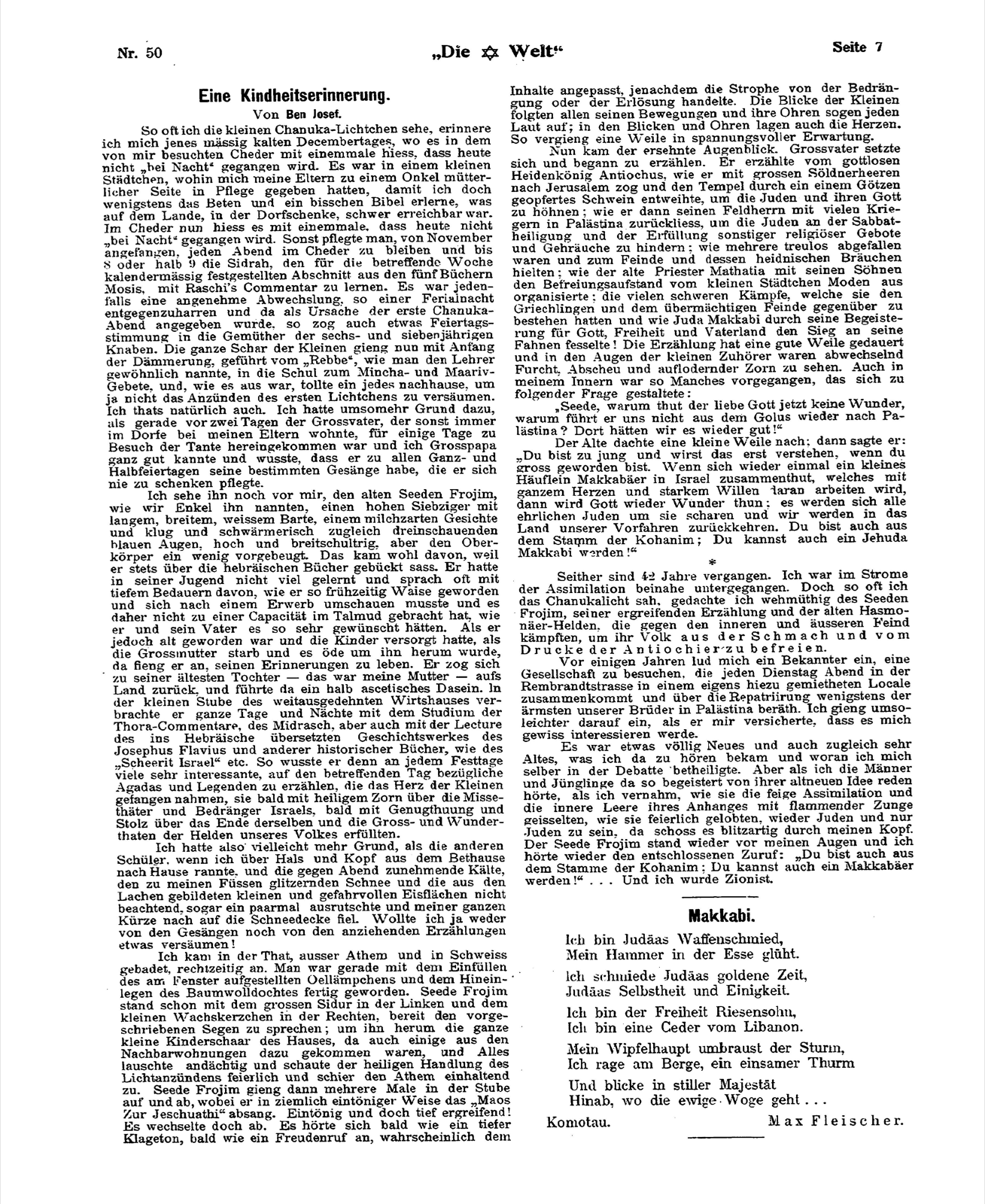
No. 50. — "Die ✡ Welt" — Page 7.
A Recollection of Childhood.
By Ben Josef.
As often as I see the little Chanuka lights, I call to mind that moderately cold December day when in the Cheder which I attended it was all at once given out that to-day there would be no going "by night". It was in a little country town, whither my parents had put me out to the care of an uncle on my mother's side, that I might at least learn to say my prayers and a little Bible, which in the country, in the village tavern, was hard to come by. In the Cheder, then, it was all at once given out that to-day there would be no going "by night". Otherwise it was the custom, from November onwards, to remain every evening in the Cheder and until 8 or half-past 8 to learn the Sidrah — the portion from the five Books of Moses appointed by the calendar for the week in question — with Rashi's commentary. It was in any case a pleasant change to look forward to such a holiday night, and since the first Chanuka evening was given as the reason, something of a festival mood came over the spirits of the six- and seven-year-old boys as well. The whole troop of little ones went now, at the coming on of the dusk, led by the "Rebbe", as the teacher was commonly called, into the Schul for the Mincha and Maariv prayers, and, when it was over, each one romped off home, that he might on no account miss the kindling of the first little light. I did so too, of course. I had all the more reason for it, since but two days before my grandfather, who otherwise always lived in the village with my parents, had come in for a few days on a visit to my aunt, and I knew grandpapa very well and knew that for all the whole and half festivals he had his appointed chants, which he never used to let himself off.
I see him before me still, old Seede Frojim, as we grandchildren called him, well on in his seventies, with a long, broad, white beard, a face soft as milk, and blue eyes that looked out shrewdly and dreamily at once, tall and broad-shouldered, but with the upper body bent a little forward. That came, no doubt, of his sitting always bowed over the Hebrew books. In his youth he had not learned much, and often spoke with deep regret of how he had been orphaned so early and had had to look about him for a livelihood, and had therefore never attained to authority in the Talmud, as he and his father would so much have wished. When, however, he had grown old and had provided for his children, when my grandmother died and it grew desolate about him, then he began to live to his memories. He withdrew to his eldest daughter — that was my mother — into the country, and there led a half-ascetic existence. In the little chamber of the wide, rambling inn he passed whole days and nights in the study of the commentaries on the Thora, of the Midrasch, but also in the reading of the historical work of Josephus Flavius translated into Hebrew, and of other historical books, such as the "Scheerit Israel", etc. Thus on every festival day he knew how to tell many very interesting Agadas and legends bearing upon the day in question, which took the hearts of the little ones captive and filled them now with holy wrath at the evildoers and oppressors of Israel, now with satisfaction and pride at the end that befell them and at the great and wondrous deeds of the heroes of our people.
I had then perhaps more reason than the other pupils, when I ran headlong from the house of prayer homewards and, heeding neither the cold that grew keener towards evening, nor the snow that glittered at my feet, nor the little and perilous sheets of ice formed out of the puddles, even slipped a few times and fell my whole short length upon the covering of snow. For I would miss nothing either of the chants or of the enthralling tales!
I did in fact arrive in good time, out of breath and bathed in sweat. They had just finished filling the little oil lamp set up at the window and laying in the cotton wick. Seede Frojim stood already with the great Sidur in his left hand and the little wax taper in his right, ready to pronounce the prescribed blessing; about him the whole little company of the children of the house, for some had come in besides from the neighbouring dwellings, and all listened devoutly and looked on at the holy act of the kindling of the light solemnly and well-nigh holding their breath. Seede Frojim then walked several times up and down the room, singing out the while, in a fashion rather monotonous, the "Maos Zur Jeschuathi". Monotonous and yet deeply moving! For it did vary. It sounded now like a deep note of lamentation, now like a cry of joy, adapted probably to the burden, according as the strophe treated of the oppression or of the deliverance. The eyes of the little ones followed all his movements and their ears drank in every sound; in the eyes and the ears lay the hearts as well. So a while passed in tense expectation.
Now came the longed-for moment. Grandfather sat down and began to tell. He told of the godless heathen king Antiochus, how he marched upon Jerusalem with great armies of mercenaries and defiled the Temple with a swine sacrificed to an idol, in order to mock the Jews and their God; how he then left his general behind in Palestine with many soldiers, in order to hinder the Jews in the hallowing of the Sabbath and in the fulfilment of other religious precepts and usages; how several had faithlessly fallen away and held with the enemy and his heathen customs; how the old priest Mathatia with his sons organised the rising for freedom from the little town of Moden; the many hard struggles which they had to sustain against the Greeklings and the overwhelming foe, and how Juda Makkabi, by his enthusiasm for God, freedom and fatherland, bound victory fast to his banners! The tale lasted a good while, and in the eyes of the little hearers there were to be seen by turns fear, abhorrence and flaming wrath. Within me too much had passed which shaped itself into the following question:
"Seede, why does the dear God work no miracles now, why does He not lead us out of the Golus back to Palestine? There we should be well off again!"
The old man reflected a little while; then he said: "Thou art too young, and wilt understand that only when thou hast grown up. When once again a little handful of Maccabees shall band together in Israel, who will labour at it with their whole heart and with a strong will, then will God work miracles again; all honest Jews will gather about them, and we shall return into the land of our forefathers. Thou too art of the tribe of the Kohanim; thou too canst become a Jehuda Makkabi!"
*
Since then 42 years have gone by. In the stream of assimilation I had all but gone under. Yet as often as I saw the Chanuka light, I thought with sadness of Seede Frojim, of his moving tale and of the old Hasmonean heroes who fought against the foe within and the foe without, in order to deliver their people from the shame and from the oppression of the Antiochians.
Some years ago an acquaintance invited me to visit a society which comes together every Tuesday evening in the Rembrandtstrasse, in a room hired expressly for the purpose, and takes counsel upon the repatriation to Palestine of at least the poorest of our brethren. I fell in with it the more readily as he assured me that it would certainly interest me.
It was something wholly new and at the same time something very old that I got to hear there, and in which I myself took part in the debate. But when I heard the men and the young men speak there with such enthusiasm of their old-new idea, when I perceived how with flaming tongue they scourged the cowardly assimilation and the inward emptiness of its adherents, how they solemnly vowed to be Jews again and Jews only, then it shot like lightning through my head. Seede Frojim stood again before my eyes and I heard again the resolute call: "Thou too art of the tribe of the Kohanim; thou too canst become a Maccabee!" . . . And I became a Zionist.
Makkabi.
I am Judaea's armourer, My hammer glows within the forge.
I forge Judaea's golden age, Judaea's selfhood and its unity.
I am the giant son of freedom, I am a cedar of Lebanon.
About my crowning head the storm roars, I tower upon the mountain, a solitary tower
And gaze down in silent majesty To where the eternal billow goes . . .
Komotau. Max Fleischer.