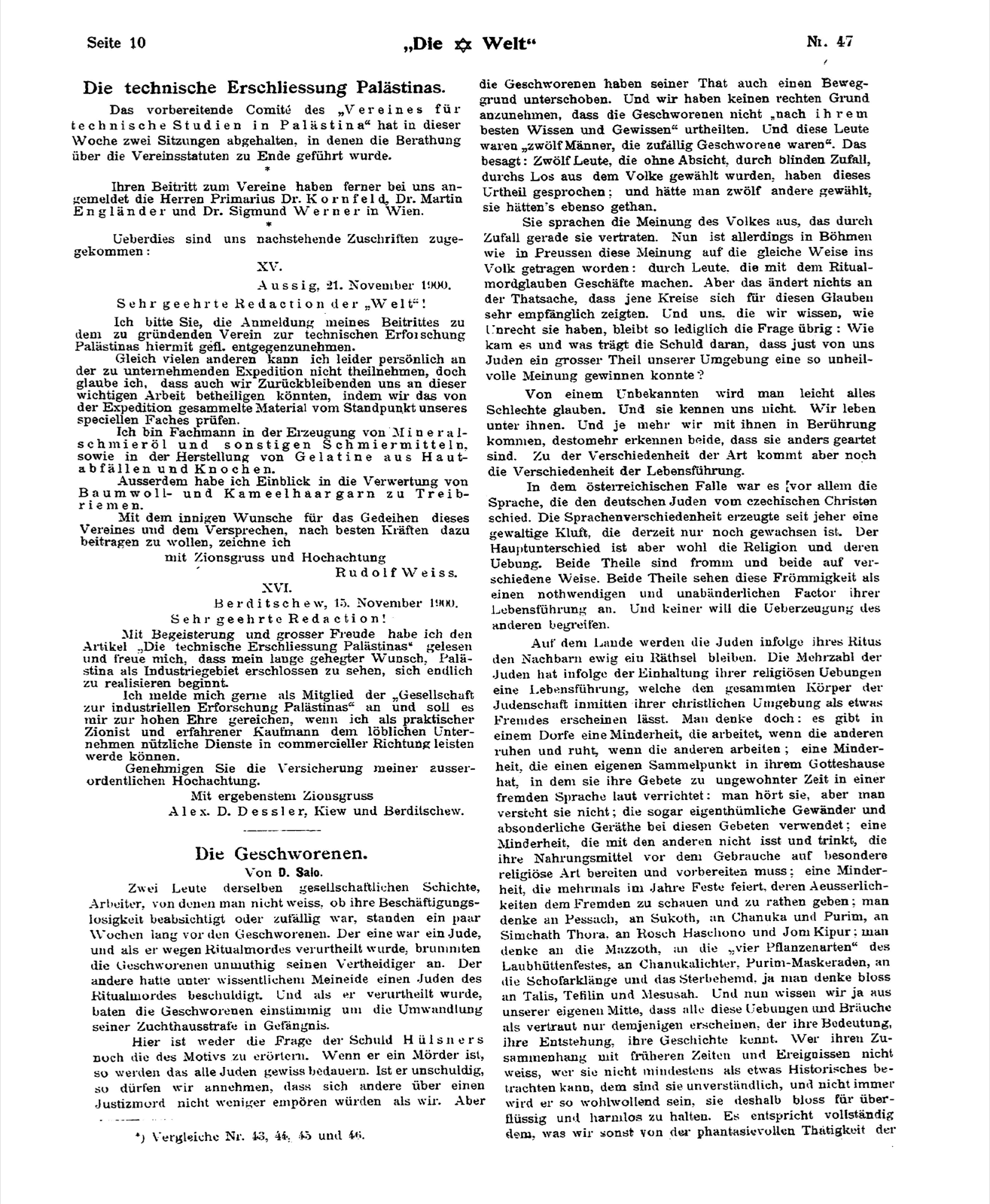
Page 10. — "Die ✡ Welt" — No. 47.
The Technical Opening-Up of Palestine.
The preparatory Committee of the "Society for Technical Studies in Palestine" has held two sittings this week, in which the deliberation upon the statutes of the Society was brought to a close.
*
Their accession to the Society has further been announced to us by the gentlemen Primarius Dr. Kornfeld, Dr. Martin Engländer and Dr. Sigmund Werner in Vienna.
*
Moreover, the following communications have reached us:
XV. Aussig, 21 November 1900. Esteemed Editors of the "Welt"!
I beg you kindly to receive herewith the announcement of my accession to the Society for the Technical Investigation of Palestine which is to be founded.
Like many others, I unfortunately cannot take part personally in the expedition that is to be undertaken; yet I believe that we who remain behind might also share in this important work, in that we examine the material collected by the expedition from the standpoint of our own special branch.
I am an expert in the manufacture of mineral lubricating oil and other lubricants, as well as in the preparation of gelatine from hide waste and bones.
Besides this, I have some insight into the utilisation of cotton and camel-hair yarn for driving-belts.
With the heartfelt wish for the prospering of this Society, and with the promise to contribute thereto to the best of my powers, I sign myself with Zion's greeting and high esteem Rudolf Weiss.
XVI. Berditschew, 15 November 1900. Esteemed Editors!
With enthusiasm and great joy I have read the article "The Technical Opening-Up of Palestine", and I rejoice that my long-cherished wish, to see Palestine opened up as an industrial region, is at last beginning to be realised.
I gladly announce myself as a member of the "Society for the Industrial Investigation of Palestine", and it will redound to my high honour if, as a practical Zionist and experienced merchant, I shall be able to render the laudable undertaking useful services in the commercial direction.
Accept the assurance of my extraordinary esteem. With most devoted Zion's greeting Alex. D. Dessler, Kieff and Berditschew.
The Jury.
By D. Salo.
Two men of the same social stratum, workmen of whom it is not known whether their want of employment was intentional or accidental, stood for a couple of weeks before the jury. The one was a Jew, and when he was condemned for ritual murder, the jurymen growled ill-humouredly at his defender. The other had, under wilful perjury, accused a Jew of ritual murder. And when he was condemned, the jurymen unanimously begged for the commutation of his sentence of penal servitude into simple imprisonment.
Here neither the question of Hülsner's guilt nor that of the motive is to be discussed. If he is a murderer, all Jews will assuredly deplore it. If he is innocent, we may assume that others would be no less indignant at a judicial murder than we. But the jurymen have also foisted a motive upon his deed. And we have no proper ground for assuming that the jurymen did not judge "according to their best knowledge and conscience". And these men were "twelve men who happened to be jurymen". That is to say: twelve men who without design, by blind chance, by lot were chosen out of the people, have pronounced this verdict; and had twelve others been chosen, they would have done the same.
They uttered the opinion of the people whom by chance they precisely represented. Now in Bohemia as in Prussia this opinion has indeed been carried into the people in the same manner: by men who make a business of the ritual-murder belief. But that alters nothing in the fact that those circles showed themselves very susceptible to this belief. And for us, who know how wrong they are, there remains merely the question: How came it, and what bears the blame for it, that precisely of us Jews a great part of our surroundings could form so calamitous an opinion?
Of a man unknown one readily believes everything bad. And they do not know us. We live among them. And the more we come into contact with them, the more do both perceive that they are of a different nature. But to the difference of nature there is added the difference of the conduct of life.
In the Austrian case it was above all the language that divided the German Jew from the Czech Christian. The diversity of language has from of old engendered a mighty gulf, which of late has only grown wider. The chief difference, however, is doubtless religion and its practice. Both parties are devout, and both in a different manner. Both parties regard this piety as a necessary and unalterable factor of their conduct of life. And neither will comprehend the conviction of the other.
In the country the Jews will, in consequence of their ritual, remain for ever a riddle to their neighbours. The majority of the Jews have, in consequence of the observance of their religious practices, a conduct of life which makes the entire body of Jewry, in the midst of its Christian surroundings, appear as something alien. Only consider: there is in a village a minority which works when the others rest, and rests when the others work; a minority which has its own gathering-place in its house of God, wherein at unwonted hours it says its prayers aloud in a strange tongue: one hears them, but one does not understand them; which even employs peculiar garments and singular utensils at these prayers; a minority which does not eat and drink with the others, which must prepare and make ready its foodstuffs before use in a particular religious fashion; a minority which several times in the year celebrates festivals whose outward observances give the stranger much to see and to guess at; let one think of Pessach, of Sukoth, of Chanuka and Purim, of Simchath Thora, of Rosch Haschono and Jom Kipur; let one think of the Mazzoth, of the "four kinds of plants" of the Feast of Tabernacles, of Chanuka lights, Purim masquerades, of the notes of the Shofar and the shroud — nay, let one but think of Talis, Tefilin and Mesusah. And now we know indeed from our own midst that all these usages and customs appear familiar only to him who knows their meaning, their origin, their history. He who does not know their connexion with earlier times and events, who cannot at least regard them as something historical, to him they are unintelligible; and he will not always be so benevolent as on that account to hold them merely superfluous and harmless. It corresponds entirely to what we otherwise of the imaginative activity of the
*) Cf. Nos. 43, 44, 45 and 46.