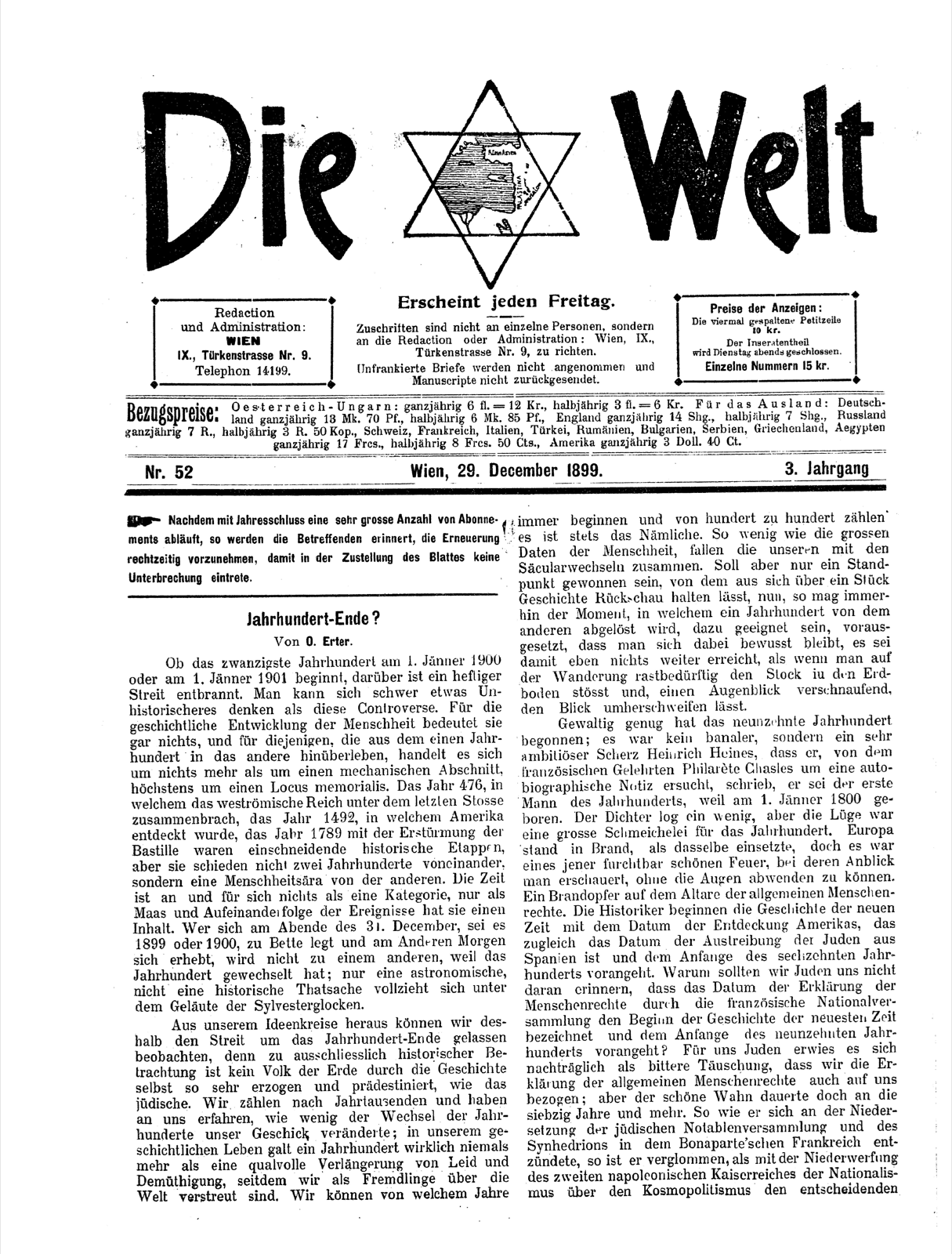
Die Welt
Appears every Friday.
Editorial Office and Administration: VIENNA, IX., Türkenstrasse No. 9. Telephone 14199. — Communications are to be addressed not to individual persons, but to the Editorial Office or the Administration: Vienna, IX., Türkenstrasse No. 9. Unstamped letters are not accepted and manuscripts are not returned. — Rates of advertisement: the four-column petit line 10 kr. The advertisement section closes Tuesday evening. Single numbers 15 kr.
Subscription rates: Austria-Hungary: yearly 6 fl. = 12 Kr., half-yearly 3 fl. = 6 Kr. For abroad: Germany yearly 13 Mk. 70 Pf., half-yearly 6 Mk. 85 Pf.; England yearly 14 Shg., half-yearly 7 Shg.; Russia yearly 7 R., half-yearly 3 R. 50 Kop.; Switzerland, France, Italy, Turkey, Roumania, Bulgaria, Servia, Greece, Egypt yearly 17 Frcs., half-yearly 8 Frcs. 50 Cts.; America yearly 3 Doll. 40 Ct.
No. 52 — Vienna, 29 December 1899. — Third Year
Since a very large number of subscriptions expires with the close of the year, those concerned are reminded to effect the renewal in good time, so that no interruption may occur in the delivery of the paper.
End of the Century?
By O. Erter.
Whether the twentieth century begins on the 1st of January 1900 or on the 1st of January 1901 — over this a violent strife has broken out. One can hardly think of anything more unhistorical than this controversy. For the historical development of mankind it signifies nothing at all, and for those who live over out of the one century into the other it is a matter of nothing more than a mechanical division, at most of a Locus memorialis. The year 476, in which the Western Roman Empire collapsed under the last blow; the year 1492, in which America was discovered; the year 1789 with the storming of the Bastille, were incisive historical stages, but they did not divide two centuries from one another, but rather one era of mankind from another. Time in and for itself is nothing but a category; only as the measure and the succession of events has it a content. Whoever lies down to bed on the evening of the 31st of December, be it 1899 or 1900, and rises the next morning, does not become another man because the century has changed; only an astronomical, not a historical fact accomplishes itself beneath the pealing of the bells of New Year's Eve.
Out of our own circle of ideas, therefore, we can observe the strife over the century's end with composure, for no people upon earth has been so thoroughly educated and predestined by history itself to a purely historical contemplation as the Jewish. We count by millennia, and have experienced in our own persons how little the change of centuries altered our destiny; in our historical life a century has truly never meant more than an agonising prolongation of sorrow and humiliation, ever since we have been scattered as strangers over the world. We may begin from whatever year we please and count from hundred to hundred: it is always the same. As little as the great dates of mankind do our own coincide with the secular changes. But if only a standpoint is to be gained from which a survey may be held over a piece of history — well, then the moment in which one century is relieved by the other may serve well enough for it, provided one remains conscious that nothing more is thereby attained than when, upon a journey, in need of rest, one thrusts one's staff into the ground and, taking breath a moment, lets the glance rove about.
Mightily enough did the nineteenth century begin; it was no banal, but a very ambitious jest of Heinrich Heine's when, being asked by the French scholar Philarète Chasles for an autobiographical note, he wrote that he was the first man of the century, because born on the 1st of January 1800. The poet lied a little, but the lie was a great flattery for the century. Europe stood in flames when it set in, yet it was one of those fearfully beautiful fires at the sight of which one shudders without being able to turn one's eyes away. A burnt-offering upon the altar of the universal rights of man. The historians begin the history of the new age with the date of the discovery of America, which is at the same time the date of the expulsion of the Jews from Spain and precedes the beginning of the sixteenth century. Why should we Jews not remember that the date of the declaration of the rights of man by the French National Assembly marks the beginning of the history of the most recent age and precedes the beginning of the nineteenth century? For us Jews it proved afterwards a bitter delusion that we referred the declaration of the universal rights of man to ourselves also; but the fair illusion lasted for some seventy years and more. As it was kindled at the setting up of the Jewish Assembly of Notables and of the Sanhedrin in the France of Bonaparte, so it died away when, with the overthrow of the second Napoleonic Empire, nationalism gained over cosmopolitanism the decisive