Page 6. — "Die ✡ Welt" — No. 34.
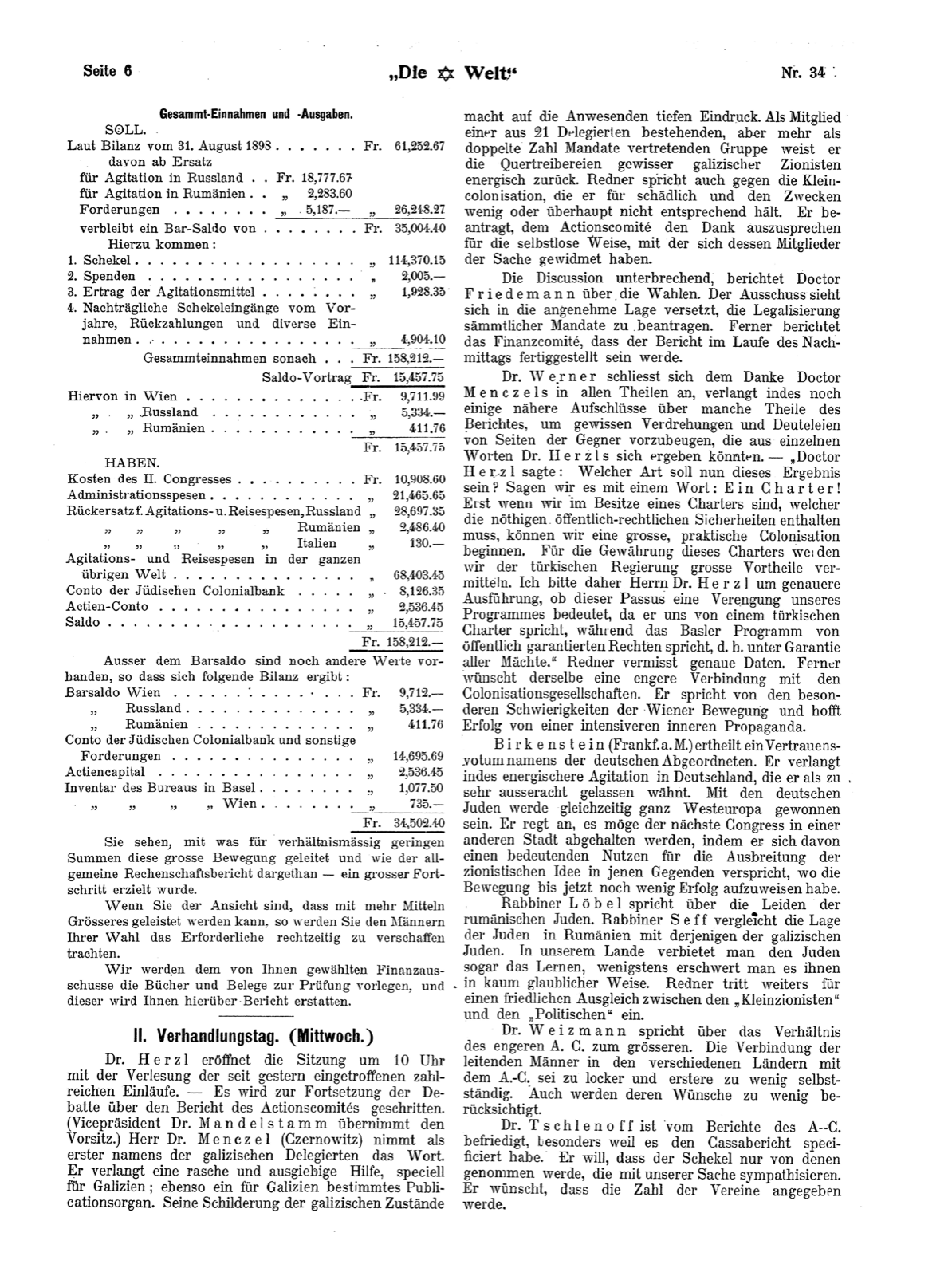
Total Receipts and Expenditures.
DEBIT.
Per balance of the 31st August 1898 . . . . . . . Fr. 61,252.67
less reimbursement
for agitation in Russia . . Fr. 18,777.67
for agitation in Roumania . . „ 2,283.60
Claims . . . . . . . „ 5,187.— „ 26,248.27
there remains a cash balance of . . . . . . . Fr. 35,004.40
To this are added:
- Shekels . . . . . . . . . . . . . . . „ 114,370.15
- Donations . . . . . . . . . . . . . . „ 2,005.—
- Proceeds of the means of agitation . . . . . . . „ 1,928.35
- Subsequent shekel receipts from the previous year, repayments and sundry receipts . . . . . . . . . . . . . . . „ 4,904.10
Total receipts accordingly . . . Fr. 158,212.—
Balance carried forward Fr. 15,457.75
Of this in Vienna . . . . . . . . . . . . . Fr. 9,711.99
„ „ Russia . . . . . . . . . . . „ 5,334.—
„ „ Roumania . . . . . . . . . . . „ 411.76
Fr. 15,457.75
CREDIT.
Cost of the II. Congress . . . . . . . . . Fr. 10,908.60
Administration expenses . . . . . . . . . . . „ 21,465.65
Reimbursement for agitation and travelling expenses, Russia „ 28,697.35
„ „ „ „ „ Roumania „ 2,486.40
„ „ „ „ „ Italy „ 130.—
Agitation and travelling expenses in all the rest of the world . . . . . . . . . . . . . . „ 68,403.45
Account of the Jewish Colonial Bank . . . . . „ 8,126.35
Shares account . . . . . . . . . . . . . . . „ 2,536.45
Balance . . . . . . . . . . . . . . . . . . „ 15,457.75
Fr. 158,212.—
Besides the cash balance there are still other values on hand, so that the following balance sheet results:
Cash balance, Vienna . . . . . . . . . . . . . . Fr. 9,712.—
„ Russia . . . . . . . . . . . . „ 5,334.—
„ Roumania . . . . . . . . . . . . „ 411.76
Account of the Jewish Colonial Bank and other claims . . . . . . . . . . . . . . „ 14,695.69
Share capital . . . . . . . . . . . . . . „ 2,536.45
Inventory of the bureau in Basle . . . . . . . . „ 1,077.50
„ „ „ „ Vienna . . . . . . . . . „ 735.—
Fr. 34,502.40
You see with what relatively small sums this great movement is conducted, and how — as the general report of accounts has shown — a great advance has been achieved.
If you are of opinion that with greater means greater things can be accomplished, you will endeavour to procure for the men of your choice in good time what is required.
We shall lay the books and vouchers before the finance committee elected by you for examination, and it will render you a report thereupon.
II. Day of Proceedings. (Wednesday.)
Dr. Herzl opens the sitting at 10 o'clock with the reading of the numerous communications which have come in since yesterday. — The debate upon the report of the Actions Committee is proceeded with. (Vice-President Dr. Mandelstamm takes the chair.) Dr. Menczel (Czernowitz) is the first to take the word in the name of the Galician delegates. He demands a speedy and ample assistance, especially for Galicia; likewise an organ of publication designed for Galicia. His description of the Galician conditions makes a deep impression upon those present. As a member of a group consisting of 21 delegates, but representing more than double that number of mandates, he energetically repudiates the intrigues of certain Galician Zionists. The speaker also speaks against small colonisation, which he holds to be harmful and little or not at all answering to its purposes. He moves that thanks be expressed to the Actions Committee for the selfless manner in which its members have devoted themselves to the cause.
Interrupting the discussion, Doctor Friedemann reports upon the elections. The committee finds itself placed in the agreeable position of being able to move the legalisation of all the mandates. Further, the finance committee reports that its report will be completed in the course of the afternoon.
Dr. Werner associates himself in every part with the thanks of Doctor Menczel, but desires some further explanations upon certain parts of the report, in order to forestall certain distortions and captious interpretations on the part of opponents which might arise out of particular words of Dr. Herzl's. — "Doctor Herzl said: Of what kind, then, is this result to be? Let us say it in one word: A Charter! Only when we are in possession of a charter, which must contain the necessary securities under public law, can we begin a great, practical colonisation. For the granting of this charter we shall procure great advantages for the Turkish Government. I therefore beg Dr. Herzl for a more exact exposition whether this passage signifies a narrowing of our programme, since he speaks to us of a Turkish charter, while the Basle programme speaks of publicly guaranteed rights, that is to say, under the guarantee of all the Powers." The speaker misses exact data. He further desires a closer connection with the colonisation societies. He speaks of the particular difficulties of the Vienna movement and hopes for success from a more intensive internal propaganda.
Birkenstein (Frankfort-on-Main) delivers a vote of confidence in the name of the German deputies. He demands, however, a more energetic agitation in Germany, which he fancies has been too much left out of account. With the German Jews the whole of Western Europe will at the same time be won. He suggests that the next Congress be held in another city, promising himself therefrom a considerable benefit for the spread of the Zionist idea in those regions where the movement has hitherto had but little success to show.
Rabbi Löbel speaks of the sufferings of the Roumanian Jews. Rabbi Seff compares the situation of the Jews in Roumania with that of the Galician Jews. In our country the Jews are even forbidden to learn, or at least it is made difficult for them in a scarcely credible manner. The speaker further pleads for a peaceable settlement between the "small Zionists" and the "political" ones.
Dr. Weizmann speaks upon the relation of the narrower A. C. to the larger. The connection of the leading men in the various countries with the A.-C. is too loose, and the former too little independent. Their wishes, too, are too little regarded.
Dr. Tschlenoff is satisfied with the report of the A.-C., especially because it has specified the cash account. He wishes that the shekel be taken only from those who sympathise with our cause. He desires that the number of the societies be stated.