No. 47. — "Die Welt" — Page 13.
Society News.
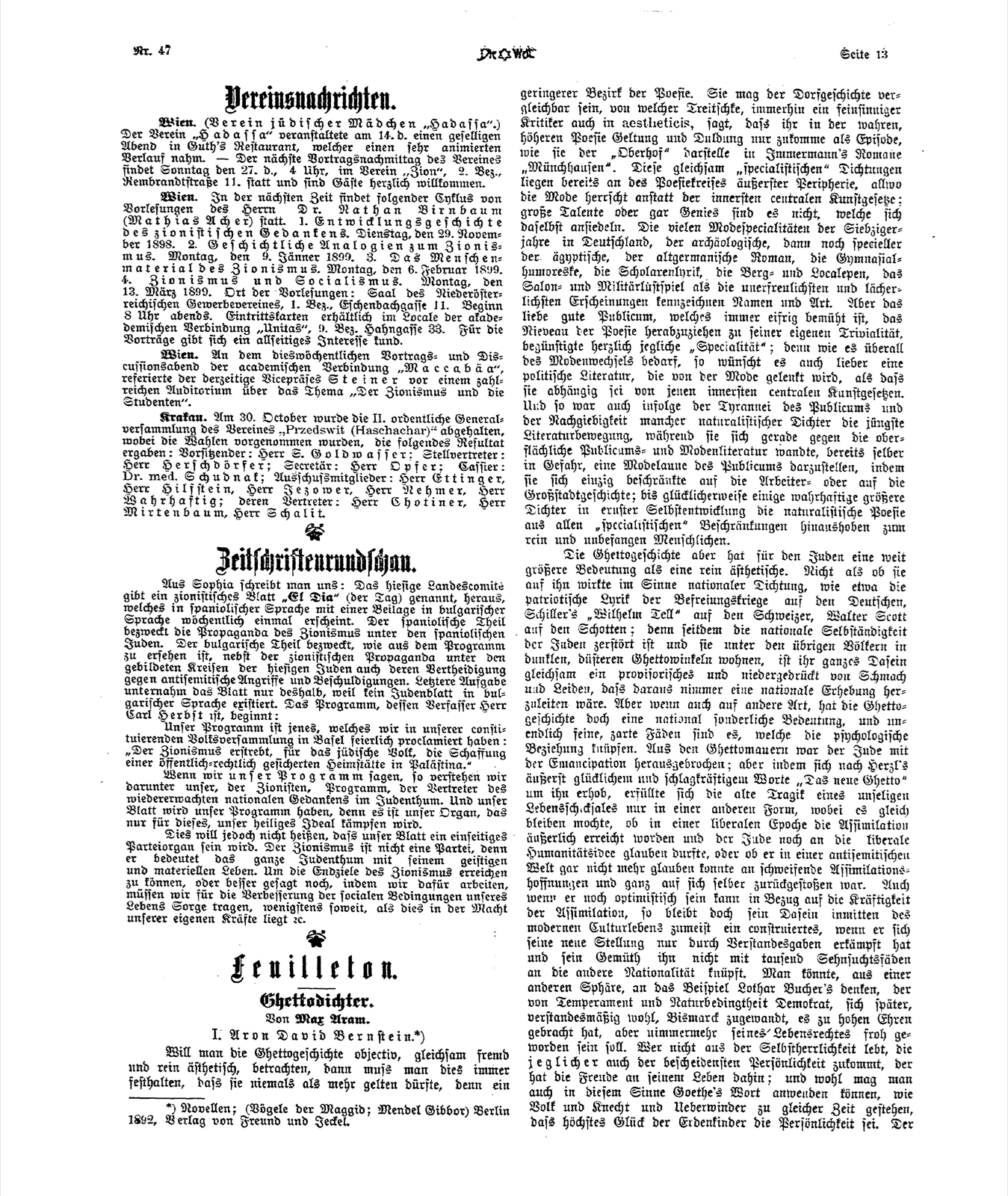
Vienna. (Society of Jewish Girls "Hadassa".) The society "Hadassa" arranged a social evening on the 14th inst. in Guth's Restaurant, which took a most animated course. — The next lecture-afternoon of the society takes place on Sunday the 27th inst., at 4 o'clock, in the "Zion" Society, 2nd District, Rembrandtstraße 11, and guests are heartily welcome.
Vienna. In the near future the following cycle of lectures by Herr Dr. Nathan Birnbaum (Mathias Acher) will take place. 1. Developmental history of the Zionist idea. Tuesday, the 29th of November 1898. 2. Historical analogies to Zionism. Monday, the 9th of January 1899. 3. The human material of Zionism. Monday, the 6th of February 1899. 4. Zionism and Socialism. Monday, the 13th of March 1899. Place of the lectures: hall of the Lower Austrian Trade Association, 1st District, Eschenbachgasse 11. Beginning at 8 o'clock in the evening. Admission tickets obtainable at the premises of the academic union "Unitas", 9th District, Hahngasse 33. An interest on all sides is making itself known for the lectures.
Vienna. At this week's lecture and discussion evening of the academic union "Maccabäa", the present Vice-President Steiner read a paper before a numerous audience upon the theme "Zionism and the Students".
Cracow. On the 30th of October the II. ordinary general meeting of the society "Przedswit (Haschachar)" was held, at which the elections were carried out, yielding the following result: Chairman: Herr S. Goldwasser; Deputy: Herr Herschdörfer; Secretary: Herr Opfer; Treasurer: Dr. med. Schudnak; Committee members: Herr Ettinger, Herr Hilfstein, Herr Jezower, Herr Nehmer, Herr Wahrhaftig; their substitutes: Herr Chotiner, Herr Mirtenbaum, Herr Schalit.
Review of Periodicals.
From Sofia we are informed: The Provincial Committee here publishes a Zionist paper named "El Dia" (the Day), which appears once weekly in the Spaniolish language with a supplement in the Bulgarian language. The Spaniolish part aims at the propaganda of Zionism among the Spaniolish Jews. The Bulgarian part aims, as may be seen from the programme, besides Zionist propaganda among the educated circles of the local Jews, also at their defence against anti-Semitic attacks and accusations. This latter task the paper undertook only because no Jewish paper exists in the Bulgarian language. The programme, whose author is Herr Carl Herbst, begins:
Our programme is that which we solemnly proclaimed in our constituent popular assembly at Basle: "Zionism strives to create for the Jewish people a home in Palestine secured by public law."
When we say our programme, we understand thereby our own, the Zionists', programme, that of the representatives of the reawakened national idea in Jewry. And our paper will have our programme, for it is our organ, which will fight for this alone, our holy ideal.
This does not, however, mean that our paper will be a one-sided party organ. Zionism is not a party, for it signifies the whole of Jewry with its spiritual and material life. In order to be able to attain the final aims of Zionism, or better said, in that we work for them, we must take care for the improvement of the social conditions of our life, at least so far as this lies within the power of our own forces, etc.
Feuilleton.
Ghetto Poets.
By Max Aram.
I. Aron David Bernstein.*)
If one would contemplate the ghetto story objectively, as it were from without and purely aesthetically, then one must always hold fast to this, that it might never rank as more than a
*) Novellen; (Vögele der Maggid; Mendel Gibbor) Berlin 1892, Freund and Jeckel, publishers.
lesser province of poetry. It may be comparable to the village story, of which Treitschke, at all events a subtle critic in aestheticis also, says that in the true, higher poetry currency and toleration fall to it only as an episode, such as the "Oberhof" presents in Immermann's romance "Münchhausen". These, as it were, "specialistic" poetic works lie already at the outermost periphery of the circle of poetry, where fashion rules instead of the innermost central laws of art; it is not great talents, still less geniuses, that settle there. The many fashionable specialities of the seventies in Germany — the archaeological, then still more specially the Egyptian, the old-Germanic novel, the gymnasium humoresque, the scholars' lyric, the mountain and local epics, the drawing-room and military comedy as the most unedifying and most ridiculous manifestations — mark name and kind. But the dear good public, which is always zealously at pains to drag down the level of poetry to its own triviality, cordially favoured every "speciality"; for as it everywhere requires a change of fashion, so it also would rather have a political literature guided by fashion than that it should be dependent upon those innermost central laws of art. And thus, in consequence of the tyranny of the public and the complaisance of certain naturalistic poets, the latest literary movement, at the very time when it turned precisely against the superficial literature of the public and of fashion, was itself already in danger of presenting a mere fashionable whim of the public, inasmuch as it restricted itself solely to the story of the workman or of the great city; until happily a few truly greater poets, in earnest self-development, lifted naturalistic poetry out of all "specialistic" limitations up to the purely and unconstrainedly human.
But for the Jew the ghetto story has a far greater significance than a purely aesthetic one. Not as though it worked upon him in the sense of national poetry, as, say, the patriotic lyric of the Wars of Liberation upon the German, Schiller's "Wilhelm Tell" upon the Swiss, Walter Scott upon the Scot; for ever since the national independence of the Jews was destroyed and they have dwelt among the other peoples in dark, gloomy ghetto corners, their whole existence has been, as it were, a provisional one, and so depressed by ignominy and suffering that never could a national uprising be derived therefrom. But even if in another way, the ghetto story has nevertheless a peculiar national significance, and it is infinitely fine, delicate threads that knit the psychological relation. Out of the ghetto walls the Jew had broken forth with the emancipation; but inasmuch as, according to Herzl's exceedingly happy and telling word, "the new ghetto" rose about him, the old tragedy of an unhappy life-destiny was fulfilled only in another form, wherein it might come to the same thing whether in a liberal epoch assimilation had outwardly been attained and the Jew was still permitted to believe in the liberal idea of humanity, or whether in an anti-Semitic world he could no longer believe at all in roving hopes of assimilation and was thrust back entirely upon himself. Even when he can still be optimistic with regard to the vigour of assimilation, his existence in the midst of modern cultural life yet remains for the most part a constructed one, if he has won his new position only through gifts of the understanding and his heart does not knit him with a thousand threads of longing to the other nationality. One might think, out of another sphere, of the example of Lothar Bucher, who, a democrat by temperament and natural disposition, afterwards turned — by way of the understanding, no doubt — to Bismarck and brought it to high honours, but is said never more to have grown glad of his right to live. He who does not live out of that self-sovereignty which belongs to every personality, even the most modest, has the joy in his life gone; and in this sense too one may well be able to apply Goethe's word, how people and servant and conqueror confess at the same time that the highest happiness of the children of earth is personality. The