Page 6. — "Die Welt" — No. 36.
(continued from page 5)
…appeal by Countess Piotrowska to the student youth, a play, "The Eternal Jew," came to performance. The principal part found in Mr. Metzger ("Jung Israel") an understanding interpreter. Before the moving tale of the Eternal Jew's sufferings his revilers, a man and a youth, shrink back in awed emotion — that is the substance of the gripping one-act piece. After the serious part, a merry bluette. A "Schnitzelbank" "came off," a Basle speciality which differs essentially from the likewise locally customary Leckerly by its bitterness. Upon obnoxious personages there is satirical whittling round about and whittling down — hence, no doubt, the name. The Schnitzelbank, delivered "by three" costumed singers, found the applause it deserved. Stormily applauded was the toast spoken by Professor Mandelstamm to the Zionist student body and to the city of Basle. A speech by the delegate Taubes and a toast by Dr. Löwe to the Jewish people formed the close of the festivity.
At the table of honour places had been found by the members of the Actions Committee, at their head Messrs. Dr. Herzl, Dr. Nordau, Dr. Gaster and Prof. Mandelstamm, further by the president of the Basle Jewish community, Mr. Dreyfus-Strauss, together with his wife, and by a number of the most distinguished delegates with their wives. The Commers closed at an advanced hour of the night.
Speech of Chief Rabbi Dr. Gaster.
Ladies and Gentlemen!
We find ourselves now upon quite another field than that upon which we stood yesterday, the day before yesterday, and until a short while ago. Before my eyes, at least, everything has vanished with which we have occupied ourselves until now. Millions of gold have been spoken of, earthly goods have hitherto been spoken of, the question of colonisation and of the bank, nothing but earthly goods, which are at all events of importance for the immediate necessity. We now enter upon the highest, the ideal field of education, of knowledge and of faith.
It is to be emphasised here, namely, that we neither can nor may conceive of a national rebirth which rests upon material elements and confines itself to them. It is not merely a matter of political rebirth or of national unity; what concerns us, and me in particular, is that the old and precious possessions also shall not be lost to us.
We must at once impart to the people the consciousness that we bind up with our Zionism a higher and ideal striving, and bind it up so intimately that the two neither can nor may be separated from one another, if Zionism is to be capable of life at all.
When great, critical, heavy days come upon a people, it commonly calls up its dead again, it conjures the past out of the tomb, seeks to breathe new life into it. Men remember the great man whom they hitherto misjudged, they read his writings, seek to fathom his activity, erect statues and monuments to him, and set up before the youth a picture of the past.
Gentlemen! If you will permit, I shall allow myself the expression: that is Aryan. We do not conjure up the dead, because we do not believe in the past alone; we believe rather in the progress of the future.
We are known as the people of optimists. When anyone tramples upon us or does us hurt, when things go ill with us, then we console ourselves: it will surely grow better! For we believe in the progress of mankind. We do not look back upon a golden age that has vanished, followed by an age of bronze or of iron; we look, on the contrary, hopefully, or with joyous hope, towards the future, because we believe that mankind advances regularly, though sometimes hindered, yet unstoppably, from the evil days of the past to the better days of the future.
That is the meaning of our Messianic hope and of our religious tradition: therefore we can identify ourselves so completely with the culture of the peoples in whose midst we live; for everything that is great, everything that is noble, everything that is mighty in its spiritual manifestation is for us religious also. With this Judaism has always united itself. This, ladies and gentlemen, we may not forget: We are the only people that knows no Middle Ages, we have gone through no period of darkening: while all the other peoples let the treasures of Hellas and Rome be buried and covered over, we out of the ghetto took the spade in hand and dug out, polished and preserved for the old peoples the treasures of Hellas and Rome.
Therefore great men have appeared in Israel precisely at that time when darkness and gloom, when superstition and ignorance ruled the world; in our midst, as in the olden time in Egypt when darkness reigned there, light has always reigned and shall reign.
We will not permit the torch of knowledge or the conviction of faith to be extinguished for a single moment in our midst.
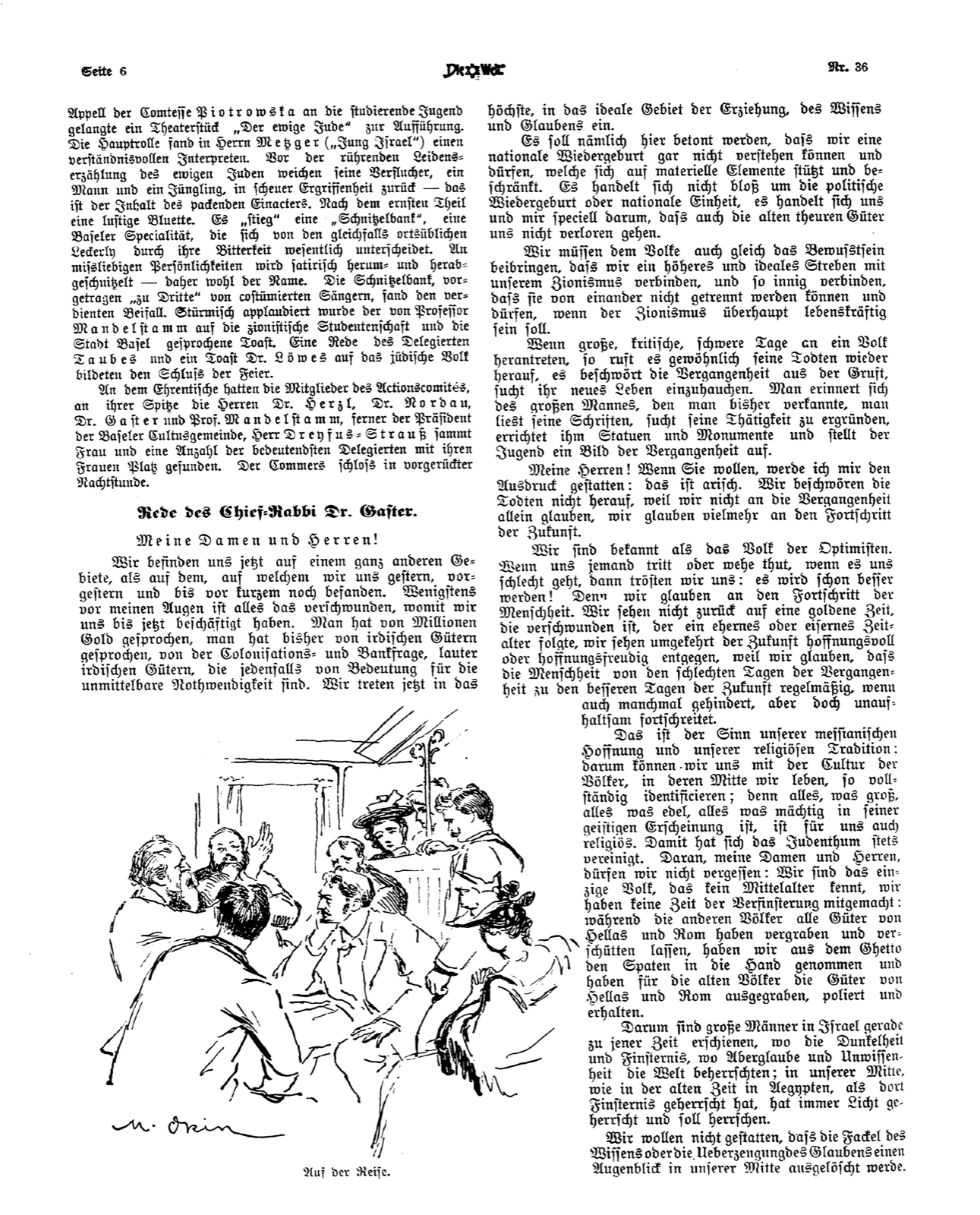
On the Journey.