Page 12 — Dro — No. 16
(continued from page 11)
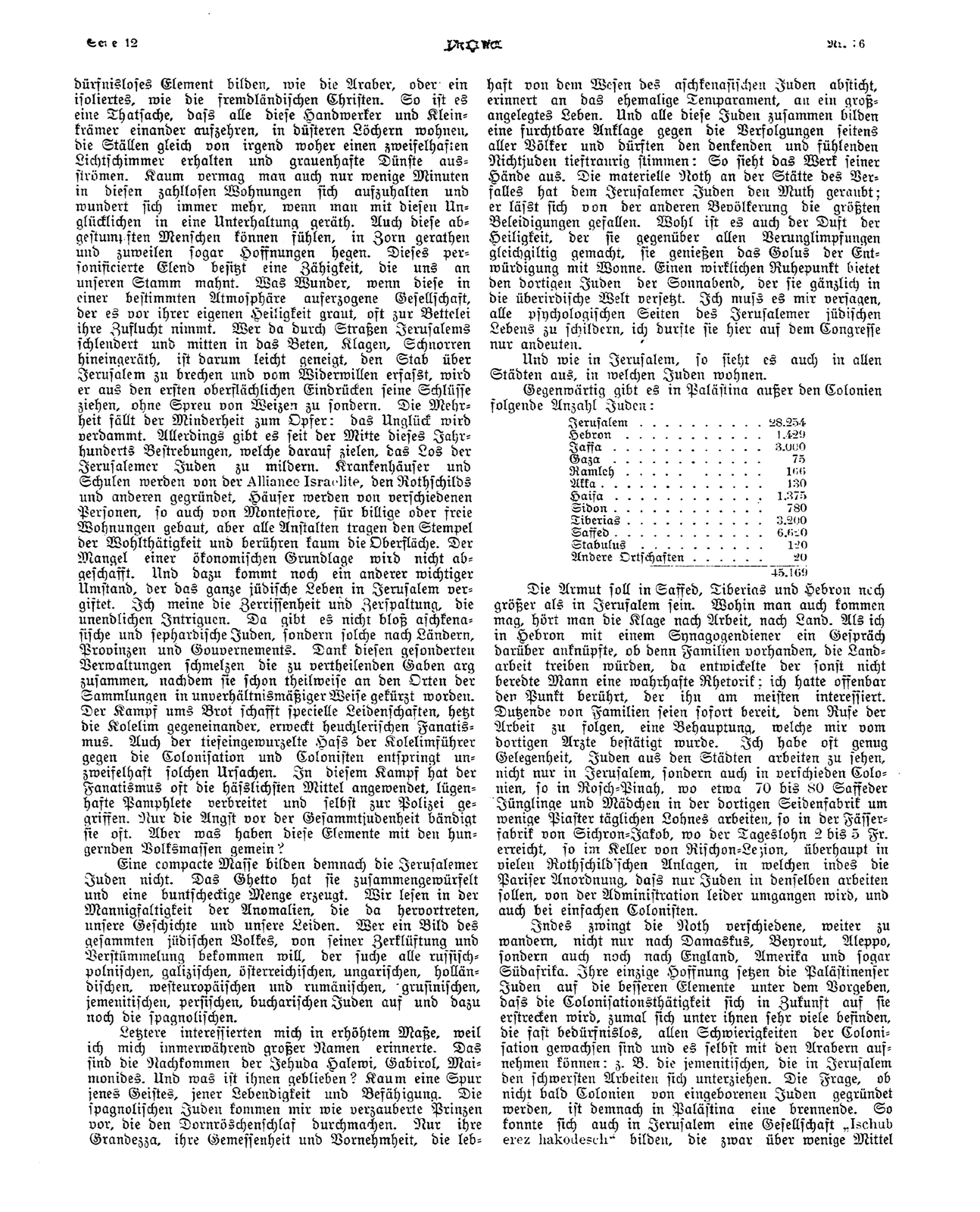
…demanding element, like the Arabs, or an isolated one, like the foreign Christians. Thus it is a fact that all these artisans and small hucksters consume one another, that they dwell in gloomy holes which, like stables, receive a doubtful glimmer of light from somewhere or other and give off horrible vapours. One is scarcely able to remain even a few minutes in these countless dwellings, and one wonders more and more when one falls into conversation with these unfortunates. Even these blunted human beings can feel, can fall into anger and at times even cherish hopes. This personified misery possesses a tenacity which reminds us of our race. What wonder if this society, reared in a particular atmosphere and shuddering at its own holiness, often takes refuge in beggary. Whoever strolls through the streets of Jerusalem and finds himself in the midst of the praying, the lamenting, the schnorring, is therefore easily inclined to pass sentence upon Jerusalem, and, seized with repugnance, he will draw his conclusions from the first superficial impressions, without separating the chaff from the wheat. The majority falls a victim to the minority: misfortune is condemned. There are, to be sure, since the middle of this century endeavours which aim at alleviating the lot of the Jerusalem Jews. Hospitals and schools are founded by the Alliance Israelite, the Rothschilds and others; houses for cheap or free dwellings are built by various persons, thus also by Montefiore, but all these institutions bear the stamp of charity and hardly touch the surface. The lack of an economic foundation is not done away with. And to this is added yet another important circumstance which poisons the whole Jewish life in Jerusalem. I mean the disruption and the division, the endless intrigues. There are there not merely Ashkenazic and Sephardic Jews, but such according to countries, provinces and governments. Thanks to these separate administrations the gifts to be distributed shrink sadly together, after they have already in part been curtailed in a disproportionate manner at the places of collection. The struggle for bread creates special passions, sets the Kolelim at one another, awakens a hypocritical fanaticism. The deep-rooted hatred of the leaders of the Kolelim against the colonisation and the colonists also springs unquestionably from such causes. In this struggle fanaticism has often employed the ugliest means, has spread lying pamphlets and has even had recourse to the police. Only the fear of Jewry as a whole often curbs them. But what have these elements in common with the starving masses of the people?
The Jews of Jerusalem, accordingly, do not form a compact mass. The Ghetto has thrown them together and produced a motley multitude. In the manifoldness of the anomalies which there come to light we read our history and our sufferings. Whoever would obtain a picture of the entire Jewish people, of its cleavage and mutilation, let him seek out all the Russo-Polish, Galician, Austrian, Hungarian, Dutch, West European and Roumanian, Georgian, Yemenite, Persian, Bokharan Jews, and in addition the Spagnolic ones as well.
The latter interested me in a heightened degree, because I was continually reminded of great names. These are the descendants of Jehuda Halewi, Gabirol, Maimonides. And what has remained to them? Scarcely a trace of that spirit, that vivacity and capacity. The Spagnolic Jews appear to me like enchanted princes who are passing through the sleep of the Sleeping Beauty. Only their grandezza, their measured bearing and their distinction, which contrasts vividly with the character of the Ashkenazic Jew, recalls the former temperament, a life laid out on a grand scale. And all these Jews together form a terrible indictment of the persecutions on the part of all nations, and might well move the thinking and feeling non-Jew to deep sadness: such is the appearance of the work of his hands. The material distress in the place of decay has robbed the Jerusalem Jew of his courage; he submits to the greatest insults from the other population. It is doubtless also the odour of holiness which has made them indifferent to all disparagement; they enjoy the Golus of degradation with delight. A real point of rest is offered to the Jews there by the Sabbath, which transports them wholly into the unearthly world. I must deny myself the depicting of all the psychological sides of Jerusalem Jewish life; here at the Congress I was permitted only to hint at them.
And as in Jerusalem, so does it look in all the towns in which Jews dwell.
At present there are in Palestine, apart from the colonies, the following number of Jews:
| Jerusalem | 28,254 |
| Hebron | 1,429 |
| Jaffa | 3,000 |
| Gaza | 75 |
| Ramleh | 166 |
| Akka | 130 |
| Haifa | 1,375 |
| Sidon | 780 |
| Tiberias | 3,200 |
| Saffed | 6,620 |
| Stabulos | 120 |
| Other places | 20 |
| 45,169 |
The poverty in Saffed, Tiberias and Hebron is said to be still greater than in Jerusalem. Wherever one may come, one hears the complaint calling for work, for land. When in Hebron I entered into conversation with a synagogue attendant as to whether there were families present that would take up work upon the land, the otherwise not eloquent man developed a veritable rhetoric; I had evidently touched the point which interests him most. Dozens of families, he said, were ready at once to follow the call of labour — an assertion which was confirmed to me by the physician there. I have often enough occasion to see Jews from the towns at work, not only in Jerusalem but also in various colonies, thus at Rosch-Pinah, where some 70 to 80 youths and maidens from Saffed work in the silk factory there for a few piastres of daily wage; thus in the cask factory of Sichron-Jakob, where the daily wage reaches 2 to 5 fr.; thus in the cellar of Rischon-Lezion, and generally in many of the Rothschild establishments, in which, however, the Paris ordinance that only Jews shall work in them is unhappily evaded by the administration; and with simple colonists as well.
Meanwhile distress compels various of them to wander further, not only to Damascus, Beyrout, Aleppo, but even to England, America and South Africa. The Palestinian Jews set their only hope upon the better elements, upon the plea that the work of colonisation will in future be extended to them, especially as there are among them very many who, being almost without wants, are equal to all the difficulties of colonisation and can even hold their own with the Arabs: for example the Yemenites, who in Jerusalem submit to the heaviest labours. The question whether colonies of native Jews will not soon be founded is accordingly a burning one in Palestine. Thus there could also be formed in Jerusalem a society "Ischub erez hakodesch," which, to be sure, but few means