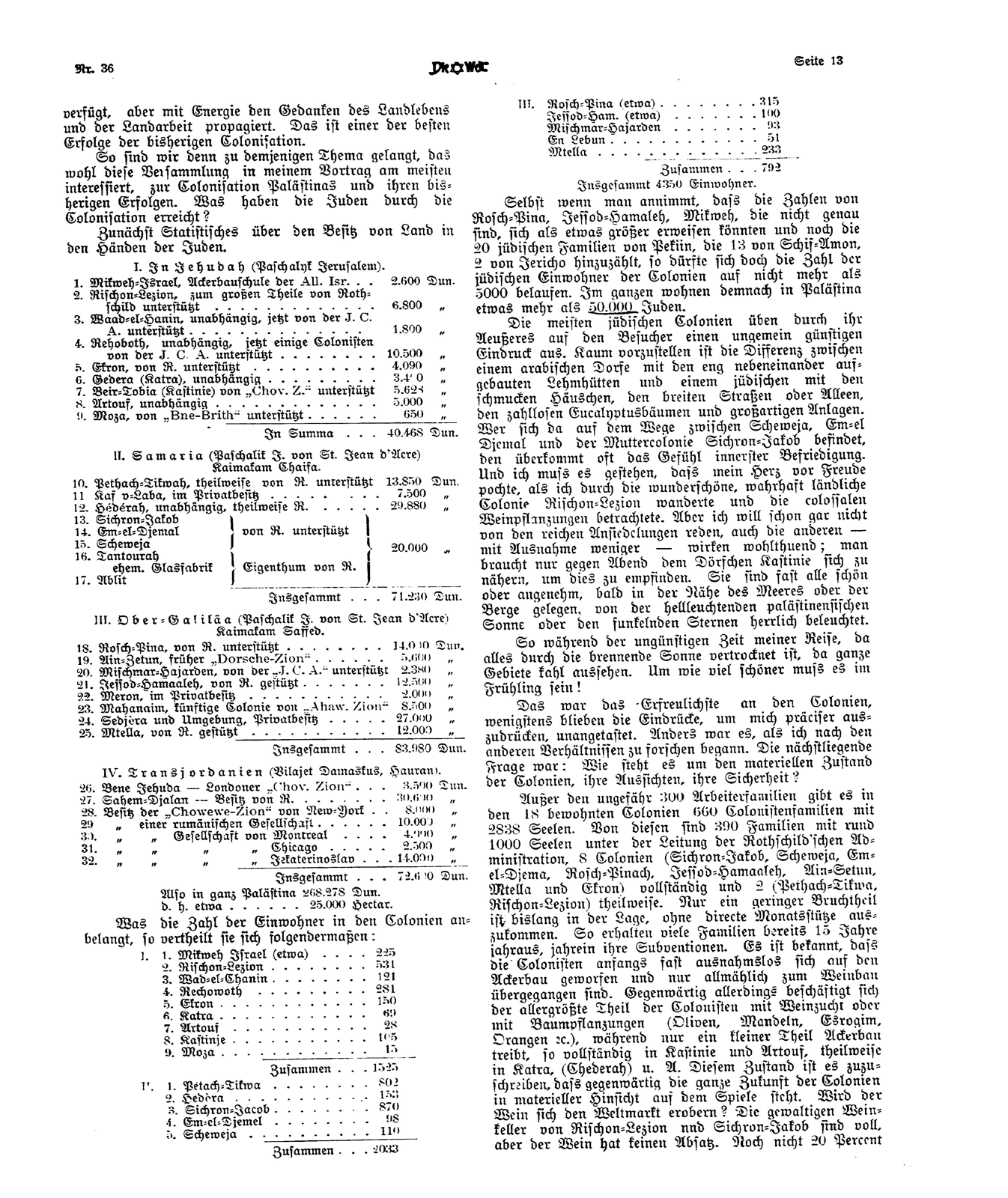
No. 36 — "Die Welt" — Page 13.
(continued from page 12)
…commands, but which with energy propagates the thought of country life and of country labour. That is one of the best successes of the colonisation hitherto.
And so we have arrived at that theme which in my address doubtless interests this assembly most of all: the colonisation of Palestine and its successes hitherto. What have the Jews achieved through the colonisation?
First, some statistics upon the possession of land in the hands of the Jews.
I. In Jehudah (Pashalik of Jerusalem).
- Mikweh-Israel, Agricultural School of the All. Isr. . . 2,600 Dun.
- Rischon-Lezion, for the greater part supported by Rothschild . . . . . . . . . . . . 6,800 "
- Waad-el-Hanin, independent, now supported by the J. C. A. . . . . . . . . . . . . 1,800 "
- Rehoboth, independent, now a few colonists supported by the J. C. A. . . . . . . 10,500 "
- Ekron, supported by R. . . . . . . . . 4,090 "
- Gedera (Katra), independent . . . . . . . . 3,410 "
- Beer-Tobia (Kastinie), supported by "Chov. Z." . 5,628 "
- Artouf, independent . . . . . . . . . . 5,000 "
- Moza, supported by "Bne-Brith" . . . . . 650 " In sum . . . 40,468 Dun.
II. Samaria (Pashalik J. of St. Jean d'Acre) Kaimakam Haifa.
- Pethach-Tikwah, partly supported by R. . 13,850 Dun.
- Kaf r-Saba, in private possession . . . . . . . 7,500 "
- Hedérah, independent, partly R. . . . . . 29,880 "
- Sichron-Jakob
- Em-el-Djemal
- Scheweja
- Tantourah, formerly a glass factory
- Ablit
(13-17) supported by R. / property of R. . . . 20,000 " In all . . . 71,230 Dun.
III. Upper Galilee (Pashalik J. of St. Jean d'Acre) Kaimakam Saffed.
- Rosch-Pina, supported by R. . . . . . . 14,000 Dun.
- Ain-Zetun, formerly "Dorsche-Zion" . . . . . 5,600 "
- Mischmar-Hajarden, supported by the "J. C. A." . 2,380 "
- Jessod-Hamaleh, aided by R. . . . . . . 12,500 "
- Meron, in private possession . . . . . . . . 2,000 "
- Mahanaim, future colony of "Ahaw. Zion" . 8,500 "
- Sedjera and environs, private possession . . . . 27,000 "
- Mtella, aided by R. . . . . . . . . 12,000 " In all . . . 83,980 Dun.
IV. Transjordania (Vilayet of Damascus, Hauran).
- Bene Jehuda — London "Chov. Zion" . . . . 3,500 Dun.
- Sahem-Djalan — possession of R. . . . . . . 30,600 "
- Possession of the "Chowewe-Zion" of New-York . . 8,000 "
- " " of a Roumanian society . . . . 10,000 "
- " " " society of Montreal . . . 4,000 "
- " " " " " Chicago . . . 2,500 "
- " " " " " Jekaterinoslav . . 14,000 " In all . . . 72,600 Dun.
Thus in all Palestine 268,278 Dun. that is, about . . . 25,000 hectares.
As regards the number of inhabitants in the colonies, it is distributed as follows:
I. 1. Mikweh Israel (about) . . . . . . . 225 2. Rischon-Lezion . . . . . . . . 531 3. Wad-el-Chanin . . . . . . . . 121 4. Rechowoth . . . . . . . . . 281 5. Ekron . . . . . . . . . . . 150 6. Katra . . . . . . . . . . . 69 7. Artouf . . . . . . . . . . . 28 8. Kastinje . . . . . . . . . . 105 9. Moza . . . . . . . . . . . 15 Together . . . 1525
I'. 1. Petach-Tikwa . . . . . . . . 802 2. Hedêra . . . . . . . . . . 153 3. Sichron-Jacob . . . . . . . . 870 4. Em-el-Djemel . . . . . . . . 98 5. Scheweja . . . . . . . . . 110 Together . . . 2033
III. Rosch-Pina (about) . . . . . . . . 315 Jessod-Ham. (about) . . . . . . . 100 Mischmar-Hajarden . . . . . . . 93 En Lebun . . . . . . . . . . . 51 Mtella . . . . . . . . . . . . 233 Together . . . 792
In all 4350 inhabitants.
Even if one assumes that the figures for Rosch-Pina, Jessod-Hamaleh and Mikweh, which are not exact, might prove to be somewhat larger, and adds thereto the 20 Jewish families of Pekiin, the 13 of Schif-Amon and the 2 of Jericho, the number of Jewish inhabitants of the colonies would nevertheless hardly amount to more than 5000. Altogether, then, there dwell in Palestine somewhat more than 50,000 Jews.
Most of the Jewish colonies produce upon the visitor, by their outward aspect, an uncommonly favourable impression. The difference is scarcely to be imagined between an Arab village, with its mud huts built up close against one another, and a Jewish one, with its trim little houses, its broad streets or avenues, its countless eucalyptus trees and magnificent plantations. Whoever finds himself there upon the road between Scheweja, Em-el Djemal and the mother-colony Sichron-Jakob is often overcome by a feeling of inmost satisfaction. And I must confess that my heart beat for joy as I wandered through the beautiful, truly rural colony of Rischon-Lezion and beheld the colossal vineyards. But I will not speak at all of the wealthy settlements; the others too — with few exceptions — have a soothing effect; one need only draw near towards evening to the little village of Kastinie to feel this. They are almost all of them beautiful or pleasant, lying now near the sea, now near the mountains, gloriously lit by the bright-shining Palestinian sun or by the sparkling stars.
Thus it was during the unfavourable season of my journey, when everything is parched by the burning sun, when whole districts look bare. How much more beautiful must it be in the spring!
That was the most gratifying thing about the colonies; at least the impressions remained — to express myself more precisely — untouched. It was otherwise when I began to enquire into the other conditions. The most immediate question was: How does it stand with the material condition of the colonies, their prospects, their security?
Besides the approximately 300 labourers' families there are in the 18 inhabited colonies 660 colonist families with 2838 souls. Of these, 390 families with round 1000 souls are under the direction of the Rothschild administration — 8 colonies (Sichron-Jakob, Scheweja, Em-el-Djema, Rosch-Pinach, Jessod-Hamaleh, Ain-Setun, Mtella and Ekron) entirely, and 2 (Pethach-Tikwa, Rischon-Lezion) in part. Only a small fraction is as yet in a position to manage without direct monthly support. Thus many families have already for 15 years, year in and year out, received their subventions. It is well known that the colonists at first threw themselves almost without exception upon agriculture and only gradually passed over to vine-growing. At present, however, by far the greatest part of the colonists occupy themselves with vine-culture or with tree-plantations (olives, almonds, esrogim, oranges &c.), while only a small part pursues agriculture — so entirely in Kastinie and Artouf, partly in Katra, (Chederah) and others. It is to this state of things that it must be ascribed that at present the whole future of the colonies, in a material respect, is at stake. Will the wine conquer the world market? The mighty wine-cellars of Rischon-Lezion and Sichron-Jakob are full, but the wine finds no sale. Not yet 20 per cent