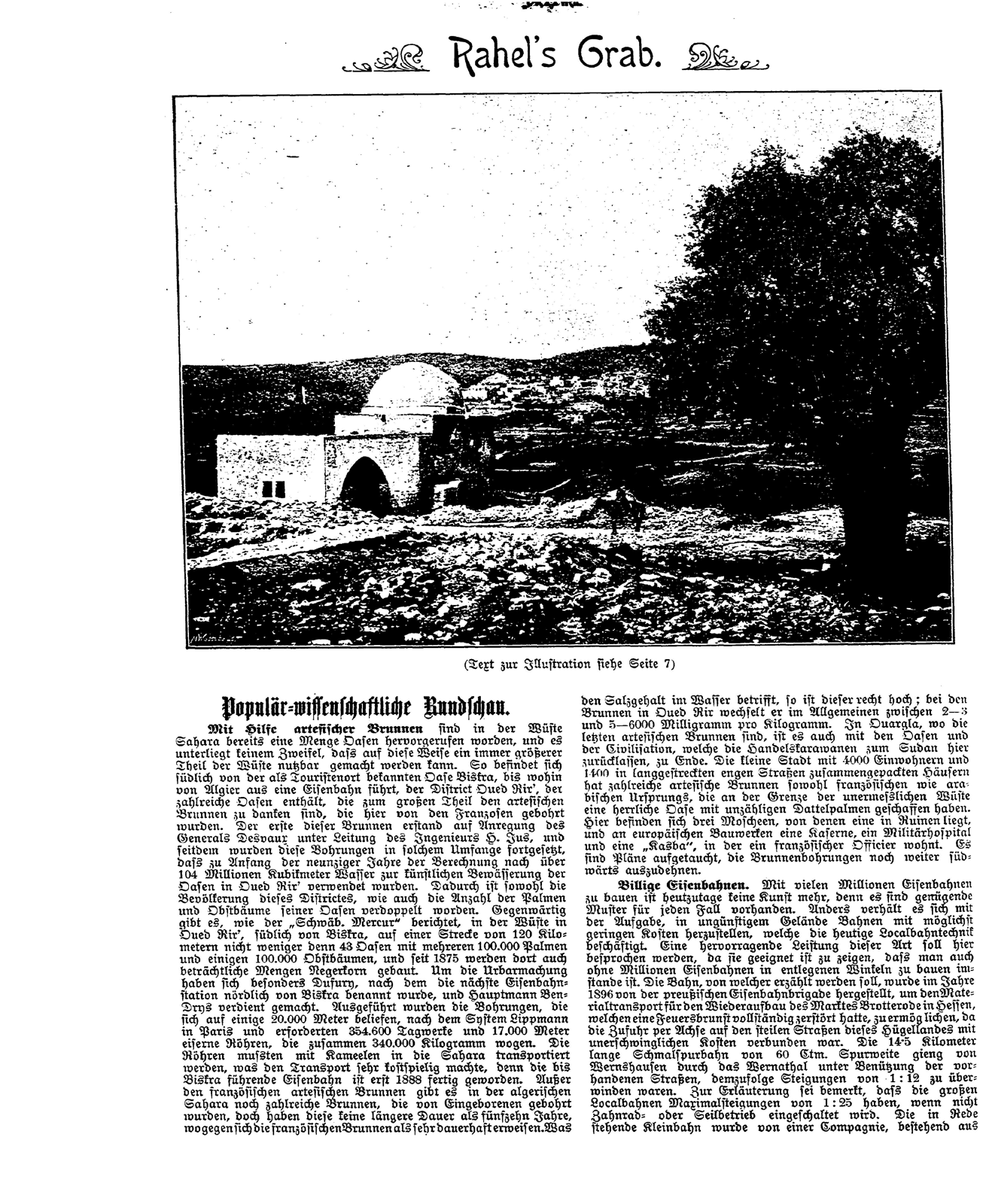
Rachel's Tomb.
(For the text to the illustration see page 7)
Popular-Scientific Review.
By the aid of artesian wells a great number of oases have already been called forth in the Sahara desert, and there is no doubt that in this way an ever greater portion of the desert can be rendered serviceable. Thus to the south of the oasis of Biskra, known as a resort of tourists and reached by a railway from Algiers, lies the district of Oued Rir', which contains numerous oases that are for the greater part to be thanked to the artesian wells bored here by the French. The first of these wells came into being at the instigation of General Desvaux under the direction of the engineer H. Jus, and since then these borings have been continued to such an extent that at the beginning of the nineties, according to calculation, more than 104 million cubic metres of water were employed for the artificial irrigation of the oases in Oued Rir'. Thereby both the population of this district and also the number of the palms and fruit-trees of its oases have been doubled. At present there are, as the "Schwäb. Mercur" reports, in the desert in Oued Rir', to the south of Biskra, over a stretch of 120 kilometres no fewer than 43 oases with several 100,000 palms and some 100,000 fruit-trees, and since 1875 considerable quantities of negro-corn are also grown there. For the reclamation particular credit is due to Dufury, after whom the nearest railway station north of Biskra was named, and to Captain Ven-Drys. The borings, which amounted to some 20,000 metres, were carried out according to the Lippmann system in Paris and required 354,600 days' work and 17,000 metres of iron piping, which together weighed 340,000 kilogrammes. The pipes had to be transported into the Sahara by camels, which made the transport very costly, for the railway leading as far as Biskra was not completed until 1888. Besides the French artesian wells there are in the Algerian Sahara numerous further wells that were bored by natives, yet these have no longer duration than fifteen years, whereas the French wells prove very durable. As regards the salt content of the water, this is quite high; in the wells in Oued Rir it varies in general between 2—3 and 5—6000 milligrammes per kilogramme. At Ouargla, where the last artesian wells are, there is an end also of the oases and of the civilisation which the trading caravans to the Sudan leave behind them here. The little town, with 4,000 inhabitants and 1,400 houses packed together in long-drawn narrow streets, has numerous artesian wells both of French and of Arab origin, which upon the border of the immeasurable desert have created a splendid oasis with countless date-palms. Here there are three mosques, of which one lies in ruins, and by way of European buildings a barracks, a military hospital and a "Kasba," in which a French officer dwells. Plans have arisen for extending the well-borings still further southward.
Cheap railways. To build railways with many millions is nowadays no longer an art, for sufficient models are at hand for every case. It stands otherwise with the task of constructing lines in unfavourable ground at the least possible cost, which is the task that occupies the light-railway engineering of to-day. An outstanding achievement of this kind shall here be discussed, since it is fitted to show that one is in a position to build railways in remote corners even without millions. The line of which we are to tell was constructed in the year 1896 by the Prussian railway brigade, in order to make possible the transport of material for the rebuilding of the market-town of Brotterode in Hesse, which a conflagration had completely destroyed, since the conveyance by axle upon the steep roads of this hill country was attended with prohibitive costs. The narrow-gauge line, 14·5 kilometres long and of 60 Ctm. gauge, went from Wernshausen through the Wernathal, making use of the existing roads, in consequence of which gradients of 1:12 had to be overcome. By way of explanation be it remarked that the great local railways have maximum gradients of 1:25, if rack or cable working is not brought in. The light railway in question was constructed by a company consisting of