(continued from page 7)
…mindedness and the curtailment of the liberal principle, this association is at all events a gratifying deed; practically, alas, it will be able to achieve no successes against the ever-encroaching Nativism.
Zionism had yesterday a great evening to record. The centralization of a great part of the Zionists has been accomplished. Long before the appointed hour the Norfolt Street Synagogue, where the meeting took place, was thronged full. Delegates have been sent by the orthodox Rabbinical Union Keneseth Zion, Hamezujeneth, Jedide Zion, Zionoh, Dorsche Zion, Benoth Zion, a society of boys named Pirsche Zion, the Chowewe Zion of Brooklyn, the society Zion of Newark, Benei Zion of Bayonne. In writing there have announced their adhesion: Chowewe Zion of Elizabethport, Chowewe Zion of Treuton, Chowewe Zion of Cleveland, Benei Zion and Benoth Zion of Cleveland — the societies, or rather the Zionist groups represented by the delegates, of together 2864 members.
For the framing of a plan of action a committee was appointed. As president of the Central Body there officiates Rabbi Dr. Ph. Klein.
The next meeting, at which also the officers of the Central Body are to be definitively elected, takes place on 19 January in the Norfolk Street Synagogue. There is warranted hope that the remaining societies too will in the meantime announce their adhesion.
To the Chalukah question, too, America seems minded to take up a position. Under the name "The American Congregation the Pride of Jerusalem" a society has formed which has made it its task, in common with the United States Consul in Jerusalem, to order the Chalukah.
Even now the written report reaches me that in Rochester, N. Y., a great Zionist society has arisen and is ready to adhere to the Central Body. S.
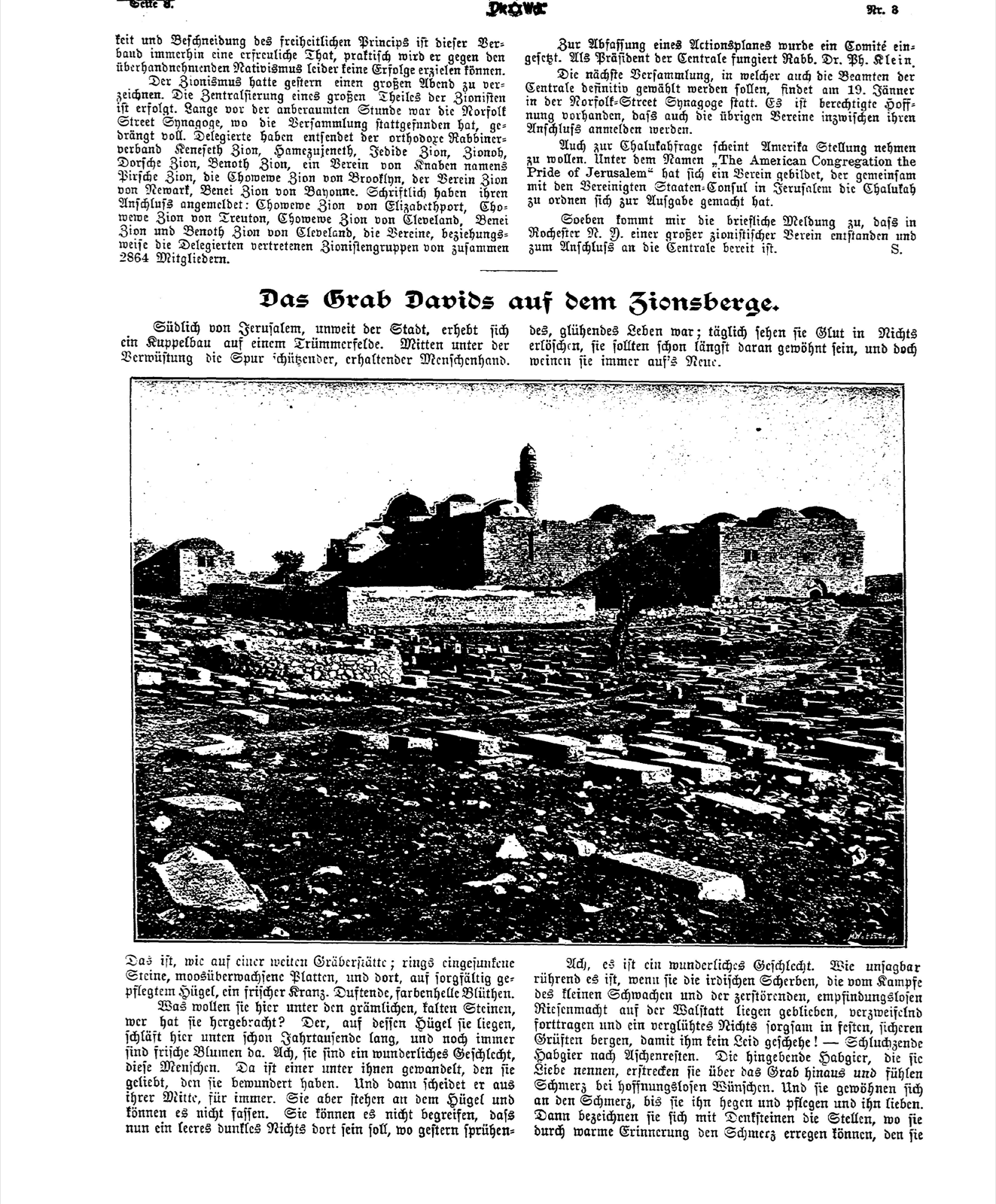
The Grave of David on Mount Zion.
To the south of Jerusalem, hard by the city, there rises a domed structure upon a field of ruins. In the midst of the devastation, the trace of a protecting, preserving human hand.
…ling, glowing life was; daily they see the glow die away into nothingness; they ought long since to have grown used to it, and yet they weep ever anew.
It is as upon a wide burial-ground; round about, sunken stones, moss-overgrown slabs, and there, upon a carefully tended mound, a fresh wreath. Fragrant, brightly hued blossoms.
What would they here among the sullen, cold stones; who has brought them hither? He upon whose mound they lie has slept down here already for thousands of years, and still there are fresh flowers there. Ah, they are a strange race, these men. There walked one among them whom they loved, whom they admired. And then he departs from their midst, for ever. But they stand at the mound and cannot grasp it. They cannot comprehend that now an empty, dark nothingness is to be there, where yesterday spark-
Ah, it is a strange race. How unspeakably touching it is when they, despairing, bear away the earthly shards that have remained lying upon the field of battle from the strife of the small and weak against the destroying, unfeeling giant-might, and carefully lodge a burnt-out nothingness in firm, secure vaults, that no harm may befall it! — Sobbing avarice after remnants of ashes. The devoted avarice that they call love, they extend beyond the grave, and feel pain at hopeless wishes. And they accustom themselves to the pain, until they cherish and tend it and love it. Then they mark for themselves with memorial-stones the places where, through warm remembrance, they can arouse the pain that they